


Epistry
What is it to think the planet? What forms of thought are adequate to the task?
One answer: Planetarity as philosophical engineering. Earlier this year, I spent many a month on a planetarity syllabus that culminated in habitability as the core concept of my inquiry into planetarity. Having taken a break, I want to revisit the term “philosophical engineering” with the intent of replacing it with a new term that not only encompasses philosophical engineering, but also methods from design and speculation, and the use of new cognitive technologies, i.e., AI as Augmented Intelligence.
That term is Epistry.
Aside: I have been playing with that term, with more or less the same meaning that I am using here, for over a decade now, with this essay in particular being quite close to my current usage. Epistry is philosophy for a synthetic age, where we don’t just study the world, but make it. Or to put it in computational terms:
Epistry is philosophy when it becomes executable.
In this new adventure of abstraction, we aren’t abstracting away from the world, but rather, abstracting into the world. That is how philosophy becomes executable. In my mind, Epistry is an Aristotelian + Nagarjunian mode of intellectual being. They are the second most important thinkers (after Plato for Aristotle, and the Buddha for Nagarjuna) in their respective intellectual tradition, but that’s a plus.
At the risk of being reductive, Aristotle inspires my head, while Nagarjuna touches my heart. Their fusion makes for a vibe, a mood, an atmosphere more than a theory or a doctrine that I hope the second-in-commands would approve and adopt if they were alive today. But A & N are distant gods, Mahadevatas, and it’s always good to have some local guides, the Ishtadevatas who bless our pilgrimage.
Here are a few nearby minds who continue to inspire me: (in no particular order): Daniel Dennett, Douglas Hofstader, Christopher Alexander, D’Arcy Thompson, Nassim Nicholas Taleb, Francisco Varela, J.J. Gibson, Jakob von Uexkull....If I had to think of a concrete step I want to take that goes beyond these Ishtadevatas, it’s that the epistrator has to engage deeply with the process of technology creation, especially technology that serves as infrastructure for doing science.
TLDR; I am restarting my investigation of habitability; expect one long, deeply researched essay - likely split into two parts - every month. While this essay is being published in July, I am counting it as my essay for August, so you will see the next habitability essay in September.
Habitability
The planet is the ‘first object’ of epistry (that should remind you of Aristotelian first philosophy and the unmoved mover as its first object…). Planetarity is the planet thought as philosophy thought as epistry - i.e., planetary thinking that extends seamlessly into the making of the planet; not just by human beings, but by all living beings. And within that thinking of the planet as first object, habitability becomes the first concept, the central concern of philosophical engineering planetary epistry.
What does that reorientation look like? Too early to tell, but over the next few months, I am going to revisit the planetarity syllabus reframed around habitability.
When I started working on the planetarity syllabus, I was reading and writing my way through entanglements of governance, time, and space, trying to figure out the contours of our planetary condition. I didn’t know that habitability was the destination until I arrived there. But now looking back at the territory that has been surveyed: it’s time to draw a map. In this second iteration, we are not going to meander toward habitability; we are going to start with it.
Round two has two foundational commitments. The first is that planetarity is, fundamentally, a species of philosophical engineering a species of epistry. We are composing concepts, protocols, institutions, and artifacts because, in our planetary condition, the earth is known through instruments and governed through executable code. Understanding the world and intervening in it should fuse into a continuum. If the first two acts of the play of epistry were about the Hegelian idea of philosophy being its own time apprehended in thought and the Marxian idea of changing the world rather than studying it, then the third act is to engineer the concepts and the code that will allow all beings to flourish in the Anthropocene.
The second commitment is to the planet as the first object and habitability as the first concept of planetary epistry (note that concepts here aren’t abstractions - they have to be executable, like any other aspect of epistry). We usually think of habitability as an astrobiological concept - conditions that a planet needs to satisfy before it can teem with life. A rock in the Goldilocks zone, some liquid water, an atmosphere, and abracadabra, life happens. I am no expert on the origins of life, but as far as I can tell, habitability is not a given; it is a relational, metabolic, planetary achievement. In the autopoietic conception of life, it is an ongoing, dynamic process at many scales - living systems both produce and reproduce themselves.
Our technologies should be in service of this planetary autopoiesis. The maintenance of this planetary metabolic order is our primary collective task as a species.
As an intellectual commitment that’s grounded in material practice, habitability will not be achieved or squandered at the level of abstract moral belief, but at the level of protocol. In order to engineer this metabolic achievement, we have to address the design challenges posed by the three themes I covered in the planetarity syllabus: Governance, Time, and Space, but before I get to those themes, a few words on the method behind the madness.
A Pattern Language for Habitability
If our investigation of habitability is to be a manual of epistry rather than a sequence of arguments, it needs a pattern language: recurring forms through which philosophical ideas encounter the world, acquire structure, and be tested in practice. Four patterns will recur throughout these essays, each placing the reader in a different role: witness, constituent, rule-maker, and inhabitant.
Witness: Field Note.
Consider the room in which you are reading this essay. What electricity keeps the screen lit and the air at a tolerable temperature? Which watershed supplies the building? What materials, organisms, infrastructures, and forms of labor keep the room functioning? Where do its heat and waste go? For which beings is this environment habitable, and for which is it hostile? What protocols determine what happens when the electricity fails, or someone cannot pay the water bill?
When seen via the pattern, every room turns out to be a planetary fractal. Inside it are power stations, reservoirs, mines, forests, microbes, supply chains, maintenance workers, financial systems, atmospheric processes, and histories of construction and extraction.
The Field Note pattern trains us to notice these relations. It asks us to cultivate a form of planetary attention, the ability to perceive habitability as an ongoing accomplishment instead of a passive background.
The field note is a combination of actual field work - say, walking outside the door to see who is laying a pipe - and metaphorical journeys to rare earth mines in China to see who is purifying neodynium for the car plugged into your wall socket.
Constituent: Institutional Prototype.
This pattern begins with a philosophical claim and asks what kind of institution would have to exist for that claim to acquire heft. If future beings deserve consideration, for example, what institution could give them standing in present decisions? One possible prototype might be a Ministry for the Distant Future, permitted to deliberate only on consequences unfolding more than a thousand years from now.
Ministry for X is an institutional prototype pattern for many futures/alternatives.
Who would constitute the ministry and how would it acquire knowledge of distant futures? What authority would it possess? How can its decisions be contested by those alive today, and by our successors? How could it speak for people and species that do not yet exist without simply projecting present values onto them? Under what conditions should it be revised, or dissolved?
The Institutional Prototype convenes the actors, forms of knowledge, sensing capacities, rights, obligations, and limits that collective action requires. The term agency has two common meanings - our agency as individuals or collectives to change the world to suit our needs, and institutions that serves a collective purpose, like the now defunct ‘US Agency for International Development’, USAID. The institutional pattern combines the two agencies into one, while asking the question: what kind of agency would make this philosophical claim actionable?
Rule-Maker: Draft Protocol.
Institutions make agency possible; protocols make agency actual. which is to say, protocols operationalize the agency that institutions convene. A protocol specifies what a system can sense, which participants it recognizes, how it responds to particular signals, what actions follow, and how its decisions can be challenged or revised.
Imagine, for instance, an interspecies carbon currency (carbon being the element that makes life possible) through which humans exchange value with other forms of life, and even more speculatively, other forms of life start trading with one another. Designing such a currency immediately raises many questions such as:
What would count as participation by a forest, a pollinator, or a microbe?
How to translate their activity into a signal the carbon currency system can recognize?
How would we compile the traded activity into a biochemical signal that could be read by cellular processes and potentially encoded in DNA?
Would such a currency enable reciprocity, or merely extend the market’s power to commodify life?
Could another species refuse to participate?
What happens when the relevant signals are ambiguous, manipulated, or entirely unintelligible to us?
Let’s wear a designerly hat and look at this protocol more closely.
Protocols: Carbon Currency Case Study
Carbon is the element that makes earthly life possible. An interspecies carbon currency is a medium of exchange grounded in carbon. Its basic unit would not represent carbon in the abstract, but as a verified metabolic event: carbon fixed, transferred, transformed, stored, or released under specified ecological conditions.
Such a currency would have to pass through several worlds/umwelts. An ecological activity, say, photosynthesis by a plant, methane oxidation by a microbial community, or the transfer of sugars from a tree to a mycorrhizal fungus - would first need to generate a biochemical signal. A cellular sensor could detect that signal and activate a CRISPR-based molecular recorder. CRISPR would function as the protocol’s writing mechanism, making a defined alteration in a designated region of DNA.
The DNA sequence might encode several features of the exchange: the kind of carbon transformation, the identities or classes of the participants, its approximate magnitude or duration, the conditions under which it occurred, and its position within a sequence of earlier transactions.
CRISPR is the inscription instrument; DNA the durable ledger.
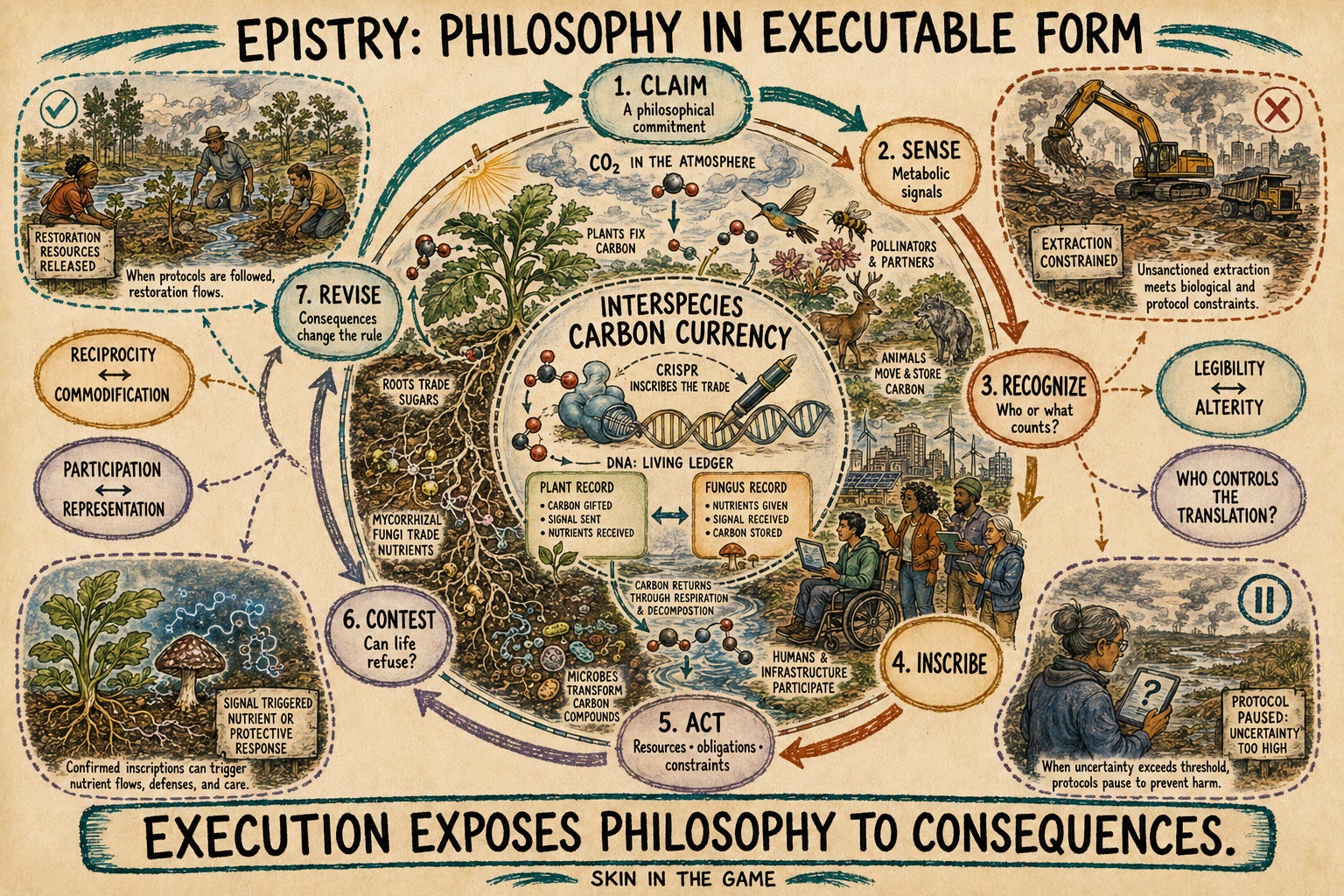
Trade between organisms will therefore leave complementary records. If a plant transfers carbon-rich sugars to a fungus and receives phosphorus in return, molecular signals associated with the exchange would trigger different inscriptions in engineered sentinel cells positioned at the interface. One record would attest to the carbon transfer; another to the reciprocal nutrient flow. Like with the blockchain, neither inscription alone would constitute the transaction. The trade would be recognized only when the protocol detected a corresponding pair of events.
Once a particular trade or threshold had been inscribed in DNA, the altered genetic state might change what a participating cell does next: release a nutrient, produce a signal legible to another organism, activate a protective function, or acquire access to a shared resource. The ledger becomes more than an archive; it would operate as a biological contract in which past exchanges alter the conditions of future ones.
I could then collect DNA samples across an ecosystem to translate these molecular records into human-legible institutions. A verified inscription might trigger the release of funds for habitat restoration, impose an obligation upon an extractive actor, or allocate resources to the maintenance of the ecological community that produced the value.
The DNA inscription is evidence that a cell registered a signal, but by itself, it’s not proof that an ecosystem flourished, that carbon remained stored, or that another species consented to the exchange. Ecological observations, carbon-flux measurements, durability assessments, and multiple biological witnesses would still be required.
In short: the carbon ledger makes a multispecies economy and democracy possible, but much work will be needed to make sure organisms are consenting to the trade (can a bacterium in my blood consent to being ingested by a white blood cell?). The currency could enable organisms to become participants in a shared economy, or it could turn them into involuntary accountants for a human one. The currency must therefore preserve the capacity of living systems to remain illegible, to interrupt the transaction, and to refuse it.
Giving a concept executable form does not end philosophical inquiry; ideally, it gives philosophy skin in the game.
Inhabitant: Speculative World.
A speculative world is an imaginary environment in which institutions, protocols, technologies, organisms, and everyday practices have been assembled into a possible form of life. It asks the reader to inhabit the world an idea might produce, not just evaluate that idea from the outside.
A multispecies home, for example, would not be a human house decorated with bird feeders and insect hotels. It would recognize several species as first-class inhabitants. Its light, temperature, acoustics, surfaces, circulation routes, appliances, and rhythms would be designed around their differing needs.
Inhabiting such a home would quickly reveal conflicts. What happens when the temperature one species prefers is intolerable to another? How are predators and prey accommodated? Who decides which forms of reproduction, contamination, noise, decomposition, or death belong inside the home?
The Speculative World is not a utopia; it is an integration environment, a place where philosophical commitments, institutional arrangements, and operational protocols meet one another’s consequences.
The Grammar of Habitability
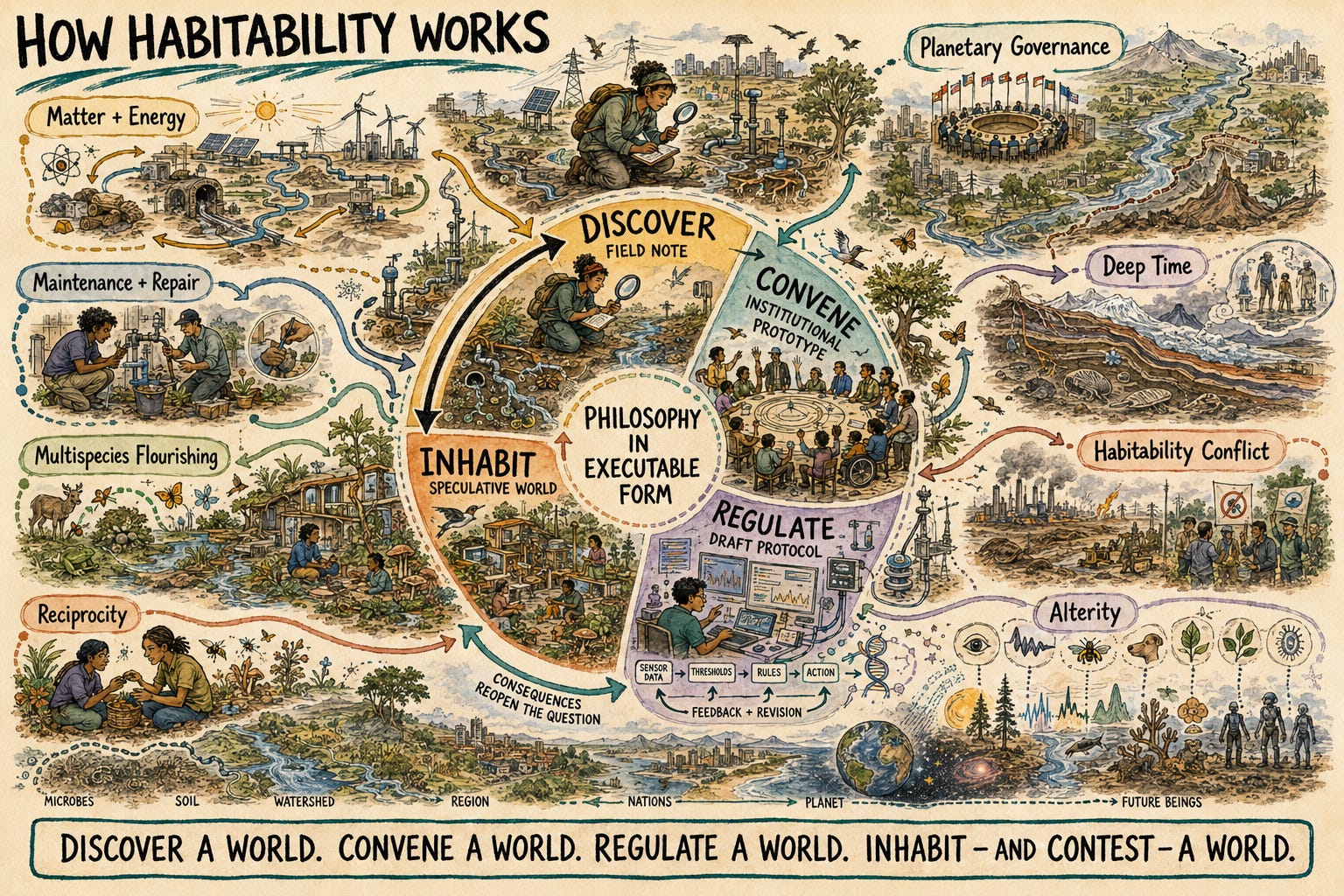
Witnessing, Constituting, Rule-making and Inhabiting: together, the four artifacts describe a movement:
The Field Note discovers a world.
The Institutional Prototype convenes a world.
The Draft Protocol regulates a world.
The Speculative World lets us inhabit and contest the world they produce together.
This movement is a circle, not a line. After entering a speculative world, we return to the existing one with altered senses. We notice relations that had appeared as background. We find exclusions our institutions concealed, consequences our protocols erased, and forms of life our imagined futures failed to accommodate. Inhabiting returns us to discovery, and the cycle begins again.
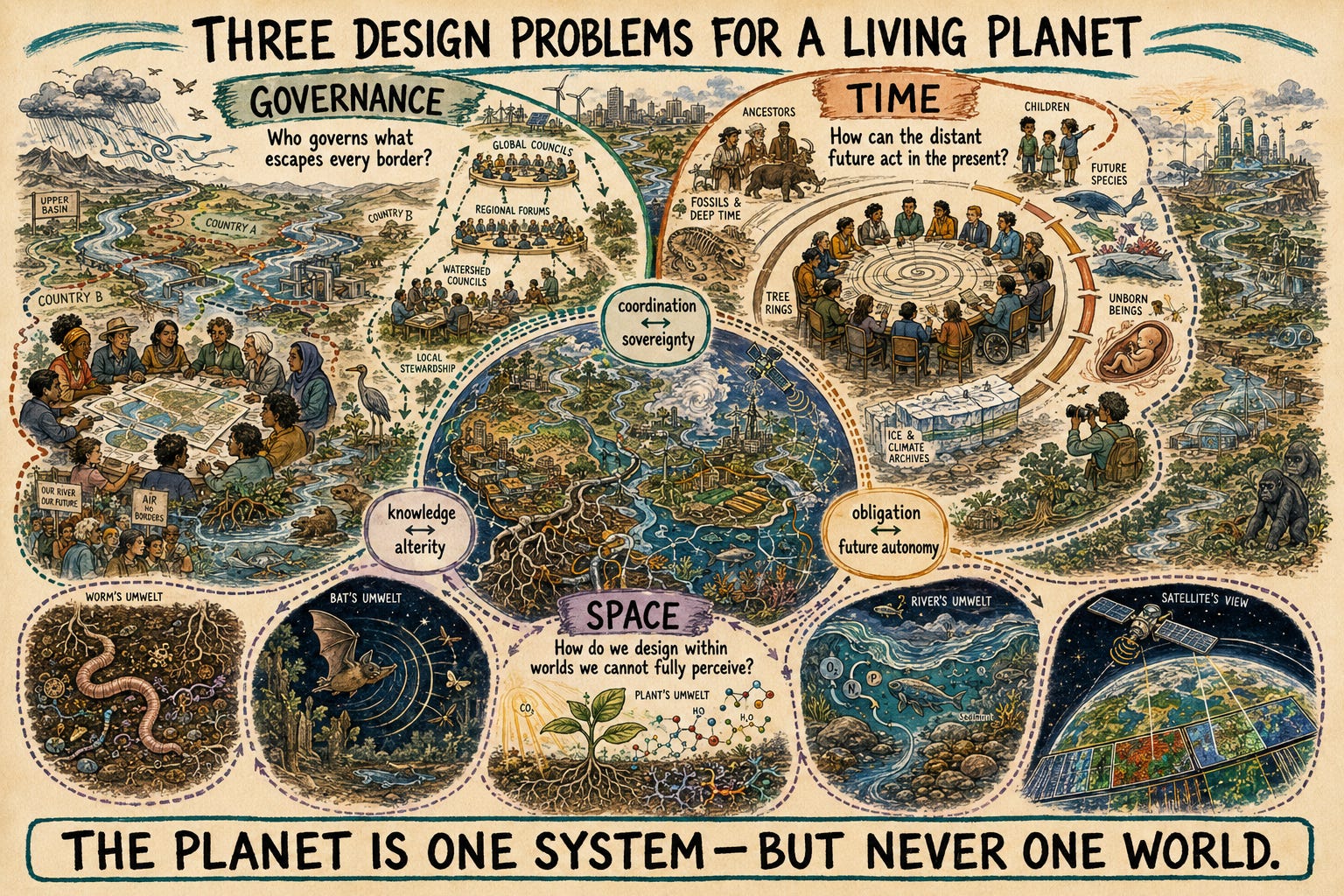
These artifacts will recur throughout the three principal themes that I am going to cover - governance, time, and space - and together they form a design language for turning habitability from an idea about the world into a practice of making worlds habitable.
The First Design Problem: Governance (Who maintains habitability?)
If you are reading this on a screen, inside a temperature-controlled room (I am), you are insulated from the vagaries of the flesh by an interlocking series of technological systems. We have built a technosphere that extracts energy, processes information, and spits out waste at a planetary scale. Think of Benjamin Bratton’s concept of “The Stack” - the accidental, planetary-scale megamachine of computation that is currently terraforming the Earth.
The problem is that the Stack, and the globalized capitalist system it serves, is completely indifferent to habitability. It operates in the register of the Globe, a human-centric construct that views the Earth merely as a backdrop for trade and extraction. But we don’t live on a Globe. We live on a Planet, a deeply entangled biophysical system.
So, who should maintain the metabolic order of the Planet?
It certainly can’t be the traditional nation-state. The nation-state is a geographic and juridical fiction completely mismatched to the scale of atmospheric carbon or ocean acidification. Planetary governance requires us to move past the idea that humans are the only actors that matter. Perhaps the solution is Gilman and Blake’s idea of “Planetary Subsidiarity” - a system of governance that embeds reciprocity, decentralization, and multispecies justice. However we do it, we have to learn to govern not as masters of a passive rock, but as self-conscious organs of a living planet. We need new epistries for this: the Elephant who holds the memory of the whole, the Architect who designs the institutional rooms for new forms of life to gather, and the Connector who maintains the relational networks across species and timescales.
The Second Design Problem: Time (Across what durations do we maintain it?)
We have a massive temporal contradiction at the heart of our planetary condition. Human political and economic cycles operate on scales of days, quarters, and four-year election terms. But the hyperproblems we face - like climate change or ecological collapse - operate on geological scales.
If we are to engineer habitability, we have to grapple with the “Planetary Durée.” This requires a radical expansion of our temporal imagination. As the geologist Marcia Bjornerud points out, we suffer from ‘time-illiteracy.’ We have to cultivate ‘timefulness’ - an awareness of deep time. We need to look at the Earth not just as a snapshot of the present, but as a vast, unfolding text, the book of the world.
In this context, our cognition, our sensor networks, our climate models, and our artificial intelligence are not unnatural aberrations. They are the planet thinking itself in rapid time that’s embedded in geological time. We are the means by which the Earth has become aware of its own deep duration. But this also means we are responsible for designing and executing institutions, protocols, and legal frameworks that can respect a polytemporal reality.
How do you write a constitution that protects the habitability of the planet for a species that won’t exist for another million years?
How do you design for deep time? This is where the Ministry for the Distant Future might help concentrate our imagination.
The Third Design Problem: Space (In the face of what otherness?)
When we expand our view of governance and time, we inevitably crash into the problem of Space, or what I called “Planetary Alterity.” For the last few centuries, the Western, now Global, project has been one of reducing the world to a known, mapped, and exploitable grid. But as we transition from the Globe to the Planet, we discover that the Earth is profoundly alien to us. As Gayatri Spivak notes, the planet is in the species of alterity, it belongs to another system. It is unmasterable. We inhabit it ‘on loan.’
We see this alterity when we look up at exoplanets, realizing how bizarre and varied the universe’s planetary zoo really is. But we also see it when we look down into the soil, or into the abyssal oceans, or even into our own microbiomes. We are surrounded by non-human actors - fungi, bacteria, weather systems, forests - that all have their own Umwelt, their own bubble of perception and meaning. They are terraforming the Earth right alongside us.
Another project of mine (also on Substack), the Cellosophy project, is a focused exploration of the alien umwelts that cohabit the earth.
To take planetary space seriously is to abandon the disembodied cosmic eagle view that treats the Earth as a fragile blue marble to be managed from above. Instead, we need the perspective of the cosmic earthworm: embedded, intimate, crawling through the dirt, acutely aware of its entanglement with the immediate, messy, alien realities of the biosphere.
Terraforming for Habitability
Usually, when we hear of terraforming, we think of science fiction (Expanse is really good!), or Elon Musk blasting nukes over the poles of Mars to create an atmosphere. But the truth is much closer home, for we have been terraforming the Earth for centuries through agriculture, industrialization, and carbon emissions. It’s just that our current terraforming project, aka, the Globe, is accidental, blind, and suicidal.
The question is not whether we will terraform the Earth; we are already doing it. The question is whether we can terraform it intentionally, with an ethics of care and reciprocity for all beings (what I called Mahayanics).
However, the recognition of our responsibility has to go hand in hand with humility, because the Earth has always been terraformed by life. Cyanobacteria were the OG epistrators, terraforming the planet billions of years ago by pumping it full of toxic oxygen, forcing a massive extinction and paving the way for complex life. The biosphere is an autopoietic, self-making system. Our job is not to retreat into a fantasy of pristine, untouched nature, for that’s the cosmic eagle speaking, but to accept our species-dharma as the cosmic earthworm.
We must use our technological power, our planetary sapience, and our deep time historical consciousness not to conquer nature, but to embed ourselves gracefully within it. We have to design the bio-futures of our terrestrial habitats so that they support the flourishing of the multitude.
This is the task of planetary epistry.
Over the next few months, I am going to build out this framework, a reworking of the planetarity syllabus as a manual of habitability. We will reread the deep history of the Earth as Bjornerud and Chakrabarty put it, reparse the cybernetics of the Stack, and take another look at the stars to understand the ground beneath our feet.
We must embrace our role as conscious, active, and deeply entangled participants, recognizing that our future as a species depends on our ability to terraform a world where life can flourish.
Starting in September 😛