


Introduction
In the first essay on Time, I introduced the main temporal contradiction underlying the condition of planetarity - the contradiction between the time of human history and the time of planetary history. Last week I gave an overview of how we might think through that contradiction using the readings for this month - Bjornerud, Chakrabarty, and DeLanda - as our guides. Now it’s time to add a layer of Bergson to our planetary cake. Over the next two essays, I will attempt to address the following question in the affirmative:
Is a ‘Planetary Duree’ a coherent concept? Does it help resolve the contradiction between human and planetary history?
First up, a brief overview of Bergson’s conception of “duree” as it informs our inquiry.
On Duree
Duree as such
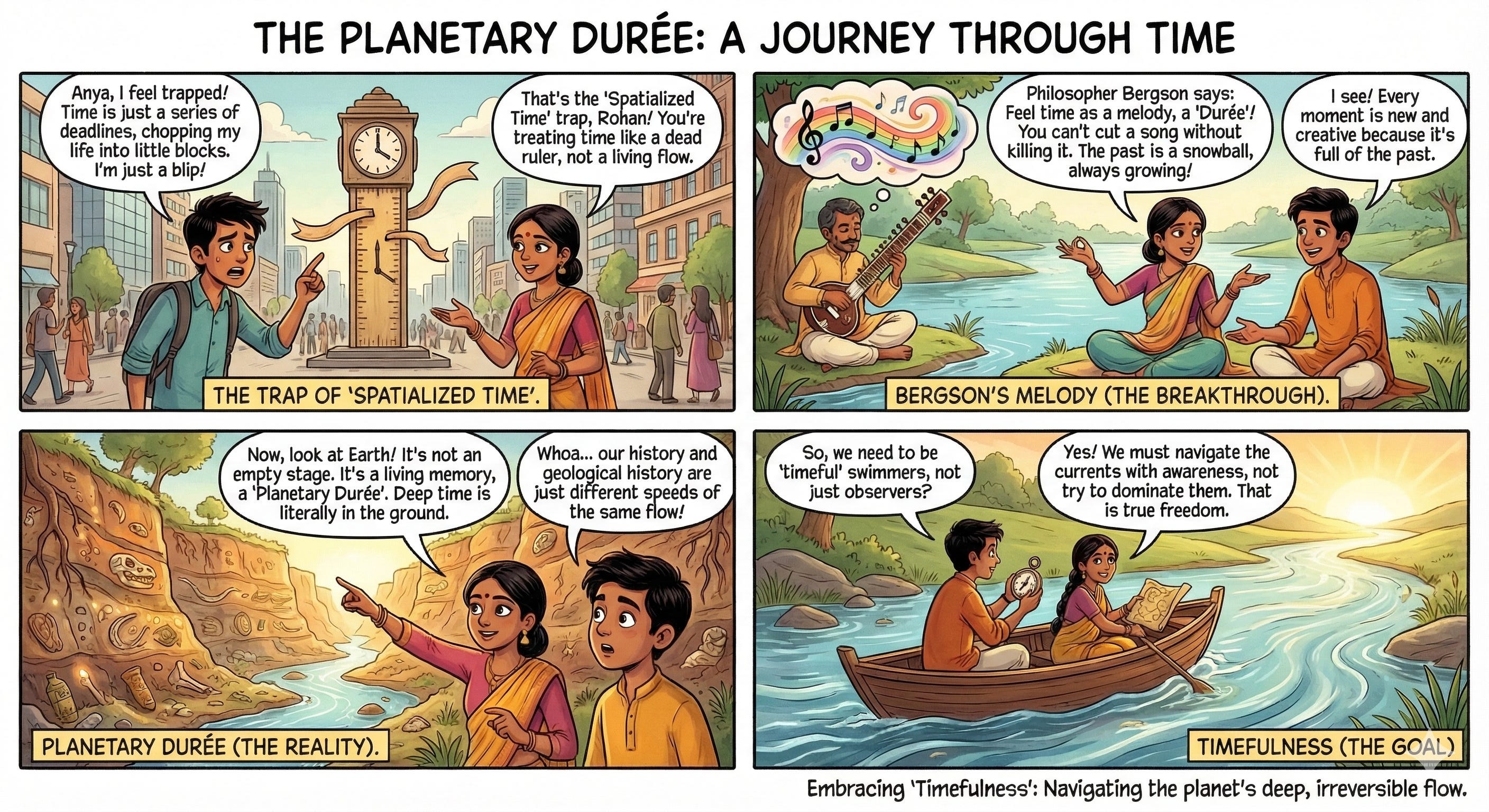
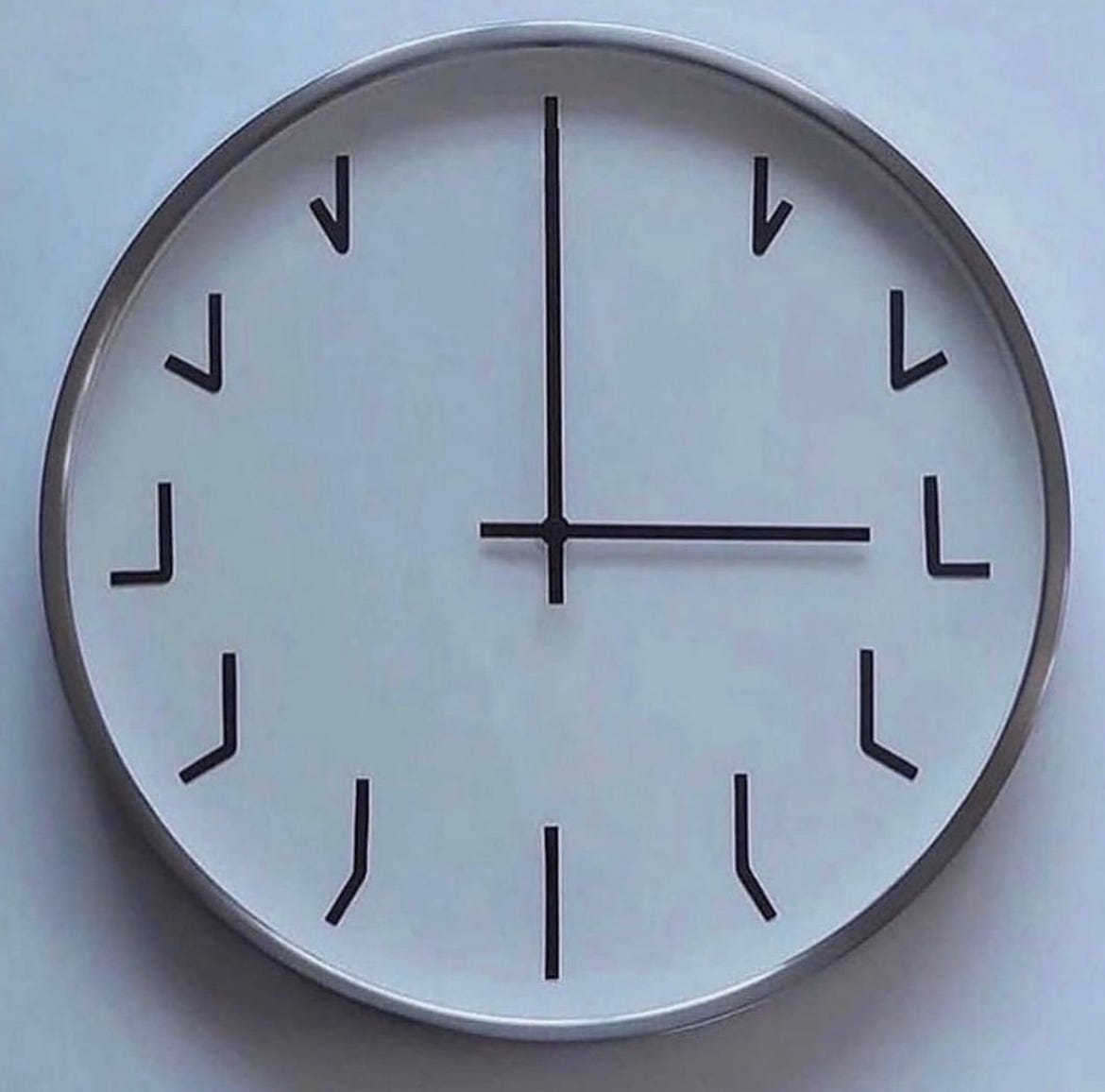
For Henri Bergson, to understand durée is to stop treating time like a ruler 📏 and start experiencing it like a melody 🎵. We typically commit a “spatial fallacy” by imagining time as a line of discrete points - seconds, minutes, or hours - strung together like beads. This version of time, which Bergson calls “spatialized time,” is a useful tool for physics and scheduling, but it is a corpse of the actual experience. It treats the past as a place we have left and the future as a place we are going, reducing the fluid movement of life to a series of static snapshots.
This brings me to one of my all-time pet peeves: that we have mangled the foundations of mathematics and computing by imagining ‘form’ as a sum of discrete entities, a reduction I blame on the otherwise blameless Cantor and Turing. Resurrecting the continuum qua continuum will help turn the wheel in the other direction, with some help from AI, since the new machine learning is a way to smuggle the continuum back into computation IMHO. This is way way off course from our planetary journey, so I am gonna tease you with these thoughts and shut up.
True durée, or pure duration, is the heterogeneous, continuous flow of inner consciousness. It is a qualitative multiplicity rather than a quantitative one; you cannot “divide” a moment of duration any more than you can cut a symphony into individual notes without destroying the music. In duration, the past is never truly gone. Bergson famously compares the soul to a snowball rolling down a hill: it doesn’t just move through the snow; it gathers it. Every new moment is saturated with the entirety of the past that preceded it, meaning that the “now” is always growing, changing, and essentially creative.
That past can be a planetary past too!
Because the past is constantly gnawing into the future, no two moments in duration can ever be identical. This creates a fundamental unpredictability that serves as the bedrock of human freedom. While the material world of space is governed by deterministic cause-and-effect, the “inner self” exists in a state of perpetual becoming. To live in durée is to recognize that we are not objects being pushed through a void, but a continuous process of self-creation where memory and anticipation are inextricably woven into a single, unbreakable fabric of being.
Do entities in the non-human world possess an inner self? If so, which ones? What other entities exist in the state of perpetual becoming? Rocks? Mountains? The Planet itself?
Planetary Duree
In the two previous essays on Time (here and here), we identified a central crisis of the Anthropocene: the fast-paced, human-centric time of our history (the Globe) has violently collided with the vast, indifferent deep time of the Earth system (the Planet). When we look at Earth’s 4.5 billion-year history, our human presence can feel like a meaningless, cosmic blip. We usually rely on the physicist’s conception of time to understand this scale, but this pure scientific time is reductive and essentially atemporal - and as Bjornerud points out - it treats time as a series of measurable, mathematical units, stripping it of its rich, historical reality.
But that rich reality isn’t human - it’s not experienced by us, there’s no phenomenology of Planetary Time, which leads to a crucial question for us: Is there a qualitatively rich conception of time that transcends the human? Can we break free from the tyranny of the discrete measurable?
While Bergson originally focused on our inner psychological lives, he also suggested that we naturally extend this duration to the physical world, arriving at the idea of an impersonal time that links the universe together. This is the key to grasping our condition of planetarity. If we adapt Bergson’s durée for the extreme longue durée of geological time, we realize the Earth itself endures. As Bjornerud points out, the Earth is not an empty, static stage; it is palpably made of time. The planet’s deep past isn’t gone, it’s preserved in rock strata, groundwater, and our own evolutionary biology. Manuel DeLanda helps us ground this materially, showing that human history, biological life, and geological formations are all just expressions of the same continuous matter-energy flowing and enduring at radically different speeds.
By viewing the Earth through the lens of a planetary durée, we can cure our societal time denial. The physicist’s spatialized clock-time alienates us by reducing humanity to a fraction of a second before midnight. Planetary durée, however, reconnects us. It shows that human civilization is a fast-moving, highly conscious current thoroughly entangled within the vastly slower, deeper currents of the Earth’s own unfolding memory.
Embracing this richer conception of time is a vital step in the project of planetarity as philosophical engineering.
Duree and Philosophical Engineering
In the context of Planetarity as Philosophical Engineering, Bergson’s durée offers a profound shift from seeing the Earth as a static resource to viewing it as a living, accumulating process. Most engineering operates in spatialized time - and current models of planetary processes treat the Earth as a set of discrete variables, coordinates, and predictable cause-and-effect loops - we need to set aside those mechanical reflexes. Planetary “becoming” implies that the Earth is not merely a stage for human history, but a qualitative multiplicity where every geological and biological past is actively gnawing into our present climate and social infrastructure.
How might engineering embrace the durée?
Applying durée to philosophical engineering suggests that we cannot fix the planet through spatial interventions alone. Instead, we must account for the irreversibility of time. Just as a melody is ruined if you try to isolate a single note, planetary metabolism is a continuous flow where the past (carbon deposits, evolutionary leaps, colonial histories) is inextricably woven into the future. By treating the planet as a being in planetary durée, our framework moves away from the dead time of the clock and toward a living time of the biosphere. It suggests that human agency is most free when it stops trying to dominate the planet as a spatial object and starts participating in its duration as a creative process.
These are, by their very nature, speculative thoughts; I am groping at how these speculations can be turned into engineering practice. Still stuck in Plato’s Planetary Cave for sure.
Some more scattered thoughts below:
Embracing the Contradiction
Mismatched Temporalities and the Poverty of Physics’ Time
Chakrabarty points out that we are now trapped in “mismatched temporalities”. We possess the geophysical force to alter million-year carbon cycles, yet our political and phenomenological horizons barely extend beyond a human lifespan. To govern the planet for habitability, we need to grasp deep time, which is not the time of physics, based on models that seek eternal laws.
The Bergsonian Resolution: Planetary Durée
Bergson opposes spatialized time with durée (duration) - a continuous, indivisible flow of becoming where the past is preserved and prolonged into the present through memory. Bergson argues that we naturally extend this duration to the whole physical world (How though? Can we identify the cognitive processes by which we do so?). Because our environment participates in our duration, we arrive at the idea of a duration of the universe, where, by eliminating the individual human observer, we discover an impersonal time in which all things will pass.
Is there an intermediate time, one that doesn’t eliminate the human observer, but rather, expands the list of observers to include all the beings that inhabit the Earth? Can we identify ‘living time’ that extends from the earliest prokaryotes, i.e., archaea and bacteria, who came to life almost four billion years ago, all the way to us?
Planetary durée is not an empty, spatialized container stretching back 4.5 billion years; it is a massive, qualitatively rich interval. Bergson writes that duration is “a memory within change itself”. Geology perfectly mirrors this: as Bjornerud observes, the Earth is “steeped through and through with time”; the deep past is not gone, but literally preserved in the strata, landscapes, and our own DNA. The Earth is a memory, an unfolding duration.
Materializing Duration: DeLanda and the Flow of the Earth
To prevent Bergsonian Planetary durée has a ‘solidarity with all beings across time’ vibe to it, but to keep it from sounding too mystical, we can use Manuel DeLanda to ground it in material reality. DeLanda erases the boundaries between the human, the biological, and the geological by viewing reality as a “single matter-energy” undergoing phase transitions.
For DeLanda, history across temporal scales is about the coexistence of material flows operating at different speeds: the agonizingly slow flow of rocks, the faster flow of biomass, and the highly turbulent, rapid flow of human economics and culture. That said, I am not that convinced by this layer-cake model - if the fast flowing layers can be isolated from the slow moving ones in our model of history, we don’t have much interpenetration, at a time when that’s precisely not the case.
To be continued...
Concluding Thoughts on Planetary Duree
Here’s where I am at: to resolve the contradiction between making humans great again and acknowledging our cosmic unimportance, let’s agree to subsume history - human, biological, geological - inside the provenance of ‘planetary duree,’ that the Earth is not a passive standing reserve waiting for our technological mastery (MHGA), nor is it an indifferent void (the deep clock time of the physicists). We are a fast-moving, highly conscious coagulation of the planet’s own duration.
Therefore, planetary governance and the maintenance of metabolic order cannot be based on the spatialized, short-term time of the Globe, the time of election cycles and quarterly earnings. Instead, we must cultivate Bjornerud’s timefulness, an acute, lived awareness of our embeddedness in the planet’s deep duration. By embracing an impersonal, planetary durée, we accept our profound responsibility as the planetary constituent responsible for planetary sapience.
"It suggests that human agency is most free when it stops trying to dominate the planet as a spatial object and starts participating in its duration as a creative process."
Sounds like it comes straight from Daoism.