


I am going to take a break from writing. Will be back in a few (weeks, maybe months) when the Monkey Goes East.
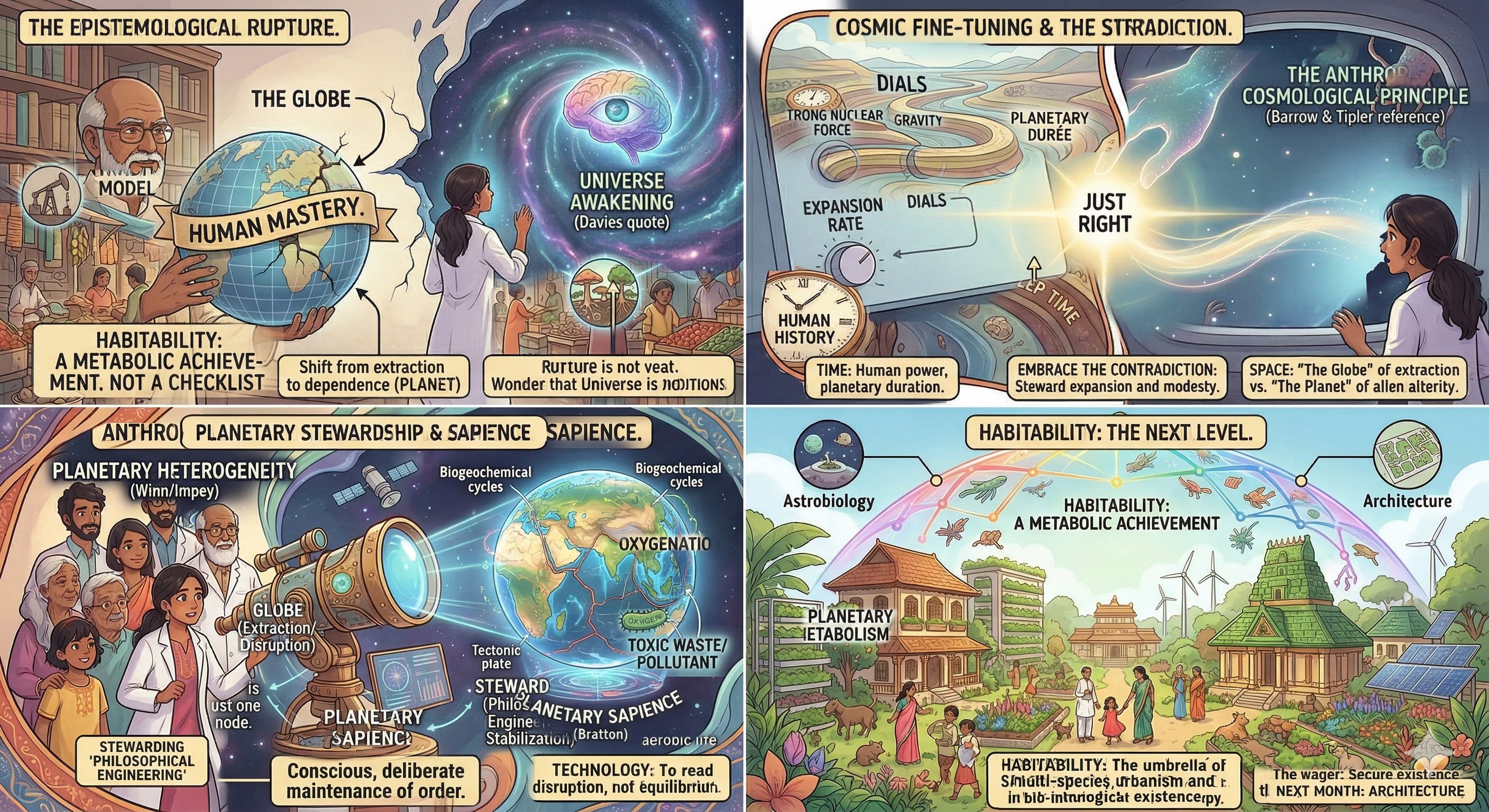
The universe is astonishing in so many ways. It’s really big. It’s really old. It started with the biggest bang ever. And to add to that litany of astonishment, there’s the fact that at least one corner of the universe has been inhabited for almost four billion years, and at least one of those creatures looks up at the sky and wonders why there’s anything at all. Out of the swirling chaos of hydrogen and helium forged in the furnace of the Big Bang, matter somehow arranged itself into complex, self-replicating patterns. It arranged itself into cells, then tissues, then nervous systems. Eventually, the universe produced creatures capable of looking back up at the night sky and wondering at the sheer improbability of their own existence. As the physicist Paul Davies has observed, we are the moment the universe wakes up to itself.
This capacity for wonder at the possibility of existence is the starting point for any serious inquiry into habitability. We cannot afford to take the existence of the world - or our presence within it - for granted. The condition of planetarity demands that we expand our philosophical imagination; it can no longer remain the humanistic discipline that it has been for a couple of millennia. We must start with the cosmos, ask questions about planetary habitability, delve into the deep geological history of the Earth, and finally arrive at the burning questions of the Anthropocene.
1. The Cosmic Prerequisite: Fine-Tuning and the Anthropic Principle
The most general setting for habitability is the universe itself. Before a planet can support life, the fundamental laws of physics must allow for the possibility of life. When physicists and cosmologists look at the basic parameters of our universe, they encounter an eerie reality: the universe appears suspiciously fine-tuned for the emergence of complexity.
If the laws of physics had been even slightly different, the universe would be a sterile void. If the strong nuclear force that binds atomic nuclei together were just a few percent weaker, the universe would contain nothing but hydrogen - no carbon, no oxygen, no nitrogen, and therefore no biology. If gravity were slightly stronger, stars would burn out in a matter of millions of years, leaving no time for evolution; if it were slightly weaker, matter would never coalesce into stars and galaxies at all. If the expansion rate of the universe immediately following the Big Bang had been altered by a fraction of a percent, the cosmos would have either rapidly collapsed back in on itself or expanded so fast that galaxies could never form.
In The Goldilocks Enigma, Paul Davies calls this the ultimate mystery of existence: why is the universe just right for life? This observation is formalized in cosmology as the Anthropic Principle. Explored exhaustively in John D. Barrow and Frank J. Tipler’s definitive 1986 tome, The Anthropic Cosmological Principle, the concept takes this idea of fine-tuning and pushes it to its logical conclusion.
In its Weak form, the Anthropic Principle is not much more than selection bias: we should not be surprised to observe that the universe’s physical constants are perfectly tuned for life, because if they were any different, we simply would not be here to observe them. We are bound to find ourselves in a Goldilocks universe because a non-habitable universe produces no astrophysicists or historians to document its sterility. The universe is the way it is because we exist.
However, the Strong Anthropic Principle proposes something far more radical: that the universe must possess those properties which allow life to develop within it at some stage in its history. This flips the narrative of life’s insignificance on its head. It suggests that while (as far as we know) living beings are a sideshow to the parade of galactic and stellar activity, observers such as living creatures are not byproducts but ontological prerequisites. If the cosmos is a Book of the World - to use the medieval metaphor we revived in our discussion of time - then the most striking feature of that book is that it’s produced specifically to allow for the existence of readers.
When we bring this cosmoanthropic perspective down to Earth, it fundamentally alters our understanding of planetarity. It suggests that habitability is not merely a lucky chemical accident; it is a profound cosmic property. Perhaps the physical universe is not an indifferent machine, its habitability is built into its architecture.
Note that while the Strong Anthropic Principle was first formulated to require observers like us, it doesn’t need to. Octopii will serve as well. Perhaps even bacteria.
2. The Planetary Sweet Spot: Exoplanets and the Goldilocks Zone
If the universe provides the foundational laws for habitability, it is in planets that we must seek environments that fulfil their promise. Having acknowledged that the universe permits life, and entertained the possibility that it necessarily does so, we must ask: what makes a specific planet habitable?
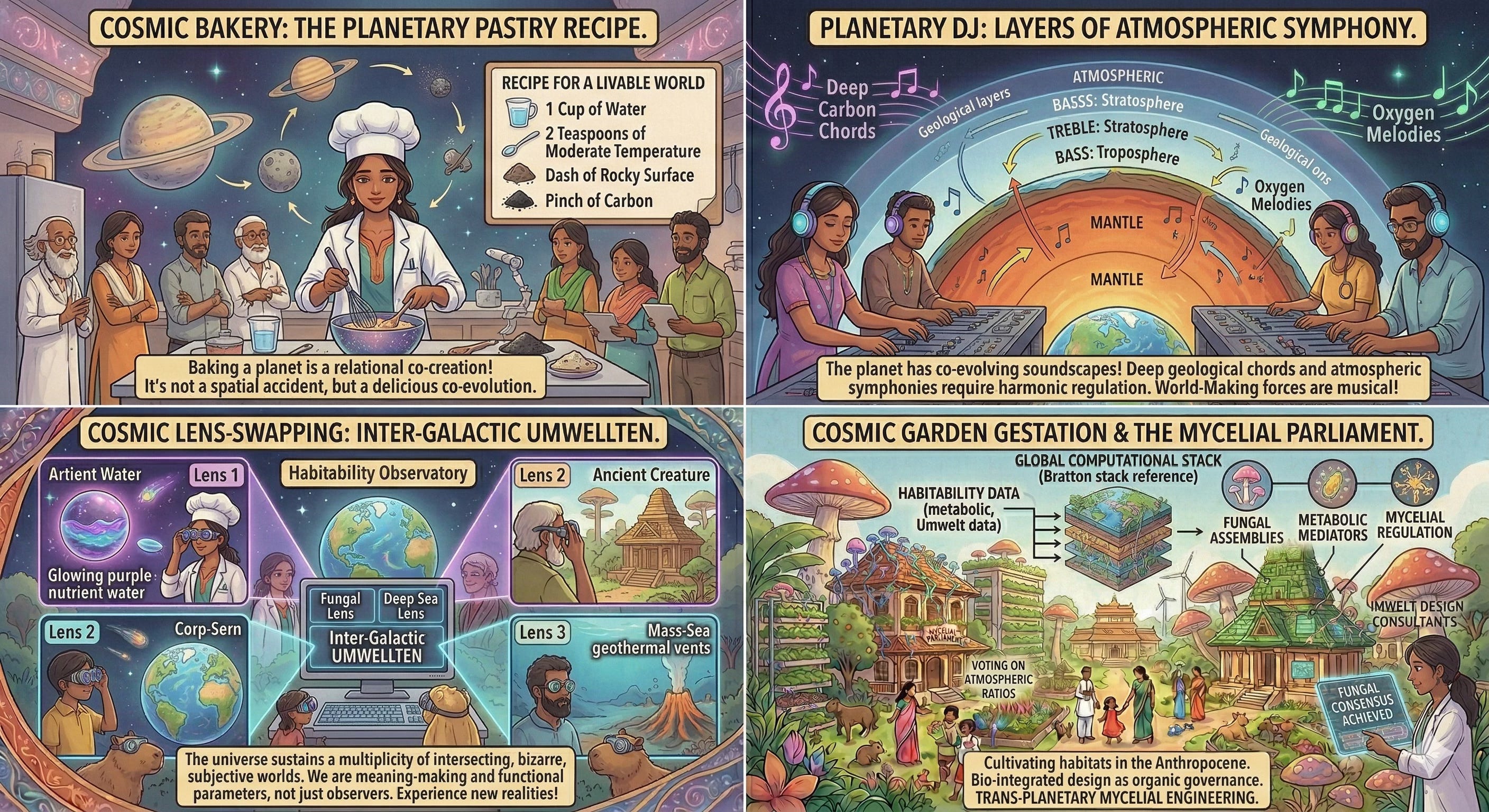
Astrobiologists looking for exoplanets will likely refer you to a standard checklist. To support life as we know it, a planet requires a rocky surface, a breathable atmosphere, the right cocktail of biogenic elements (carbon, hydrogen, nitrogen, oxygen, phosphorus, and sulfur), and, most importantly, liquid water. This dictates the search for the circumstellar habitable zone - the orbital distance from a star where temperatures are not too hot (which would vaporize water) and not too cold (which would freeze it), but just right. This is the Goldilocks Zone.
For centuries, our understanding of this zone was limited to our own Solar System. But as we have learned from Chris Impey (Worlds Without End) and Joshua N. Winn (The Little Book of Exoplanets) emphasize, the universe is teeming with planets. We have gone from knowing of zero planets outside our solar system to cataloging over 5,000, with current statistics indicating there are more planets than stars in the Milky Way. Impey estimates there are roughly a thousand billion billion (10^21) potential biological experiments happening across the observable universe.
Winn points out that not only planets aplenty, they are bizarre and diverse from the point of view of our solar system. The exoplanet zoo includes hot Jupiters skimming the surfaces of their stars, rogue planets wandering the dark void without a sun, and planets orbiting two stars at once. The two most common types of planets found in the galaxy - super-Earths and mini-Neptunes - do not even exist in our own Solar System. Looking at this diversity, one must assume that every possible chemical reaction has been repeated many times in many places.
This exoplanetary perspective reinforces what I have called Planetary Alterity. The planet is alien. The universe is alien. But the great lesson we are yet to learn is: embrace that difference. We are not the measure of all things. Perhaps there are more forms of wisdom than we can imagine!
Locating a planet in the Goldilocks Zone is only the beginning of the story. Venus and Mars both sit near or within the habitable edges of our Sun, yet Venus is a runaway greenhouse hellscape capable of melting lead, and Mars is a frigid, irradiated desert. Habitability, is a relational concept, not a widget you can extrude out of a checklist of ingredients.
As Charles Langmuir and Wally Broecker detail in How to Build a Habitable Planet, a planet is not habitable simply because it possesses certain fixed properties; it is habitable because the complex relationships between its geological, atmospheric, chemical, and biological systems are mutually sustaining over geological timescales. Habitability is a dynamic condition that living systems actively produce just as much as they require.
Habitability is a metabolic achievement.
3. Deep History: The Great Oxygenation Event and the Paradox of Life
To understand this metabolic achievement, we must grasp the rhythms of the Earth, the Planetary Durée, the realization that the deep past is woven into modern landscapes, atmospheric chemistry, and our own DNA. The Earth has been inhabited for billions of years, but the circumstances of that habitability have shifted violently. The planet we inhabit today is not the planet that first birthed life. The Earth of the Hadean eon was a churning magma ocean; the Earth of the Cryogenian period was a solid ball of ice. If we were to step out of a time machine onto the Earth of three billion years ago, we would immediately suffocate.
Life did not simply adapt to a static, habitable rock; it engineered the rock to suit itself. For the first two billion years of Earth’s history, the biosphere consisted entirely of anaerobic microbes that lived without oxygen. Cyanobacteria were the first organisms capable of photosynthesis. These microscopic entities began harvesting energy from the sun, and in doing so, they released a highly reactive, toxic waste product into the oceans and the atmosphere.
That toxic waste product was oxygen.
What followed was the Great Oxygenation Event, arguably the most significant climate catastrophe in planetary history. As oxygen accumulated, it poisoned the vast majority of the anaerobic life forms that had dominated the Earth until then, driving the planet’s first mass extinction. Furthermore, the oxygen reacted with atmospheric methane (a potent greenhouse gas, the main ingredient in LNG, which is in short supply as a result of the Gulf War), scrubbing it from the air and plunging the planet into a deep, prolonged ice age.
The oxygen that sustains our bodies today - the air we take for granted with every breath - was originally a deadly pollutant that eradicated the Earth’s first inhabitants. Their death is our life. Nature is not a harmonious whole in static equilibrium. The Earth is a polytemporal tapestry, as Marcia Bjornerud calls it, marked by periods of immense biological disruption. Life is the ultimate terraformer. Over billions of years, the interplay of life and geology - through the carbon cycle, plate tectonics, and nitrogen fixation - has continuously regulated the Earth’s temperature and chemistry.
The habitability we enjoy today is the inherited legacy of billions of years of metabolic labor by non-human actors.
4. The Anthropocene: Securing the Metabolic Order
Making the connection between this deep geological history, including acknowledging our existence to planetary poisoners, and the contemporary moment is a key task of Planetarity. Today, human history and planetary history have violently collided as Dipesh Chakrabarty says. We have entered the Anthropocene (or the Capitalocene, if we focus on the economic drivers of this shift), an epoch in which human activity operates as a planetary-scale geophysical force.
Just as the cyanobacteria once altered the atmospheric chemistry of the planet through their collective metabolism, industrial civilization is currently altering the global climate by extracting and burning millions of years of fossilized sunshine. The Great Acceleration of the mid-twentieth century has pushed multiple planetary boundaries - climate change, biodiversity loss, nitrogen cycle disruption - into the danger zone.
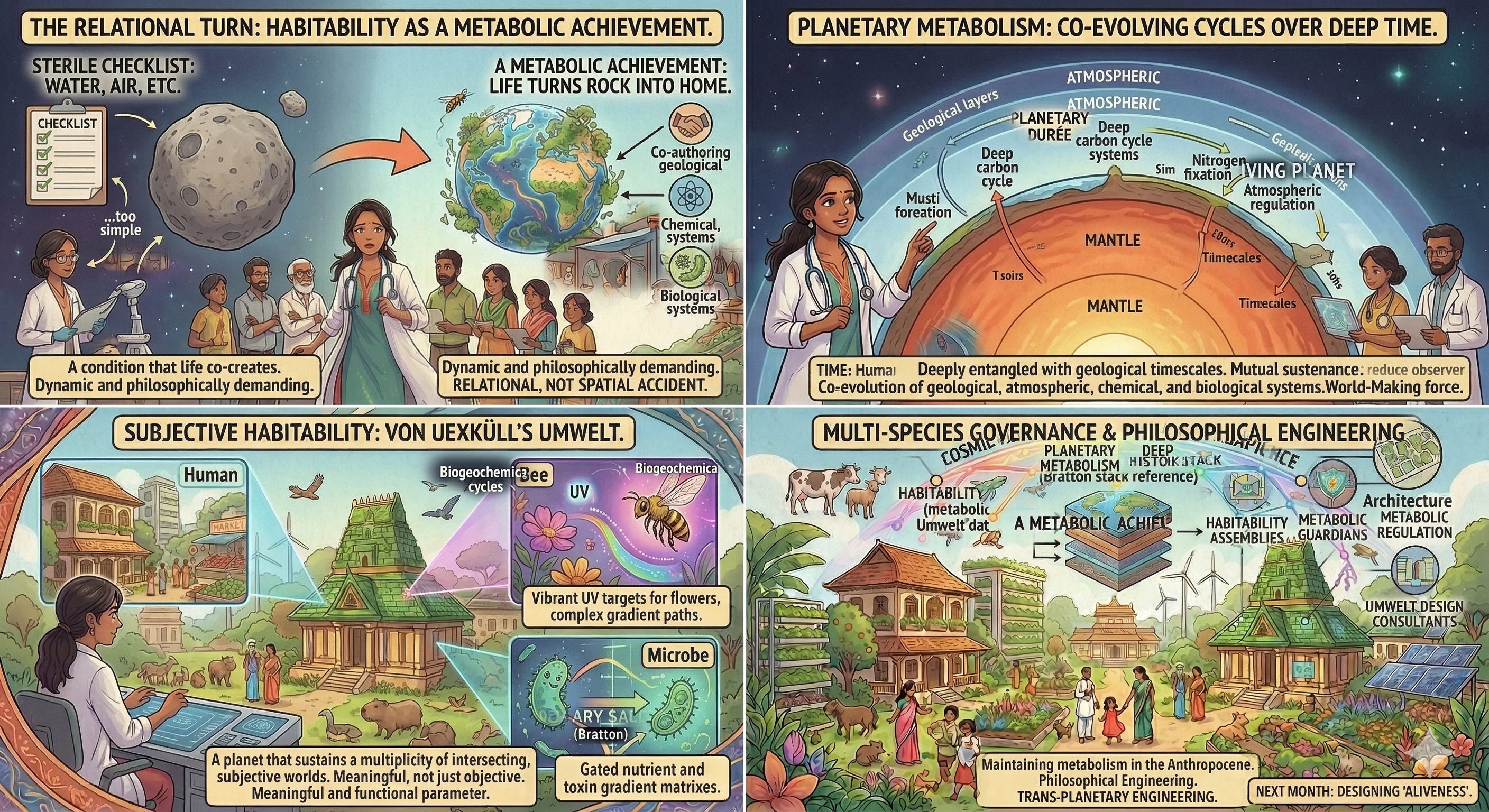
I am guessing cyanobacteria did not poison the world out of malice. They were the winners in the game of natural selection (but what about that early world made their skills so powerful? Need to find out...). We, on the other hand, possess what Benjamin Bratton calls Planetary Sapience. Through our sprawling technosphere - our satellites, sensors, deep-ocean cables, and computational models - we have developed the capacity to read the Book of the World. We can measure the parts per million of carbon in the atmosphere; we can track the melting of the cryosphere in real-time.
We are aware of the metabolic disruption we are causing.
This brings us back to the contradiction that animates the condition of planetarity: the tension between the human-scaled Globe and the alien, deep-time Planet. Globalization treats the Earth as a frictionless grid for capital and trade, a standing reserve for human extraction. We assumed that the background habitability of the planet was a permanent given.
We now know this is a dangerous delusion.
As Dipesh Chakrabarty argues, the climate crisis has collapsed the distinction between human history and natural history. We can no longer pretend that the social order sits independently above the physical order. Biogeochemical stocks and flows are the conditions that make any society possible in the first place. Without stable climate patterns, functioning water cycles, and fertile soils, there’s no human drama, no Netflix and Chill.
Therefore, our primary collective task as a species is the deliberate maintenance of planetary metabolic order. Habitability is no longer a background assumption; it is something that must be secured through explicit acts of governance. We must move beyond abstract environmentalism and engage in what I call Philosophical Engineering, designing the protocols, legal frameworks, and cybernetic feedback loops that keep the planet in tune. As Jonathan Blake and Nils Gilman propose in Children of a Modest Star, we need institutions based on planetary subsidiarity, capable of governing biogeochemical cycles that laugh at national borders. We need a politics of deep time that acts as a trustee for the unborn and the non-human. We must transition from being planetary consumers to planetary stewards.
5. Conclusion: Habitability as the Central Concept of Planetarity
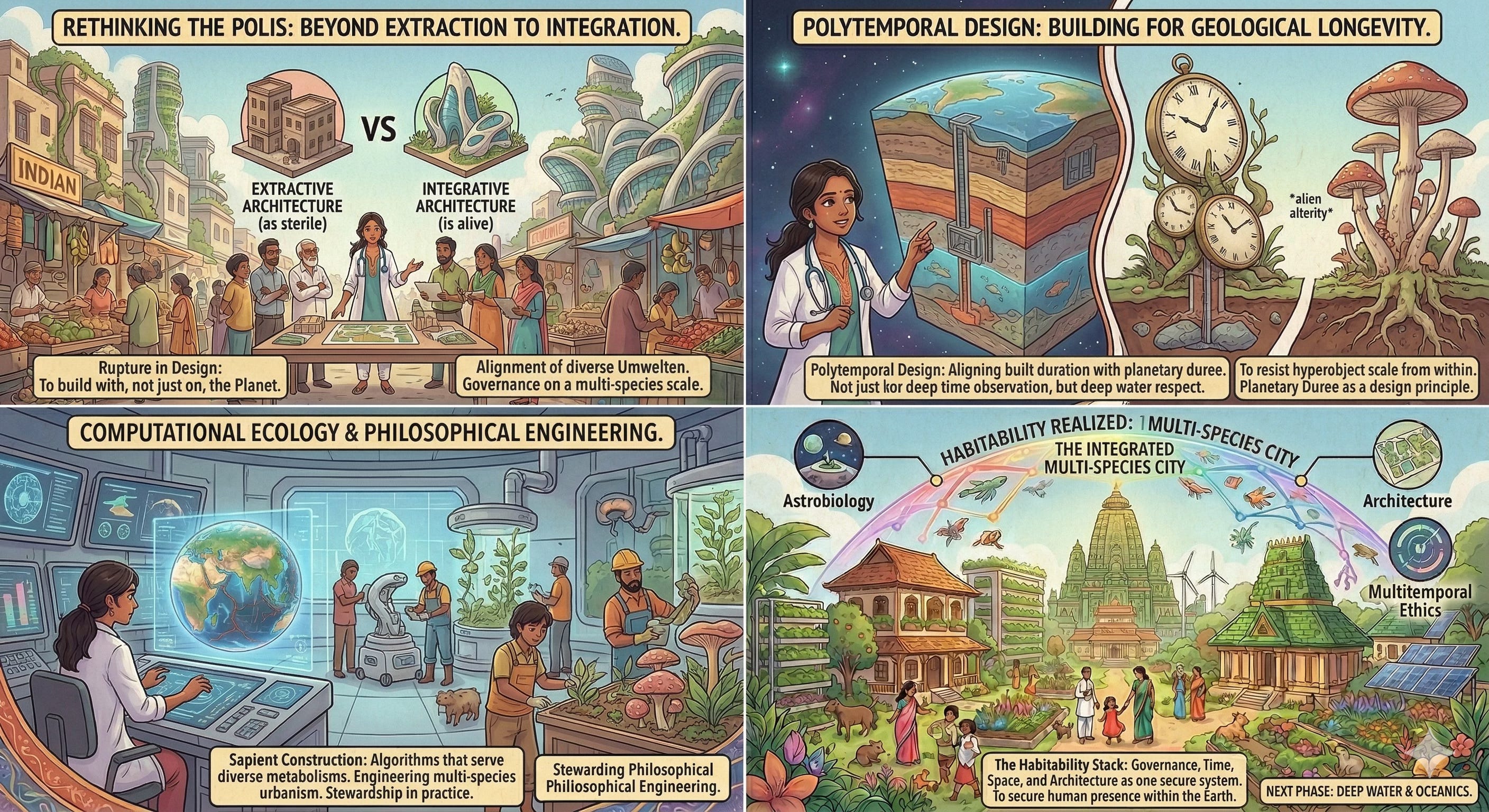
When we look at the condition of planetarity from the outside in - starting from the cosmic fine-tuning of the universe and arriving at the urgent climate politics of the present - we see that all our inquiries converge on habitability being the central concept of planetarity, one through which we can view the three previous concepts we engaged with: governance, time and space.
Through the Planetary Durée, we learned to subsume the frantic, spatialized clock-time of human history into the deep, slow rhythms of geological time. We realized that to govern effectively, we must become timeful ancestors. Through Planetary Alterity, we recognized that space is not a passive backdrop but an active, alien participant. We learned that to live on Earth is to inhabit a world that we share with a multitude of non-human kin. We rejected the fantasy of escaping to Mars, committing instead to the Bodhisattva’s vow for the Earth: to stay with the trouble of our damaged home.
And in our inquiry into Governance, we sought the architecture of institutions - the Stack, the planetary assemblies, the multi-level regulations - required to manage this complex reality. We realized that the philosopher-king of the polis must be replaced by the planetary steward of the biosphere.
Habitability is the umbrella concept under which all of these ideas come together.
It is the bridge between the cosmic and the intimate. It encompasses the astrobiologist calculating the orbital mechanics of a distant super-Earth, the geologist tracing the isotopic signatures of the Great Oxygenation Event, and the urban planner designing a biophilic city block that sustains multi-species flourishing. It merges the universal laws of physics with the subjective, lived Umwelt of every creature on Earth.
To grasp habitability through philosophical engineering (as Hegel might urge us if we were around) is to accept our species-dharma: that we can use our technological power and our historical consciousness not to conquer nature, but to embed ourselves gracefully within it. We are living in a universe that has graciously allowed us to exist. Our task now is to ensure that the unique, finely-tuned alignment of time, space, and life that makes this planet a home does not collapse under the weight of our arrogance.
We must become the architects of our own continued existence. And not only our own.
Endnote
Having written this essay, I am not sure what I will do next. I had promised a year’s worth of writing on the Planetarity Syllabus, but in my head, I have stumbled into a cavern that I need to explore more thoroughly before coming back to monthly topic-by-topic coverage.
I am thinking of coming back in a few months with a deeper exploration of habitability - it needs a sustained investigation, unlike this time, when I feel into it as I scratched beneath the surface of Time and Space.
BTW, to show how well habitability has been covered as a humanistic subject, I performed a simple n-gram search for “Philosophy of Society” versus “Philosophy of Habitability,” and here’s what I found:
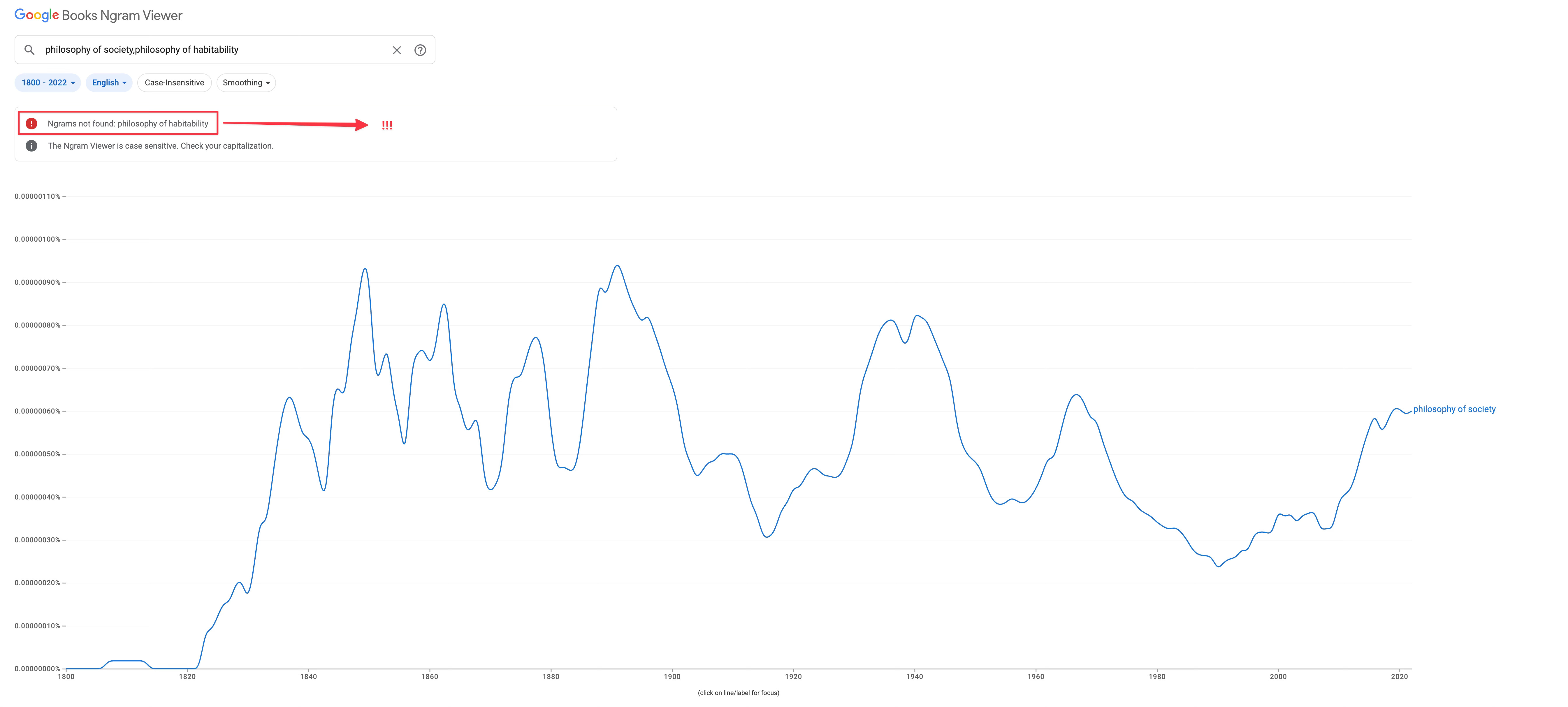
There’s no record of anything like “Philosophy of Habitability” (just see the screenshot above) while new books on the philosophy of society are published every day. What a shame isn’t it? No society without habitability, right?
Anyway, round two in a few months time, but I am taking a break from the Planetarity Syllabus for now.