


You might have heard of ‘reading for writing,’ where writing instructors will tell you that in order to write well, you need to read a lot and read closely so that you understand the choices made by other writers.
Of course.
I have a different POV: writing for reading (WFR). I can’t read until I have written enough that I have a toolbox of concepts and ideas to which I can fit what I am reading. Of course, the reading will modify those concepts, sometimes drastically, but without a strong yet flexible point of view of my own, I am in danger of being subjugated by the author’s ideas.
Which I don’t like. In order to read a lot, I have to write a lot.
This essay sets the stage for planetary and metabological WFRs of some key contemporary texts; I am going to create a foundational syllabus for Bhumics, which will have everything from the ancient to the modern. The syllabus should be useful for everyone who cares about a living planet; my take on the texts in it is of course, my own. As of this writing, I want to sample contemporary (i.e., written after 1945) texts along three dimensions:
Space: expanding our political imagination from the social to the planetary requires us to open the borders of that imagination - both literally, as in dissolving national boundaries and including the lithosphere, the hydrosphere, the cryosphere and the atmosphere in our idea of ‘territory,’ and metaphorically, in including nonhuman species and their ecological worlds as spaces that deserve our care. Representative texts: Staying with the Trouble, Children of a Modest Star, When Animals Speak.
Time: An equally, if not more, important challenge is to imagine ourselves as inheritors of a very long history, a history in which humans are recent actors and of governing not just for today or tomorrow, but for centuries and millennia and more. Representative texts: The Climate of History, Timefulness, Long Problems.
Speculation: expanding our spatial and our temporal horizons will need new sources of data, but also new sources of imagination. Or to put differently; failures of the imagination,of possibilities we can reasonably inhabit are as likely to hold us back as greed and violence. Representative texts: Speculative Everything, A Pattern Language, Wonderbook.
I will be commenting on these books and more in 2026, starting with a review of Gilman and Blake’s “Children of a Modest Star” in a couple of weeks. But in the spirit of WFR I am starting this syllabus series with a framing essay (see below - very long, sorry!) on metabolic order. The key claim, which will be repeated in the essay as well:
The maintenance of planetary metabolic order is our primary collective task as a species.It is literally the foundation for everything else.
Metabolic Order
For most of history, thinkers were concerned about the breakdown of social order. It’s no surprise that doctrines of harmony and centralized authority arose in China during the warring states period. A harsh government is preferable to the war of all against all, as Hobbes might say. Sometimes the source of disorder lies beyond the human - an earthquake or a flood or a drought might devastate a land, and people might reach for the hand of a wrathful God for an explanation.
For the most part, the modern era hasn’t had to worry about the ground beneath our feet or the clouds in the sky. Whether you begin with Hobbes and the state, Smith and the market, Weber and the bureaucracy, or Marx and the struggle over production, the basic assumption remains remarkably stable: the world is given, and the challenge is to coordinate human beings within it. Institutions are the scaffolding of that coordination. They secure legitimacy, enforce contracts, allocate resources, stabilize expectations, and keep conflict within a tolerable range. Even when these institutions fail, the failure is usually described in social terms: corruption, capture, inequality, alienation, polarization, administrative decay. When Gandhi blamed the earthquake in Bihar on the evils of untouchability, he was roundly criticized for being superstitious.
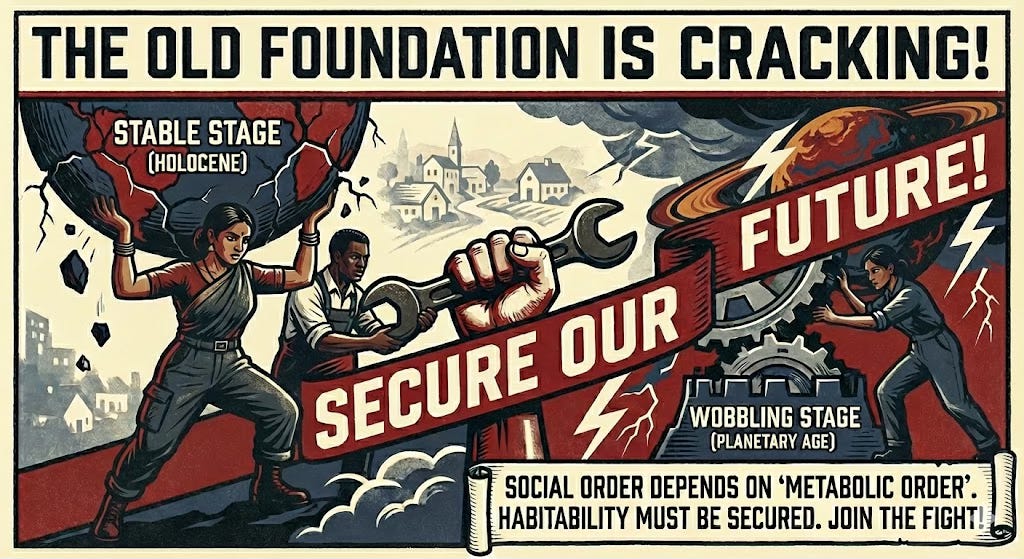
Our imminent condition of Planetarity forces a different starting point. Geology has become a matter of life and death. We are now recognizing that social order sits on a deeper stratum of planetary processes; when they start crumbling, our social institutions will lose a foundation they took for granted. Biogeochemical stocks and flows are the conditions that make any society possible in the first place. Stable climate patterns. Functioning water cycles. Fertile soils. Reliable energy systems. Tolerable air and ocean chemistry. Living ecosystems that provide pollination, disease regulation, carbon storage, and disease regulation. A planet that can absorb waste without flipping into a new regime. A built environment that can keep bodies alive through heat waves and storms.
For a long time these conditions were “there” in the background, not because they were metaphysically guaranteed, but because the Holocene’s stability made them feel like a permanent stage. The stage is now wobbling. And when the stage wobbles, every social drama becomes a different kind of drama. We are learning that social order depends on metabolic order: the maintained pattern of planetary and infrastructural flows that keeps a world habitable, and makes flourishing possible - not only for humans, but for the wider community of species entangled with us. Metabolic order is not an ideal. It is a working condition. It is what allows the social world to exist without constantly collapsing into emergency.
Thesis: The maintenance of planetary metabolic order is our primary collective task as a species.
It is literally the foundation for everything else. Habitability is no longer a background assumption. It is something that must be deliberately secured. Flourishing is no longer only a matter of rights, incomes, and recognition. It is also a matter of whether the life-support systems that sustain agency and experience can continue to function under stress.
Do you accept this shift?
No I don’t. Tell me how you’re planning to address the permanent existential risks that stem from that refusal. It doesn’t matter if the threat is nuclear weapons or climate change or a planetary pandemic - species wide existential risk is our lot as long as we refuse to recognize the condition of planetarity. The more we ignore metabolic order, the more extinction becomes possible.
Yes, I do! Those of us who recognize the importance of metabolic order have it scarcely better, for a consequence follows almost immediately: all our inherited institutions are misaligned.
The modern state is designed to manage territory, legitimacy, and security. The market is designed to allocate through price. The bureaucracy is designed to routinize decisions, reduce arbitrariness, and scale governance. All of them can help with metabolic stability, and in practice they will have to. But none of them were built with habitability or life-support as their explicit mission. Their reflexes - growth as default, extraction as baseline, “externalities” as someone else’s problem, short time-horizons baked into incentives - are increasingly at odds with a world of ecological limits and cascading risks.
There’s the “Planetary Boundaries” literature, which embeds human society as a circle inside the larger biosphere, on which it depends. As of today, we have breached six out of nine critical boundaries, which is troubling, to say the least. However, I am not a fan of ‘boundary logic,’ which maintains a separation between the human and the non-human. There’s no “safe operating space for humanity,” no social inside surrounded by the planetary outside: the planet is everywhere.
So the Planetary Age is not merely a new set of policy problems for old institutions. We will need a new class of institutions whose purpose is to produce, reproduce, and maintain metabolic order - to sense stresses early, coordinate response, repair breakdowns, and keep vital systems within safe bounds. And these institutions cannot exist only “at the top,” the planetary frosting on the social cake, because metabolic order is inherently multi-scale. It is kept or broken in neighborhoods (drainage, waste, heat islands, local water bodies), in cities (air quality, mobility, energy demand), in regions (watersheds, agriculture, grids), in nations (industrial policy, land use, extraction), and at the planetary level (carbon budgets, biodiversity protection, ocean governance). The form we need is not one monolithic sovereign, but a nested ecology of governance: structures that can act locally while remaining legible to planetary limits.
The Leviathan won’t save us, even if he wears a green cape.
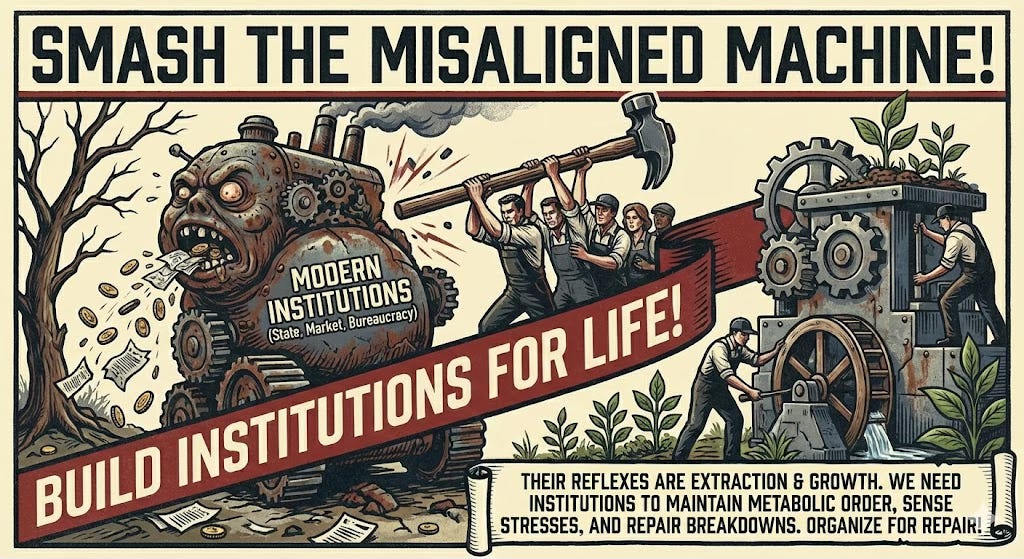
Once habitability and planetary flourishing become primary, politics and economics can no longer be thought of as decisions and struggles over distribution within a stable world. Whatever comes next, and whether we call it politics of economics or something else (my name for it is Bhumics, as you know), it will be contest over the constitution of the world, struggles over whether the world can remain livable, and over the design of the institutions that can keep it so.
That is the doorway into what I call metabology.
Why ideology is no longer enough
In the realm of ideology, politics is largely a matter of beliefs. An ideology offers a picture of the good society, an account of how power should be organized, and a moral vocabulary for identifying enemies and allies. It’s easy to convey the struggle in simple terms: the means of production should be socially owned; markets should be free; the nation must be secured; growth must be maximized; inequality must be corrected; tradition must be protected. From these maxims, we derive policy goals. We assemble coalitions. We win elections. We write plans.
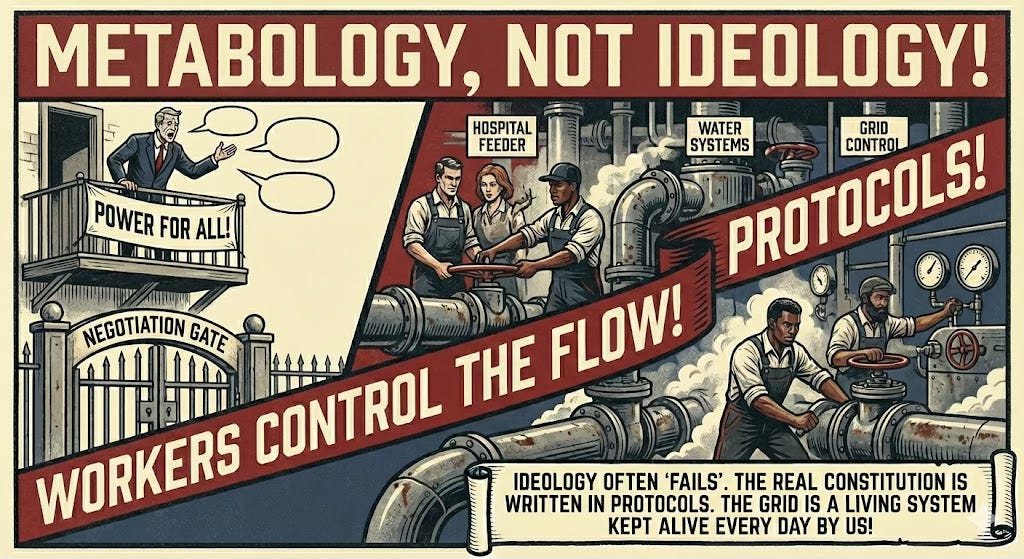
Consider a familiar example: a commitment to cheap, abundant electricity as a social good. From an ideological stance - say, a socialist one - electricity is necessary for dignity and participation, so the state should ensure universal access. A Planning Commission incorporates this into a national development program. Targets are set. Subsidies are announced. A new slogan enters public life: power for all.
And then the slogan meets the grid.
On paper, the ideology is coherent. But the grid is not a paper object. It is a system of generation capacity, fuel supply, transmission bottlenecks, transformer failures, billing cycles, theft, demand spikes, maintenance schedules, dispatch priorities, debt, and politics. It is a living system that must be kept alive every day. And every day, the system encounters scarcity and friction.
Who gets power when there isn’t enough? Not “the people” in general, but the feeder that has a hospital on it, or the feeder that serves an industrial client that pays on time, or the feeder whose local office has the right relationships. A subsidy exists on paper, but in practice it becomes a tariff category, a form, a meter type, a billing algorithm, a disconnection policy, a complaints queue. A promise of cheap electricity becomes a choreography of procurement rules, payment cycles, maintenance routines, emergency exemptions, and load-shedding rosters.
This is not a marginal detail. This is the point at which the real constitution of society shows itself - not the constitution written in founding documents, but the constitution written in procedures and protocols. That is why ideology so often feels like it “fails” in practice. It doesn’t fail because the ideas are necessarily wrong. It fails because ideas do not move matter. However, protocols do: unlike writing, computing is a technology that both points and pushes.
Metabology is a name for this middle realm.
It is the study, and the deliberate design, of how we mediate norms, values, supply chains, solar cycles, generative models and other nodes of modern life to organize reality itself, not just its representation on paper. The Planetary Age makes this shift from ideas to protocols unavoidable, because metabolic order itself is maintained or broken at precisely this level. A carbon budget is not a moral exhortation; it is a set of constraints that must be translated into permitting rules, grid upgrades, industrial standards, financing conditions, and enforcement capacities: even better if those rules and contracts are automated. A watershed is not a symbol; it is a physical system that must be protected through land-use rules, monitoring protocols, agricultural practices, and infrastructure maintenance. A heat wave is not an opinion; it is a physiological assault that requires cooling access, urban design, reliable electricity, and emergency planning. If we are serious about habitability, we have to become serious about protocols.
What metabology actually is
Energy must be generated and delivered. Water must be stored, purified, and routed. Food must be grown, transported, inspected, sold. Housing must be financed, permitted, built, maintained. Materials must be mined, refined, moved, and turned into things. Waste must be collected, processed, and absorbed without poisoning the world. Information must be recorded, processed, and acted upon to coordinate all of this. These are not just “sectors.” They are metabolic systems. They ingest resources, convert them through institutions, and distribute outputs that make life possible.
Every society has gates. Some are literal: a valve, a port, a pipeline, a checkpoint, a transformer. Some are administrative: a permit, a tender, a clearance, a subsidy rule, a compliance certificate. Some are computational: an eligibility score, a ranking model, a fraud flag, a dispatch algorithm, a platform’s default setting. At each gate, there’s a negotiation: budgets become allotments, rights become entitlements, files get held up or passed. There might be rules set from up above, but at each checkpoint, there’s a soldier who might let you through or shoot at you: we might as well start with the patterns on the ground and generalize from those, even if the global rules have high predictive value.
This is why metabology is not merely a synonym for “infrastructure policy.” It is a theory of governance at the level where the social meets the physical and increasingly, the biogeochemical. It treats infrastructure and institutions as one coupled system. It insists that the moral and the material are entangled, because moral commitments only become real when they are converted into stable procedures that can withstand bad days.
Who is served first when a system is stressed? What failure modes are tolerated? What is measured, and therefore optimized? What is invisible, and therefore neglected? What is automated, and therefore hardened into default? To think metabologically is to become attentive to the often-invisible machinery of collective life. It is to recognize that the most consequential political decisions are increasingly made not only in parliaments and courts, but in standards bodies, procurement contracts, logistics systems, software platforms, and grid control rooms. It is to understand that “policy” is not only a document; it is an executable sequence of operations.
If the Planetary Age requires the maintenance of metabolic order, we need institutions that can do three things reliably:
Sense: monitor vital flows and detect stress early (not only through scientific measurement, but through everyday feedback from those who live in the system).
Coordinate: align action across scales and sectors when a disturbance propagates (because in a coupled system, no agency can act alone).
Repair and reproduce: maintain the mundane capacities - maintenance crews, spare parts, governance routines, financial stability - that keep systems from decaying.
These are not glamorous functions. Urban governance is a good model - most of the fights are over waste collection, road laying and school bus routes. Urban governance is already metabolic! I am only adding a line of (admittedly vast) generalization: think of the planet itself as a city.
Once the planetary city takes root in our minds, we are immediately impressed with its fractal character: the city exists at all scales from the neighborhood to the planet as a whole. A neighborhood metabolic institution might look like a localized heat and water resilience organization: monitoring temperatures, ensuring cooling access, maintaining drainage, managing local waste, protecting a water body, coordinating emergency response. A city’s metabolic institution might integrate grid resilience, mobility, housing retrofits, air quality, and public health. A regional one might govern a watershed or an agricultural belt, aligning land use with ecological thresholds. A national one might coordinate industrial policy, energy transition, and critical supply chains. A planetary one might maintain carbon accounting, biodiversity protection, and the governance of shared commons like oceans and atmosphere.
The point is not to imagine one perfect institution that solves everything. The point is to name the missing layer: planetary institutions that treat habitability maintenance as their primary mission, and that can translate planetary constraints into operational reality without collapsing into either technocratic fantasy or ideological theater.
In Asimov’s Foundation series, the highest official in the (first) Foundation was the Mayor of Terminus.
Competing metabolic orders
Earlier forms of conflict aren’t going away; the post war ideological poles of geopolitics such as democracy vs authoritarianism, or the language of national interest such as security dilemmas and the balance of power, and the language of economics such as trade, investment and supply chains: these will disappear slowly, if ever, but the Planetary Age adds a contest at the stratum that lies beneath them: a contest over metabolic systems.
In a constrained world, power increasingly belongs to those who can secure and coordinate life-support flows: energy, food, water, materials, logistics, and now, crucially, computation. In the future, we will have competing visions of the institutional architectures for keeping systems running, different philosophies of coordination between state, market, and platform. We can see a glimpse of this future already, where China’s ability to build energy, information, transportation and manufacturing infrastructure at scale is both a matter of envy and fear. American teens are consuming Chinese metabology with relish, even as the ideology is far from attractive. I sense an emerging contrast between two large-scale metabolic orientations: a prediction metabology and a production metabology.
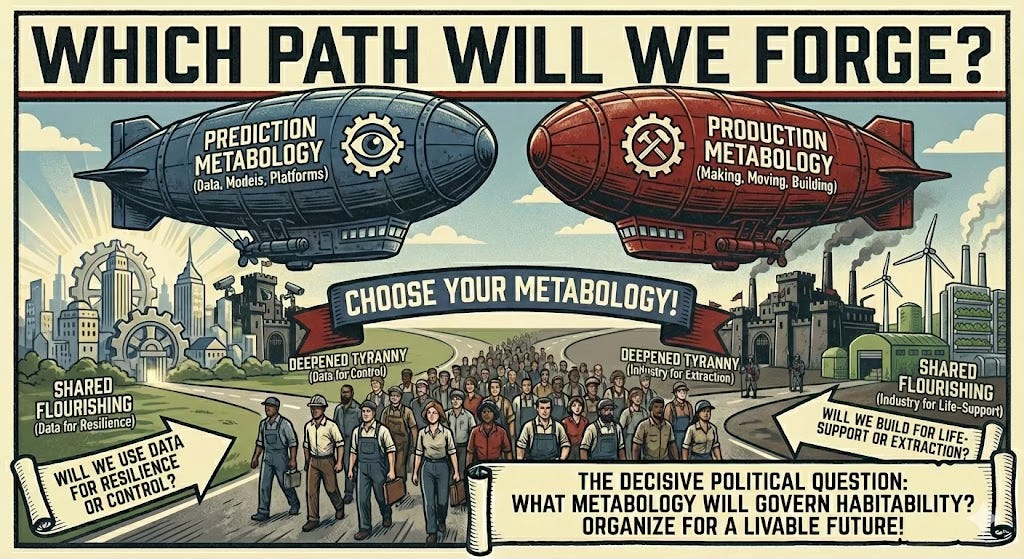
The prediction metabology - the US is the archetype - is centered on the capacity to sense, model, and steer complex systems through information. It treats data, compute, software platforms, financial networks, and standards regimes as the primary instruments of power. Its advantage is not only technological; it is organizational. It excels at building systems where prediction becomes a lever over behavior: advertising markets, credit scoring, risk pricing, logistics optimization, automated compliance, algorithmic governance. It builds a world in which uncertainty is turned into a tradable object and then managed through models.
The production metabology - China is the archetype - is centered on the capacity to make and move physical things at scale: industrial ecosystems, manufacturing capacity, infrastructure build-out, resource processing, and the logistics that connect them. It treats the control of supply chains, ports, industrial standards, and energy/material throughput as the primary instruments of power. Its advantage is also organizational. It excels at aligning state capacity, industrial policy, and manufacturing ecosystems to accomplish physical transformation quickly, often through long time-horizons and coordinated investment.
These are ideal types, not caricatures. Each system contains the other. A production metabology needs prediction to optimize and coordinate. A prediction metabology needs production to build the chips, the data centers, the grids, and the physical substrate of computation. But the emphasis matters. It shapes what gets built first, what is treated as strategic, and what kinds of institutions are cultivated. Maintaining metabolic order in a warming, volatile world requires both kinds of capacity: the ability to predict and coordinate across coupled systems, and the ability to build and repair physical infrastructure at speed. It also requires something even harder: the ability to cooperate on shared constraints while competing for advantage.
Carbon does not respect borders. Biodiversity loss cascades across regions. Supply chain shocks propagate through oceans. Climate disasters trigger migration, instability, and conflict. Yet the institutions capable of acting at planetary scale are weak, contested, and often captured by narrow interests. So the likely future is not a neat story of global unity, nor a neat story of total fragmentation. It is a messy, intermittent pattern: cooperation where metabolic interdependence is unavoidable, competition where metabolic advantage is at stake.
We can already anticipate what the arenas will be.
On the cooperative side: disaster response norms, pandemic surveillance, methane reduction, certain forms of grid interconnection, shared scientific monitoring, and possibly baseline agreements on carbon accounting. Not because of enlightenment, but because failure to cooperate will be too costly even for rivals. In a coupled system, some coordination becomes a matter of self-preservation. On the competitive side: control over critical minerals and processing, dominance over chip supply chains and advanced manufacturing, standards-setting for energy technologies, influence over infrastructure corridors, ownership of data and platforms, the governance of undersea cables and satellite networks, the terms of climate finance, and the emerging architectures of “green industrial policy.” Here metabolic order becomes strategic: whoever sets the protocols of transition shapes the distribution of future flourishing.
In such a world, the decisive political question becomes: what metabology will govern habitability? Will metabolic order be maintained through institutions oriented toward repair, resilience, and shared flourishing? Or will it be maintained through architectures that deepen inequality, externalize burdens, and treat large parts of the planet as sacrifice zones?
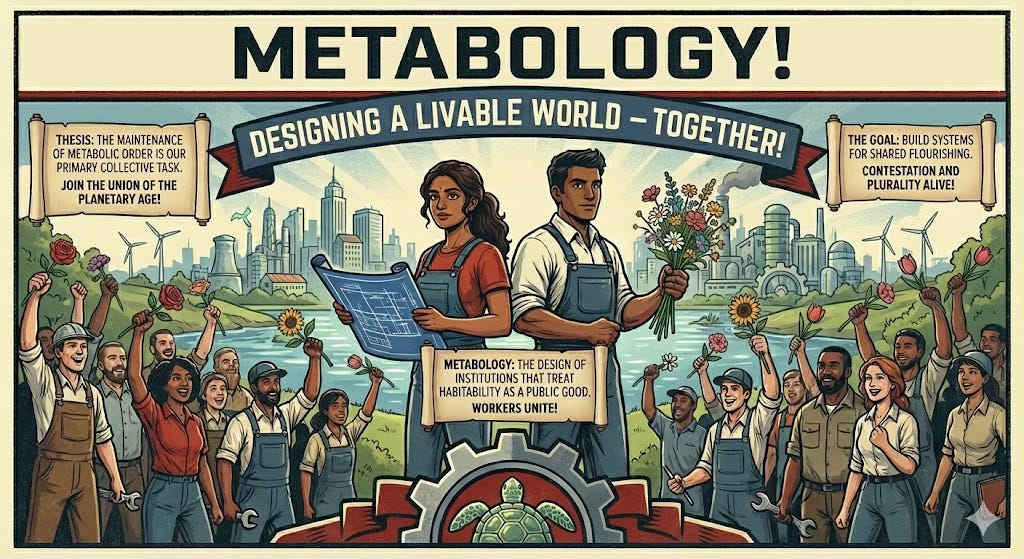
Even if we agree we are in a Planetary Age where metabolic order is primary, that metabolic order does not maintain itself. It is produced and reproduced through protocols, and protocols are housed in institutions. Metabology is how we approach the design of those institutions. It is a wager that we can learn to design institutions that treat habitability as a public good at every scale from the neighborhood to the planet. It’s a wager that we can build systems that keep the lights on and the water clean and the air breathable, while also keeping contestation, accountability, plurality alive. I foresee a not too distant future in which the deepest conflict is not between left and right, or between democracy and authoritarianism, or even between nations. It will be between competing metabologies: competing architectures for maintaining a livable world, and competing answers to the question of who gets to flourish inside it.
Parting Thoughts on Hyperproblems and Metabology as a Hyperproblem
And once you see that, it becomes obvious why metabology is not something you can “get right” with a clever essay, a good election, or even a well-funded five-year plan. It is not a position. It is not a platform. It is not a single reform. It is an attempt to redesign the operating conditions of collective life in a world whose basic background assumptions are now unstable.
Which is another way of saying: metabology belongs to the domain of the hyperproblem.
A hyperproblem is not just a hard problem. It is not even a wicked problem with better branding. Think of a hyperobject, but as a problem. It is a challenge that exceeds the cognitive bandwidth of any single individual and the coordination capacity of any single existing institution. It is large not only in size but in kind: it unfolds across long time horizons, spills across planetary spatial scales, and refuses to be reduced without losing the very thing you were trying to understand. Hyperproblems require models, prototypes, simulations - ways of exploring possibility space rather than merely arguing inside it.
Now notice what happens if you bring this back to metabology, which is a hyperproblem par excellence. Metabology began, in this essay, as a refusal to treat politics as a debate club. The core claim was that ideology is no longer enough because it cannot reliably cross the membrane between moral intention and material consequence. It produces slogans, and then the slogan meets the grid. What actually governs the world is the constitution written in procedures and protocols. Metabology names the study, and the deliberate design, of that executable layer, where the social meets the physical and, increasingly, the biogeochemical.
But this is precisely why metabology is itself a hyperproblem.
Think about what metabology is trying to do. It is trying to design institutions and protocols that can maintain metabolic order - stable, habitable flows - across a planet-sized city whose neighborhoods are watersheds, grids, supply chains, forests, ports, and data centers. It is trying to translate planetary constraints into operational reality without collapsing into technocratic fantasy or ideological theater. And it is trying to do this while keeping contestation, accountability, and plurality alive, while the systems themselves are stressed, politicized, and weaponized.
No single mind can hold this. No single institution can coordinate it. No single discipline can even describe it cleanly, because the object itself is a coupled system: energy linked to water, water linked to food, food linked to land use, land use linked to biodiversity, biodiversity linked to disease, disease linked to governance, governance linked to computation, computation linked back to energy. The whole point of metabology was that the moral and the material are entangled; that entanglement is also what makes the problem irreducible. You can partition it, yes, but you cannot solve the partitions “in isolation” without the solutions colliding downstream, sometimes violently.
And then there is time. Metabolic order is not something you install like software and forget. It is reproduced. Maintained. Repaired. It is a daily choreography of sensing, coordination, and care - mundane capacities that make the difference between resilience and collapse. Even if you “solve” a local protocol today, a new heat regime, a new migration pattern, a new geopolitical sanction, or a new platform default will change the boundary conditions tomorrow. Metabology is not a problem with an endpoint. It is a form of inquiry that must persist across generations, across civilizations, across -cenes (holocene, anthropocene…). It’s governance with the longue duree in mind, a method for civilizational self-governance under planetary constraints.
If that sounds like an impossible task, good. Hyperproblems are supposed to sound impossible. The point is not to make them smaller than they are. The point is to build protocols that allow finite beings to act intelligently inside the impossible.