Preface
I first wrote about planetarity in early 2018, now almost eight years ago. Even then, I knew that the planet is a lot greater than climate. Climate is only one of three key attributes of planetarity, the C in its ABC. Since then, my belief that we need a planetary politics not just climate politics has only grown and grown and grown, but I didn’t have much reason to act upon that belief. Not until recently.
Planetarity: the ABCs of our planetary future

TL;DR: Planetarity == Solidarity with all beings on this planet. If that piques your interest, read on….
Back then, climate politics felt like the train with the greatest momentum in late 2018 when the squad was elected and the Green New Deal was in the air. Every Democratic politician since then has had to have a public stance on climate action. I invested a lot of my time working towards the possibility of a GND in India, and that journey continues, but in late 2024 when Trump was elected, I came to the conclusion that climate politics is never going to happen. Certainly not at a global scale, but likely not at all.
The failure of climate action is also the failure of the liberal order more generally. It might still be rescued; maybe a Democrat will come to power in 2028 and we will all pretend as if Trump never happened, but I don’t think so. Whoever comes to power in DC in 2028 is going to face a brave new world.
The interregnum.
Bhumics, Part 1

We live in a world in the midst of profound transition. The end of history’s faith in liberal democracy has crumbled, replaced by an illiberal global capitalism, sinking “liberalism as culture” alongside “liberalism as power.” With the collapse of the liberal Leviathan, a new possibility emerges:
While the failure of climate action at a global level is tragic (it does make me think that climate change is inherently American as a sociotechnical formation, but that’s an argument for a different day), it’s also given us an opening for a much more expanded politics. The interregnum throws up monsters, but maybe, like Pandora’s box, there is hope at the bottom.
That hope for me is Bhumics - a way of embracing all of life in a new imagination of our collective future. I’ve been writing about Bhumics regularly for the last 10 months and today I am ready to take it up a notch.
I want to share my imagination of the future at the planetary scale. I am calling it Philosophical Engineering, but it could have easily been called Philosophical Architecture or Philosophical Gardening. Don’t worry about the name so much.
This is a first draft of ideas that I have just about beginning to congeal into a coherent framework - you may not even see as being connected with each other! - that I will be expanding upon diligently over the coming weeks and months. I will be posting twice a week just to put out the material that I have on hand. The Weekly Planets will continue as usual, but there will be an additional post on Thursdays (like this one) until I am done dumping my head on the page. Let’s start that journey with a provocation:
Planetarity as Philosophical Engineering
Philosophy, said Hegel, is its time apprehended in thought. Marx added that the point is not only to interpret the world but to change it. Today, the world has changed beyond what either could imagine. The question now is: what kind of thinking can help us make the planet we are already remaking? Not in our image, but for the flourishing of all beings.
The Task Ahead
For centuries, philosophers have sought to understand the human condition. Now the condition itself has widened. Our actions shape the chemistry of the atmosphere, the course of rivers, the metabolism of forests. We live not just in societies but in a world of feedback loops that link the human and the planetary.
The maps we draw in science, in politics, in design, help shape the terrain they describe. Our algorithms shape our attention; our models alter the climate policies they aim to explain. In this world of entanglement, the boundary between knowing and making dissolves. To paraphrase a famous line of Kant:
Knowing without making is sterile; making without knowing is fatal
Philosophy can no longer be content with reflection alone. It must become a practice of composition — philosophical engineering that builds concepts, institutions, and tools that make the planet livable for all. To think planetarily is not to dream of escape into abstraction, but to craft ways of staying with the world we have made.
Earth and Globe
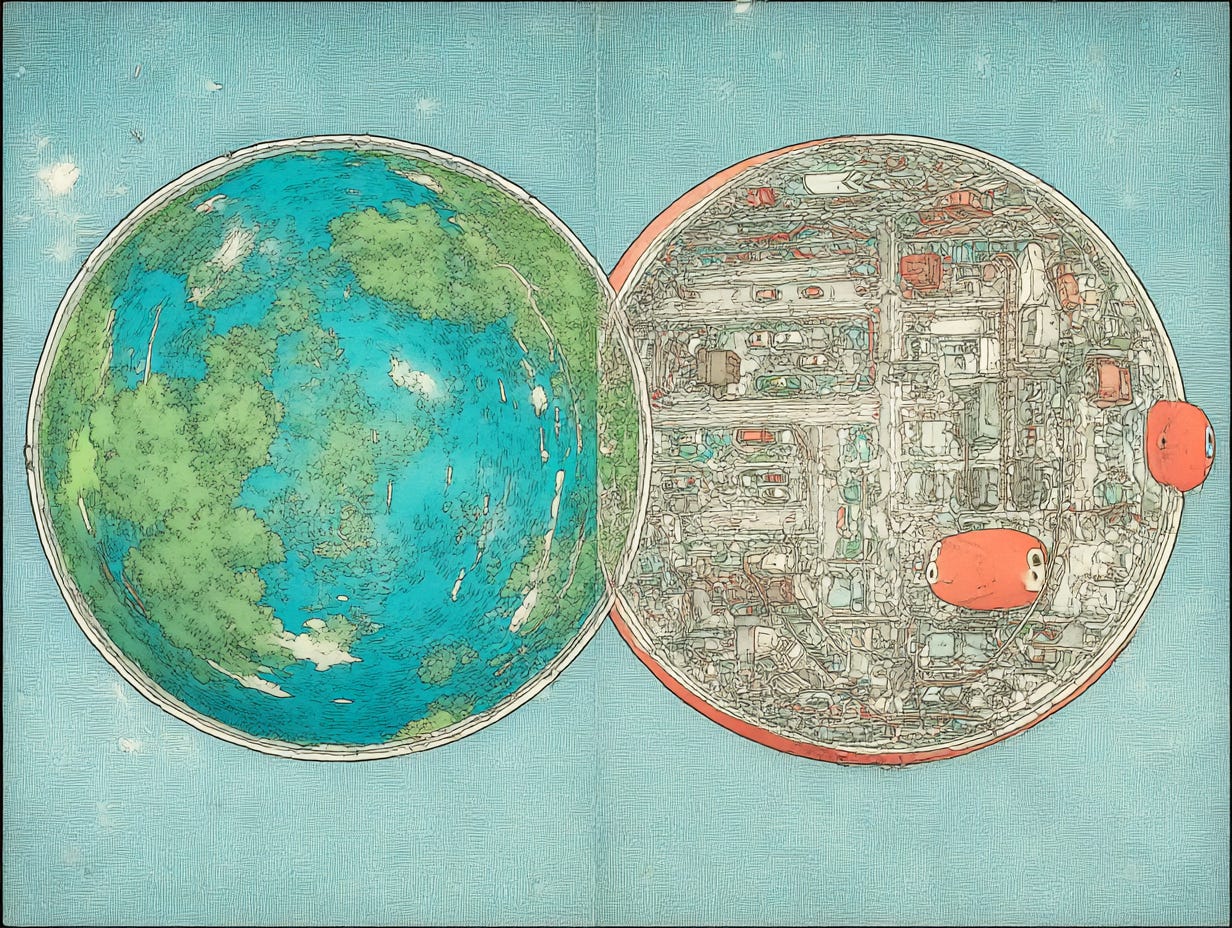
The Planet is an extension of nature as well as society, or to use another duality: the Planet is the Earth — the physical, chemical, biological system that science measures and describes and the Globe — the human and more than human world of trade, culture, law, and technology.
For most of history these seemed separate. The Earth was nature: vast, bountiful, indifferent, beyond our control. The Globe was civilization: the stage of human ambition and conflict. But in our time these two spheres have fused. The atmosphere carries the signatures of our industries; the oceans reek of acid exhaust.
To think of them together is to glimpse the planet — not just as a place, but as a dynamic field of interaction where human and nonhuman systems constantly remake each other. Planetarity means seeing the Earth not as background, nor as resource, but as a leading actor in every story we tell. Remember the in- in inhabit!
What we are seeing now with metabolic competition is the Globe acknowledging the Earth, but also trying to control it.
Terraforma
Science fiction once imagined “terraforming” as a way of reshaping distant planets to make them habitable. But we have already done that here, unwittingly. Every dam and data center, every field of wheat and ton of carbon, alters the texture of the biosphere. Whether we acknowledge it or not, we are terraformers.
The question is whether we can become good ones. Good for whom?
To terraform well means to design planetary systems — economic, ecological, legal, and technical — so that they support life rather than deplete it. It means recognizing that our infrastructures are moral architectures, encoding values about who and what will flourish. The task of philosophical engineering is to make those architectures just, reciprocal, and durable. For all beings.
The Age of Cyborg Science
The sciences that reveal the planet to us — climate modeling, satellite sensing, data analysis — also transform it. Observation has become a form of intervention.
To study the atmosphere, we launch constellations of machines that orbit above it. To model ecosystems, we build computers that consume the energy of small cities. Our sciences are no longer separate from our technologies; they are part of the same planetary machinery. The technosphere (about which more in a minute) has to be integrated into the geosphere.
This is cyborg science: the blending of human, living, and machinic intelligence into a single fabric of planetary self-perception. We cannot separate knowledge from power, model from policy, algorithm from effect. We have to ensure that the architectures of knowing serve the architectures of life so that our technologies of insight become technologies of care.
The Anatomy of Planetarity

To make sense of something as large as the planet, we need anatomy - think of anatomy as the engineering analog of ontology. Some years ago, Wilfrid Sellars gave an influential definition of philosophy:
how things in the broadest possible sense of the term hang together in the broadest possible sense of the term
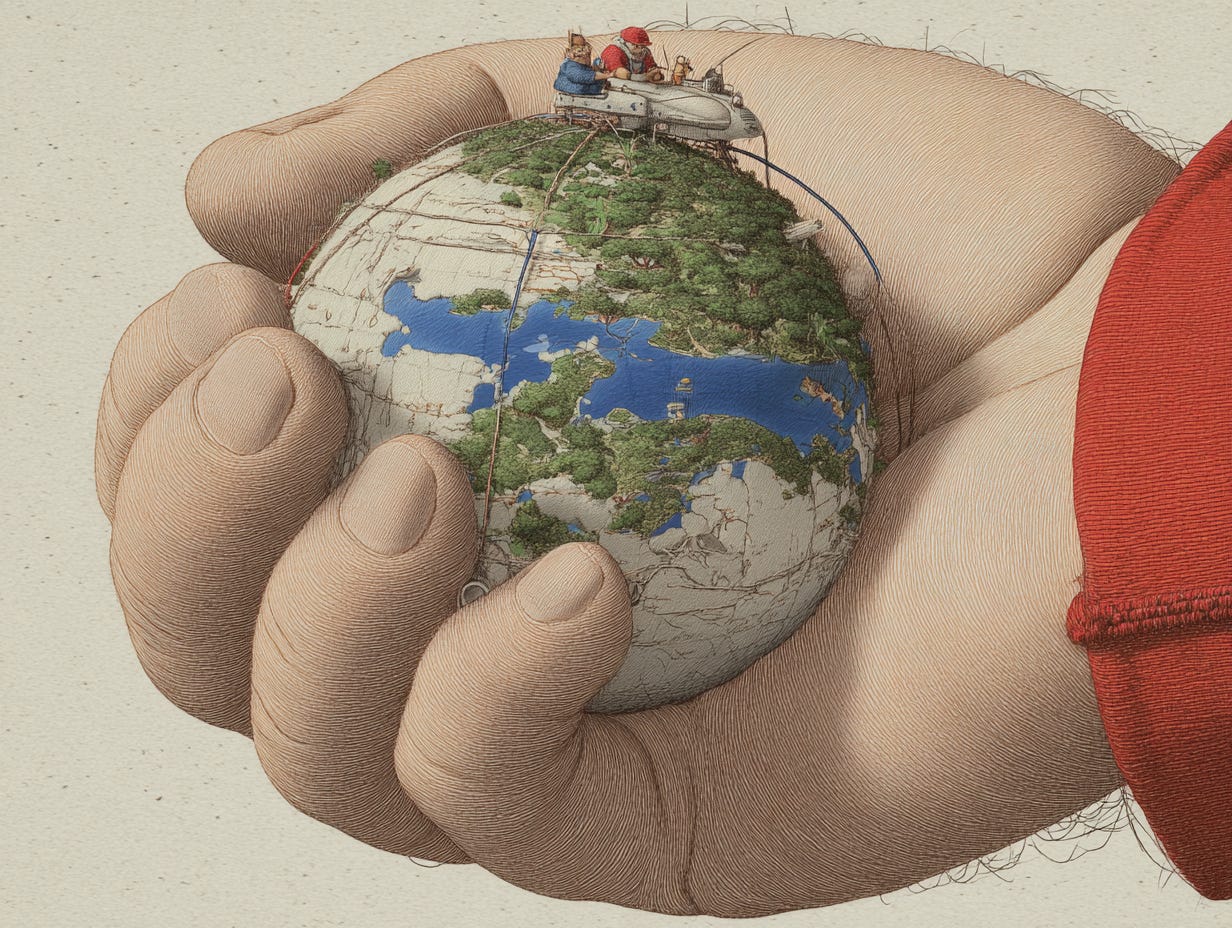
The task of philosophical engineering is to make the planet hang together in the broadest possible sense of that term; and for that purpose, we need to understand its anatomy. Today, I imagine planetary anatomy as a hand with five interlocking fingers: Metabolics, Expanse, Multitude, Technosphere, and Mahayanics.
Metabolics concerns the flows of energy and information that sustain life. The biosphere runs on sunlight and DNA; our civilization runs on fossil fuels and computation. The crisis of our age is a metabolic mismatch — the burning of ancient sunlight and the harvesting of human attention in ways that destabilize every living system. To repair this metabolism, we must align human energy and information flows with those of the biosphere — to build systems that regenerate rather than extract.
I have been talking about Metabolics in the Weekly Planet for the last month or so.
Expanse (aside: my favorite SF show ever) refers to the vast scales of time and space that not only exceed human perception, they exceed our tools of meaning making as well. The Earth is 4.5 billion years old; its processes move in rhythms too slow and long for human politics. Climate change and extinction are what the philosopher Timothy Morton calls “hyperobjects” — phenomena so massive and distributed that they warp our sense of cause and effect. To engineer the expanse is to cultivate patience: institutions, habits, and models that make deep time visible and operative.
Multitude reminds us that the planet is not a single world but many, each inhabited by its own species, its own senses and meanings. Every creature lives in what biologists call an Umwelt — a bubble of perception and significance. Forests, fungi, whales, bacteria — each weaves its own thread in the planetary fabric. To honor the multitude is to extend justice beyond the human, to design institutions that give nonhuman life a seat at the table: the rights of rivers, the guardianship of forests, the voice of the more-than-human.
Sometimes I use the term “Multispecies” instead, but I will stick to “Multitude” in this series, because the multitude also references the different ways in which the planet is sensed: not just vision which is the dominant sense for us, but also other senses such as touch and smell, and senses that humans don’t possess such as magnetic senses and ultraviolet senses.The worlds of other species differ from ours qualitatively as well as quantitatively. They are the multitude.
Technosphere names the vast infrastructure humans have built — cables, roads, grids, data centers, satellites. This too is now planetary, with its own metabolism and inertia. It shapes weather, perception, and power. The technosphere is no longer an appendage; it is a limb of the Earth. The challenge is to make it accountable to the rest of the planet - to treat its protocols and codes as the new constitutional documents of the Earth.
And finally, Mahayanics - the thumb that gives the planetary hand its grasp.
In Mahayana Buddhism, the Bodhisattva vows not to achieve enlightenment until all beings do so together. Mahayanics is a translation of that vow: the commitment to design for the flourishing of all beings, human and otherwise. To be Mahayanic is to see that one’s own thriving depends on the thriving of others - of oceans, microbes, forests, algorithms, and future generations. It is compassion operationalized: a moral logic written into our systems. A Mahayanic economy values regeneration over profit; a Mahayanic technologist codes as if empathy were a feature, not a bug. The only enlightenment worth striving for is shared.
I will be writing about these five fingers extensively over the next few months. Now for some speculative engineering
Learning to Think in Deep Time
Re: The Expanse - of all the dimensions of planetarity, deep time may be the hardest to grasp in the way Hegel grasped history. Human institutions are short-sighted: elections, markets, and news cycles compress attention into months. The Earth, by contrast, moves in millennia.
The Expanse is long and our lives are short.
To bridge that gap, we need new instruments of patience — temporal impact assessments that ask not only what a project emits, but how long its effects will last; long-term trusts for nuclear waste and ecological restoration; civic rituals that honor planetary cycles. To design for time is to align our governance with the rhythms of the world that sustains us.
I have this vague idea that I will start with Bergson’s idea of time, what he called ‘la duree,’ but then adapt it for the very longue duree.
A New Kind of Knowing
Every philosophy imagines a knower. The Enlightenment imagined a solitary rational subject gazing at a passive world. That image no longer holds. The planetary knower is plural - part human, part machine, part fungus and part mountain.
Hopefully, the technosphere will help us expand our solidarity with other knowing beings. That would be a much better use of AI than what we have today.
Satellites see in wavelengths our eyes can’t, but maybe they can beam warnings to bacteria who can? Algorithms process patterns too vast for thought - hyperdata for hyperobjects. Maybe ASI will digest these stores of data and present them to us in understandable nuggets. Indigenous cosmologies read rivers as living archives of memory. The philosophical engineer must learn to think with all these intelligences - to act as an interpreter and bridge among them.
Protocols can replace theories.
Protocols as Philosophy
If ideas once lived in books, today they live in code, contracts, and protocols. The rules that govern data, energy, and finance shape our shared reality more deeply than most political declarations. To design a protocol, then, is to write philosophy in executable form. A carbon tariff, a blockchain standard, an environmental treaty — each is a moral proposition with material consequences. Can we design these systems with reciprocity, transparency, and care?
Planetary design principles might begin with five:
Reciprocity by default: give back to everything that gives.
Presence of consequences: decisions are made in the sight of those affected.
Polycentric subsidiarity: coordinate globally only what must be global. ps: the Globe is suspect, though not for the reasons xenophobes think it so.
Multiscalar transparency: ensure every system can be read from soil to sky. Read by whom though?
Accountability of infrastructure: treat code and standards as public constitutions.
These are the building blocks of a livable planet.
The Work Already Underway
Philosophical engineering is already happening, often quietly, under other names.
When a river gains legal personhood, law evolves toward ecology.
When farmers practice regenerative agriculture, they restore planetary metabolism.
When architects design for pollinators and microbes, they expand the circle of citizens.
When writers imagine solarpunk futures, they prototype new myths of belonging.
These experiments are mostly isolated. Together they form the murmurings of a planetary constitution: distributed, revisable, and oriented toward flourishing. Our job as planetary engineers is to connect the murmurs so everyone can hear their symphony.