The Contradiction
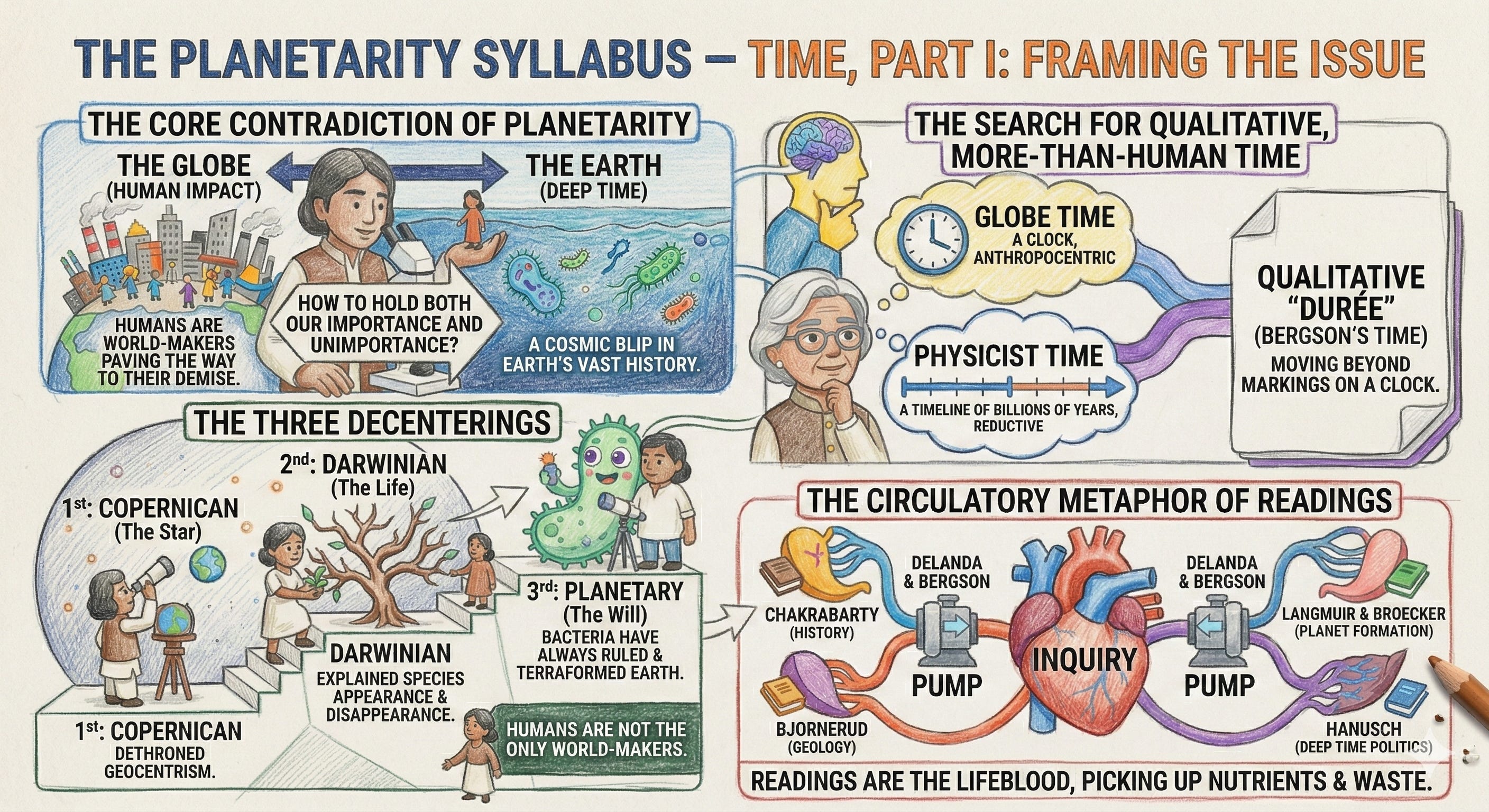
The contradiction at the heart of planetarity is the following. On the one hand, the human impact on the biosphere increases by the day, so that our exhaust threatens to warm the Earth to the hottest it’s been in millions of years, and most land mammals are either human beings or animals that we rear for food or other purposes.
There’s no teleology to this ongoing assault on the Earth, but a small part of our technosphere has specialized in the study of the Earth’s processes; the instruments we have invented to capture and kill have been repurposed to study our planetary condition. That study reveals an Earth much older and much vaster than anything humans can control; our presence is a blip in a very long history of several billion years.


One day, we too shall pass.
The more we make humans great again, the more we find out we were never great to begin with. Our arrogant present opens up a vista of deep time and space which we can only gape at in awe. We shouldn’t deny our importance, for without that we will never take responsibility for what we have done; but we should also acknowledge our unimportance in the planetary scheme.
How can we hold both values at once?
Both this month and the next month, through our exploration of time first and space second, is about exploring how exactly the condition of planetarity demands a revision of our self-conception as world-makers in a zoo of other world-makers.
The Third Decentering
But first, let me clear a potential misconception: human self-importance isn’t new and the decentering of the human isn’t new either. Ever since Copernicus, Galileo, Kepler and others dethroned geocentrism, we have increasingly come to know that we are just one creature on a planet which is an ordinary planet revolving around an ordinary star in a galaxy which is just one of hundreds of billions of galaxies. We are a minuscule fraction of the universe and our embedding in the deep time and space of the planet is, on the face of it, smaller than our embedding in the universe.
That’s one way to think about planetarity, but it’s not the right way IMHO. Darwin’s decentering of humanity was different from Copernicus’; both in their metaphysical significance and in the specific scientific inquiry that achieved the decentering. Evolutionary biology is historical and its fundamental question is: what is the process that explains biological diversity as well as the disappearance of some species and the appearance of others? In contrast, celestial mechanics is ahistorical and inquires into the unchanging laws that dictate celestial motion.
What we are at the cusp of today is yet another decentering, that takes aim at the world-making powers of humanity: if we think we can bend the Earth to our will, well we are not the first to do so, and we are not the last. The Earth was formed out of processes much bigger than anything humans can control, and the terraforming of the Earth by microorganisms - literally the air we breathe - is much more important than the carbon we are putting into the atmosphere. Bacteria have always ruled the Earth.
We may be world-makers, but we aren’t the only ones or even the most important. That’s the essence of the planetarity revolution. Isn’t this well known? We know how stars are formed. We know how planets are formed. We don’t know how life first arose, but we do know how early life created the conditions for bags of meat like us to survive and thrive. Is that it? Has the revolution already happened and we are just getting the news? I don’t have a good answer to these questions, though I am inclined to assert that the revolution has started but it’s far from complete.
But as a physicist friend of mine once asked me: it works in practice, but does it work in theory? Or put another way, what does the condition of planetarity mean and how do we think philosophically from within that condition?
My 2c: The contradiction at the beginning of this essay is central to planetary philosophy
PS: “Contradiction” here isn’t a logical paradox, but in the way Marx uses the word, i.e., a system whose activity paves the way to its demise, i.e., an instability built into the workings of the system.

This Month’s Readings
I will be exploring that contradiction in both its temporal and its spatial avatars, with time being the focus of this month’s essays and space the next. My strategy in both months is to juxtapose readings that represent the two sides of the contradiction, i.e., one reading representing the Globe (the human dominated Planet) and the other reading representing the Earth (the Planet beyond the human), but to use a third, philosophical text (or texts) as a connector. The three main readings for this month are:
The Climate of History - Dipesh Chakrabarty
Timefulness - Marcia Bjornerud.
A Thousand Years of Nonlinear History - Manuel DeLanda
The first two are books of history and geology respectively, but DeLanda’s book is a work of philosophy; he attempts to digest the nonequilibrium physics and complexity theory that I called the second systems theory paradigm and turn those into philosophy. Did he succeed? I am not sure, but it comes closest to a cybernetic philosophy of time, an account whose shoulders we should stand upon. There are several other books that I would like to cover, but will have to be content to merely sample from:
How to Build a Habitable Planet - Charles Langmuir and Wally Broecker
Duration and Simultaneity - Henri Bergson.
The Politics of Deep Time - Frederic Hanusch.
I am resigned to barely scratching the surface of the “thinking of deep time” and the instruments and institutions we need to do as a society, but that also frees me to pick and choose the passages from these readings that sharpen my thinking (and hopefully yours!) on Time or Space or any other topic.The Planetarity syllabus isn’t objective in that sense, i.e., the most reputable or highly cited readings on these topics, but the books and papers that evoke and augment our collective wisdom on the condition of Planetarity.
Quick note to say that “habitability” intensifies the contradiction between the Globe and the Earth - it brings climate change, deep time governance, multispecies justice and astrobiology into sharp conversation with one another. Human societies have always worried about political order and what happens when it collapses, whether that’s the ‘state of nature’ or ‘great chaos under heaven,’ but habitability is one level deeper - it’s the maintenance of metabolic order, and the governance of earth systems for that purpose. The deepest worry is not death or collapse but extinction. I will cover habitability once I am done with Time and Space, i.e., in two months.
That explains the inclusion of Langmuir & Broecker and Hanusch in this crowd, but why Bergson? His book is over a hundred years old, while the others are contemporary volumes, but Bergson’s idea of time, the “Duree,” is important for our project. Why?
Because the condition of planetarity is qualitative, not quantitative, and yet that condition is a more-than-human condition; it envelops every creature that inhabits the planet with us, and not just that, it has enveloped every creature that has ever existed. There’s no phenomenology to these primordial worlds; their ‘what is it like’ is inaccessible to us, but maybe AI can help translate their worlds into ours one day. Today is not that day. We cannot reduce bacterial worlds to human modes of existence, and yet they are worlds, not markings on a clock or a scale. The distinction between primary and secondary qualities has to be set aside. What are the qualia of planetarity?
Is there a qualitatively rich conception of time that transcends the human?
Not yet, as far as I can tell, but Bergson is a good place to start if we want to learn how to integrate the Globe and the Earth in time. Our conception of the Globe is anthropocentric but qualitatively rich, whether humans are seen as the chosen species of God or the being (Dasein) for whom Being is an issue. The analysis of time as it relates to Being reveals a rich anthropocentric conception of time.
The physicist’s conception of time is reductive in contrast, but has the advantage of turning the clock all the way back to the origin of the universe. Speculative realists and new materialists such as DeLanda have tried to release us from Dasein’s prison while retaining the richness of Daseinic analysis. I was of half a mind to choose Quentin Meillasoux’s “After Finitude“ as the philosophical interlocutor, and I might still include some of his ideas, but DeLanda’s evocation of nonequilibrium thermodynamics and Bergson’s positive conception of time as “duree” strike me as more obviously about time than Meillasoux and a richer engagement with the natural sciences of their times.
Almost every non-modern tradition and culture conceives of the Earth and its creatures as having meaning and purpose; it’s not a standing reserve for our needs. Saying “we are entangled in the planet’s biogeochemical systems” isn’t enough, if it’s merely an entanglement of things - the starting point has to be our entanglement as beings in a community of other beings. At the same time, we can’t be fanciful or descend into superstition - astrology and crystals are not the path forward. So let me repeat my question:
Is there a qualitatively rich conception of time that transcends the human?
The challenge of grasping more-than-human time and space will be not solved in two months; I will be happy if I can surface questions that I can carry over to the rest of this syllabus. We are at the beginning of a long journey and we will lose some guides along the way and pick up others. Theory has a visual bias, of seeing the truth from a distance. In projects such as these, I prefer a circulatory metaphor - of theory as the lifeblood of inquiry, picking up nutrients and waste throughout the body and delivering them to places that can do something with it. Leaning on that metaphor some more: DeLanda and Bergson are pumps that push us along the pipe, while Chakrabarty, Bjornerud, Langmuir & Broecker and Hanusch are organs that supply essential nutrients.