Workshop
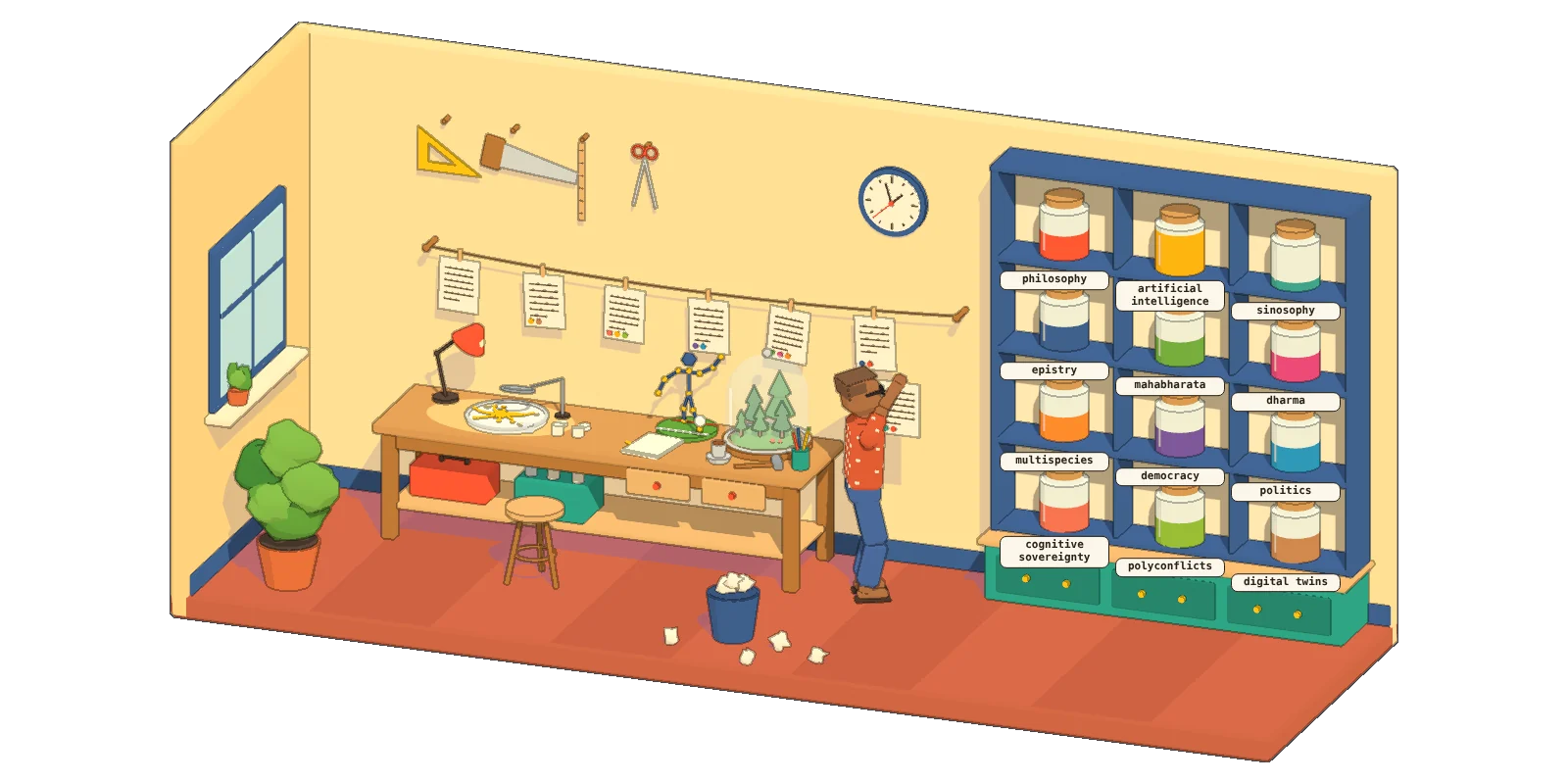
Notes from the bench: asides, half-thoughts, and lines from my essays that are still on my mind. The tags show what I keep coming back to.
But there’s also an alternative approach to philosophy, which makes it look more like art or poetry. It’s philosophy channeled as a mood or as an atmosphere. And in the last couple of hundred years, that is the way moderners have often experienced non-Western philosophy. When we encounter Oriental philosophy - and I’m using that pejorative term deliberately - we typically encounter it in spiritualist terms, as a way of life, and not a specific theory of how the world hangs together.
From Sinosophy
In this new adventure of abstraction, we aren’t abstracting away from the world, but rather, abstracting into the world. That is how philosophy becomes executable.
But the drama is more than human isn’t it? It contains a full entourage of living creatures, both mortal and immortal. As I wandered through this vast, hypertextual landscape of stories within stories, I realised that much of it was also shaped by the profound, often violent encounter between humanity and the non-human world. After all, the epic is recited at its beginning, on the occasion of a snake sacrifice (the Sarpasatra), which is stopped before it causes extinction. To understand dharma, the central, elusive obsession of the epic, we have to look beyond the battlefield of Kurukshetra. We have to look at the forests, the animals, the rivers, the gods, and the unstoppable force of Time.
Flawed as they might be, to construct a nation on a conceptual clean slate is the most revolutionary act imaginable. It is also inherently paradoxical. It is an act of breathtaking violence, because to declare a clean slate is to forcefully erase the histories, peoples, and civilizations that came before. Yet, simultaneously, it carries transcendent promise. By severing nationhood from bloodline, the Declaration created an ideological framework of universal equality that had never been institutionalized at such a scale.
From The US at 250
Cognitive sovereignty is not isolationism. A society that refuses all external ideas, all foreign tools, all imported knowledge is merely isolated. Cognitive sovereignty is the capacity to refuse a cognitive dependency when that dependency becomes coercive. A society that borrows a tool and can put it down retains its cognitive sovereignty. A society that has organized its hospitals, its courts, and its civic administration around tools it does not control, and cannot put down without catastrophic cost, has lost cognitive sovereignty.
A faithful digital representation of the event has become part of what we think the event itself is. If a human referee sees a goal but the algorithm reconstructs a 3D wireframe showing the striker’s shoulder three millimeters offside, the reconstruction wins. The digital twin becomes the undisputed ground truth.
Cells are not passive bags of chemistry. A single cell senses, evaluates, repairs, remembers, moves, metabolizes, and survives in a turbulent world. A bacterium compares past and present chemical conditions as it swims toward food. A slime mold solves mazes without a nervous system. A ciliate, faced with irritation, tries one response, then another, as if working through a tiny behavioral repertoire.