The Planetary Syllabus. Time, Part IV: The Planetary Durée and The Book of the World
Timefulness, Governance, and the Melody of the Earth

Reading the Book of the World
Galileo was my first scientific hero. I read about him in the How and Why book on Famous Scientists and fell in love. Thumbing your nose at the Church - muttering “and yet it moves“ while being shown instruments of torture - is based isn’t it? It took me many more years to learn that Galileo’s troubles were multiplied by his being an arrogant asshole; he was the Pope’s confidant until his attitude caused him to lose favor. But even that is really a lack of obsequiousness towards power - even more based!
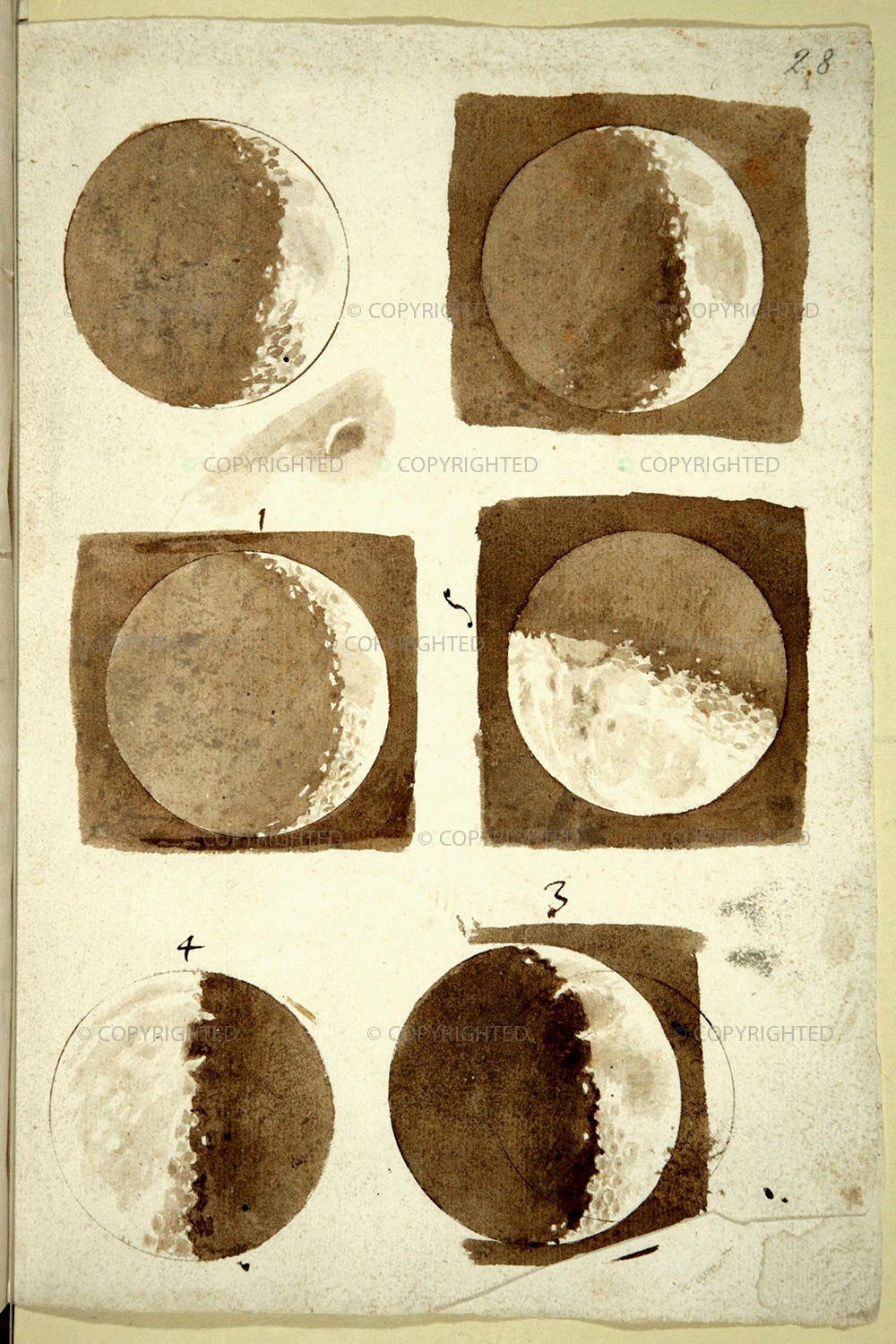
It took even longer for me to realize Galileo was much more of a humanistic scholar than a scientist in the way we understand the profession today. He wasn’t the best mathematician or technologist of his time - not even the best mathematical technician in Pisa or Padua, though clearly the best mathematical innovator - but he was an excellent storyteller. His drawings of the phases of the Moon are narrative masterpieces, for they show a heavenly object that isn’t perfect just through the act of close observation. Alongside the Copernican overturning of geocentrism, Galileo and Kepler’s overturning of the perfection of the heavens (elliptical orbits for planets, imperfections on the moon) is a major shift away from the earlier orthodoxy.
Of course, that perfection returned with a vengeance in physics, where physicists spend a lot of their time seeking perfect symmetry.
Galileo’s books - Dialogues Concerning the Two World Systems, Two New Sciences etc - are masterpieces of non-fiction writing, a lot more like Darwin’s Origin of Species than the mathematized physics of today. And in the Assayer, he gave us one of the great metaphors of modernity:
Philosophy is written in this grand book -- I mean the universe -- which stands continually open to our gaze, but it cannot be understood unless one first learns to comprehend the language and interpret the characters in which it is written. It is written in the language of mathematics, and its characters are triangles, circles, and other geometrical figures, without which it is humanly impossible to understand a single word of it; without these, one is wandering around in a dark labyrinth.
Remember, he’s writing this paragraph for a printed book about 150 years after Gutenberg invented the printing press. The Book is the book of the universe! It’s the technology - as much as the telescope - that reveals the physical universe for what it is.
But what about the world? Galileo was a central figure in stripping the world of its qualitative richness (the secondary qualities) and replacing those with primary qualities. Can we recover what he made us forget?
These thoughts came to me as I read Bjornerud:
geology demanded a type of whole- brain thinking I hadn’t encountered before. It creatively appropriated ideas from physics and chemistry for the investigation of unruly volcanoes and oceans and ice sheets. It applied scholarly habits one associates with the study of literature and the arts— the practice of close reading, sensitivity to allusion and analogy, capacity for spatial visualization— to the examination of rocks.
Geology is not the domain of perfect symmetry, but a mixture of laws and accidents. How do we read that mixture? A major problem for planetary sapience is that we don’t have a technological artifact comparable to a book that condenses our understanding of the earth into a thing we can hold in our hands while also opening up access to the Planetary Duree. We can multiply sensors, satellites and large planet models but we still won’t have the field of meaning we are looking for. IMHO. To say the computer is that artifact - or even the smartphone - is only partly right.
Inventing a humanistic - no, a more-than-humanistic - artifact that helps us capture the qualitative richness of planetary history is going to be key to a new culture of planetarity, a literature appropriate to the condition of planetarity.
Keep these thoughts in mind as we conclude our discussion of time in the form of the Planetary Durée.
Introduction: Overcoming the Spatial Fallacy of History
In the first essay on Time, I introduced the main temporal contradiction underlying the condition of planetarity - the contradiction between the time of human history and the time of planetary history. On the one hand, we are a dominant geophysical force, fixing more nitrogen and moving more ammonia than anything else; on the other hand, the part of our technosphere (itself a small part of the human world) specialized in the study of the Earth’s processes reveals an Earth much older and much vaster than anything humans can control. Our presence is a footnote in a very long history of several billion years. There will be a day when humans no longer exist - and we might be bringing that day closer through everything we do.
The more we try to “Make Humans Great Again” (MHGA), the more we find out we were never great to begin with. There are lessons to be learned though: our current dominant position should give us a sense of responsibility and care, and our unimportance in the larger scheme should give us humility, but those are not the lessons we are learning right now. According to Marcia Bjornerud, our time-ignorance is one of the causes of our predicament - neither do we know how to be good inheritors, nor do we know how to be good ancestors. Which prompted me to ask the following question:
Is there a qualitatively rich conception of time that transcends the human?
To answer this, we have to look closely at how we naturally conceptualize time, and how that conceptualization is failing us. For Henri Bergson, to understand time is to stop turning it into space and start experiencing it more like a musical composition. We typically commit a “spatial fallacy” by imagining time as a line of discrete points - seconds, minutes, or hours - strung together like beads. This version of time, which Bergson calls “spatialized time,” is a useful tool for physics, scheduling, and quarterly earnings reports, but it is a corpse of the actual experience. It treats the past as a place we have left and the future as a place we are going, reducing the fluid, qualitative movement of life to a series of static snapshots.
While reading this, it struck me that the planet captured in spatialized time is nothing but the Globe, whose proceedings are measured in election cycles and fiscal years, a scheme that’s fundamentally incompatible with the deep, living history of the Earth. Instead, clock time continues to treat the Earth as a passive standing reserve subordinated to our technological mastery.
Not so for the Planetary Durée. The Earth is not a dead rock ticking away on an astronomical timeline; it is a living duration. And human consciousness is not an alien observer of this duration, but rather a fast-moving, highly conscious coagulation of the planet’s own ongoing duration.
The Polytemporal Tapestry
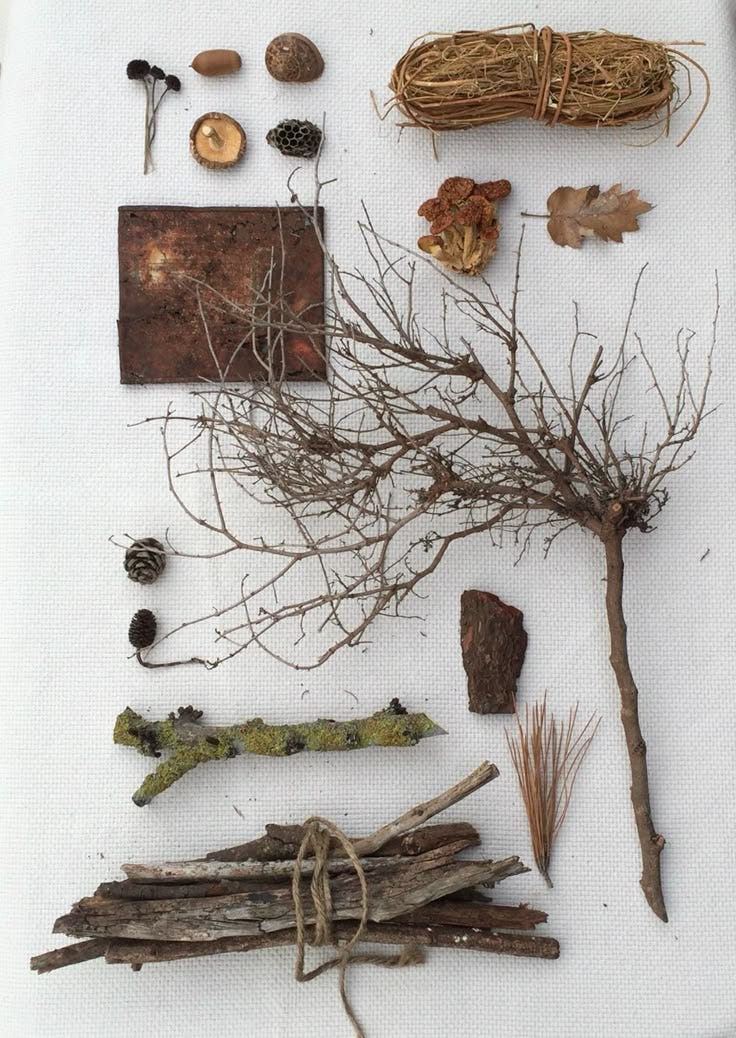
If we accept the Planetary Durée, we must stop looking at the planetary past as a graveyard of dead epochs and recognize it as a lived presence. The past courses through our veins - literally - and is visible in our geology, our atmosphere, and our DNA. To map this out, we can look to Manuel DeLanda, who argues that history across temporal scales is about the coexistence of material flows operating at different speeds. In his view, reality consists of coexisting structures defined by their speed of flow: the agonizingly slow, viscous flow of rocks and minerals; the faster, pulsing flow of biomass; and the highly turbulent, rapid flow of human economics and culture. In this planetary picture, time is not a single, forward-marching arrow of progress. The world is quite literally made of time, existing as a polytemporal tapestry with the ultimate Book of the World being written moment by moment across these varying speeds..
A fundamental aspect of the shift from clock to duree is about thinking about the world as measured in (spatialized) time to a world constituted by time. Is computing the way to embed numerical structure into time without freezing it as space?
That said, as I noted in the previous essay, I am not entirely convinced by this neat layer-cake model. If the fast-flowing layers can be neatly isolated from the slow-moving ones in our model of history, then we can neglect planetary history for all practical purposes. At this point in the Anthropocene - or whatever we choose to call the temporal condition of planetarity - isolation is precisely what we do not have.
This is where Dipesh Chakrabarty’s vital critique comes into play. Chakrabarty argues that anthropogenic global warming has brought about the violent collision of three histories that normally operate at vastly different scales and speeds: the history of the Earth system, the history of life (including human evolution), and the relatively short, recent history of industrial civilization and capitalism. These are no longer parallel streams flowing at different velocities; they are crashing into one another. The rapid flow of human economics has structurally altered the agonizingly slow flow of planetary biogeochemistry. We are experiencing the violent interpenetration of deep geological time and shallow human time.
Bhumics and the Cultivation of Timefulness
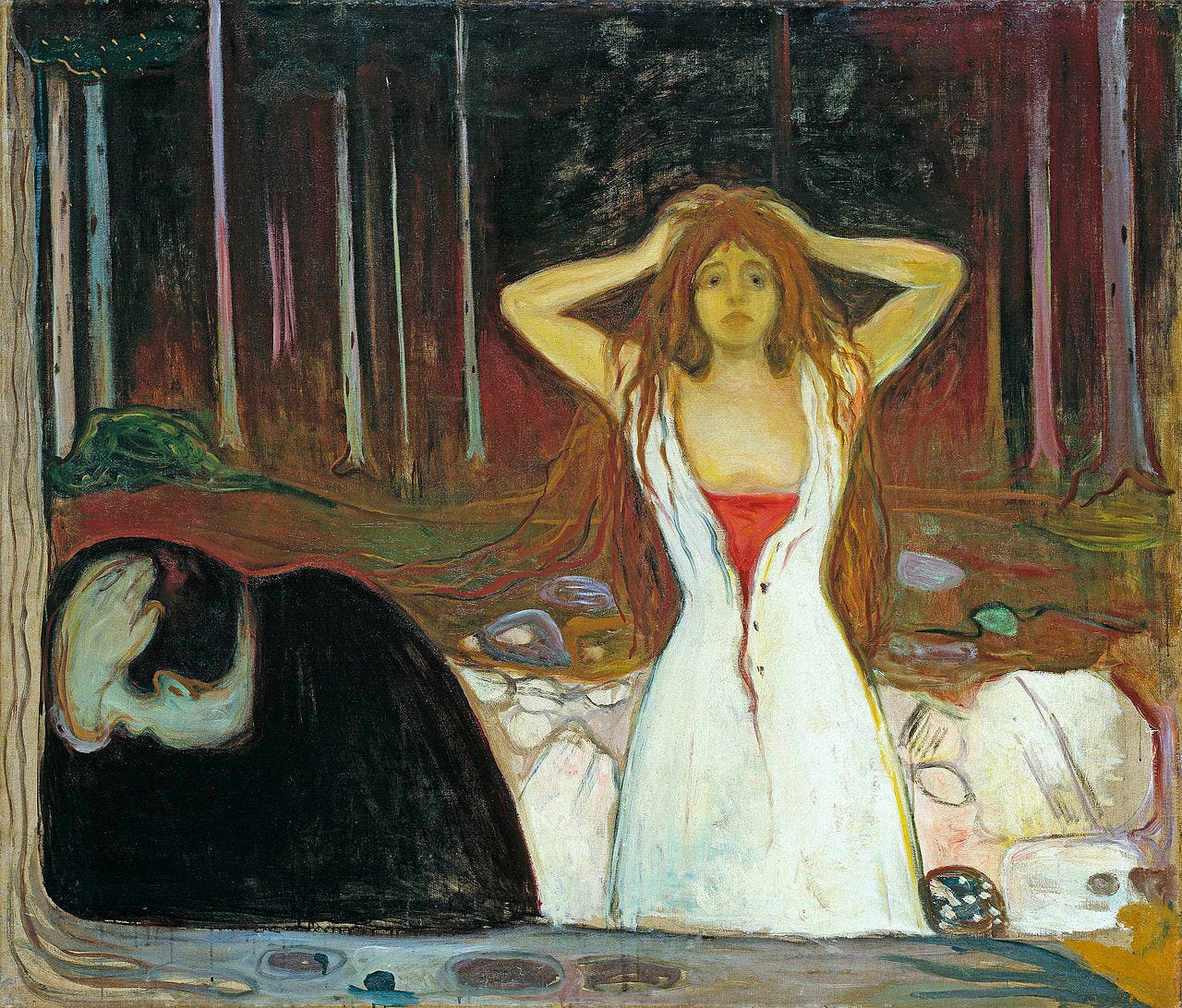
To resolve this collision of histories, we cannot simply retreat into a romantic environmentalism or “go off the grid.” We must actively cultivate what geologist Marcia Bjornerud calls timefulness—an acute, lived awareness of our embeddedness in the planet’s deep duration. Timefulness requires us to see ourselves as inheritors of a very long history, but also as active participants in the Earth’s metabolic order, and as long as we are the dominant species, one of our responsibilities is to maintain the metabolic order for all beings. It should be a daily ritual of sensing, coordination, and care.
This is the core of what I have been calling Bhumics, a way of embracing planetarity in a new imagination of our collective future. Almost every non-modern tradition and culture conceives of the Earth and its creatures as having meaning and purpose. Saying “we are entangled in the planet’s biogeochemical systems” isn’t enough if it is merely an entanglement of things. The starting point has to be our entanglement as beings in a community of other beings.
When we cultivate timefulness, we recognize a profound truth about the human condition: we are that part of the planet responsible for planetary sapience with help from our robotic masters; we are the Earth’s latest, most self-aware attempt to read its own grand book. Our cognition, our sensors, our simulations, and our planetary-scale computation (the Stack) are not unnatural aberrations. They are the planet thinking itself in rapid time. Instead of viewing humans as an external force acting upon the Earth, a true Planetary Durée positions us as a critical organ within the Earth’s metabolic body. We are the means by which the Earth has become aware of its own deep duration. By embracing this impersonal, planetary durée, we accept our profound responsibility. We will no longer be alienated dominators; we will be the self-conscious edge of the planet’s unfolding history, tasked with interpreting the Book of the World and acting upon its wisdom.
Philosophical Engineering: Designing for Deep Time

It is one thing to articulate an ontology of time; it is another to govern by it. Philosophy can no longer be content with reflection alone. It must become a practice of composition and constitution, philosophical engineering that builds concepts, institutions, and tools that make the planet livable for all. If the world is made of time, how do we build institutions that respect a polytemporal reality?
Currently, planetary governance is paralyzed because it is based on the spatialized, short-term time of the Globe. A constitution or a nation-state is ill-equipped to regulate the deep-time consequences of carbon emissions or nuclear waste because their temporal horizons extend only as far as the next election or the next generation. The Book of the World must have as many chapters as there are ages of the Earth.
Frederic Hanusch argues that this requires the invention of a politics of deep time and multitemporal governance to deliberately manage the bidirectional interactions between human society and cosmic/geological processes. To align human actions with planetary tempos, we must redesign democratic institutions to last across civilizations and geological epochs. These new institutions have to be computational - creating protocols and executable systems - because while a constitution cannot regulate a factory directly, a software protocol can.
Hanusch and Bjornerud both suggest that we need to adopt a trustee conception of sovereignty (also see Kumarappa’s idea of the Economy of Permanence) to protect the rights of the unborn and the non-human. This might look like creating new infrastructures for intergenerational governance, such as appointing a “Secretary of the Future” to guide policy, or designing planetary assemblies where the interests of the biosphere are structurally represented.
This brings me back to the archetype of the philosopher-king, which I wrote about in the context of governance. Let us reimagine this figure for the third age of systems theory. Plato envisioned a ruler who had stepped outside the cave to perceive the absolute truth, descending back into the darkness out of a duty to govern the polis. Yet, the polis was a purely human construct, existing entirely within the spatialized time of human history.
Today, the object of philosophical apprehension is the Planet. The philosopher-king, obsessed with the harmony of the human state, is fundamentally ill-equipped for this. We must replace the philosopher-king with the Planetary Steward. The planetary steward is responsible for maintaining the metabolic order across the longue durée. They are responsible for both spatial and temporal flourishing, for being a good neighbor to the community of beings, as well as being a good ancestor to the deep future.
The Planetary Steward governs not by decree, but through the rigorous philosophical engineering of protocols, institutions, and cybernetic feedback loops that keep the planet in tune. The Book of the World must be designed to be held in our hands, but it should also be a distributed artifact, spread across sensors and continents.
Conclusion: From Time to Space
Embracing the Planetary Durée is the necessary first step in revising our self-conception as world-makers. By rejecting the spatial fallacy of time, and by synthesizing the rapid flow of human history with the deep, slow rhythms of the Earth, we find a way to hold both our incredible power and our cosmic unimportance at once. We are but a fleeting moment in the Earth’s history, yet we are the moment the Earth made its presence felt in our consciousness.
The Book of the World is the foundational text for this new consciousness. We must build technologies as well as institutions that ensure that the fast-moving layers of human activity do not irreversibly shatter the slow-moving foundations of the Earth’s life-support systems.
That’s it for Time as Planetary Durée.
Having re-oriented our understanding of when we are, and how the past is intimately present in our planetary body, we must turn to the next dimension of our earthly condition. Next month, we will explore where we are, turning our attention to Space, planetary boundaries, and the material limits of our shared world.
Space was cast by Bergson as the villain; I will start by rehabilitating its reputation.