This essay is the 2nd essay in the Planetarity Syllabus, part of a series on Governance, of which the other essays are:
Introduction: A New Machine makes a New World
Last week I had mentioned there were three books in the Governance section of the Planetarity Syllabus - Benjamin Bratton’s “The Stack,” Blake and Gilman’s “Children of a Modest Star,” and “The Planetary” edited by Gilman. Today’s essay is a response to Bratton alone - I have way too many notes on The Stack to also cover the other two books in one essay. In fact, I have so many notes that I am going to stop at the Fourth Chapter “Earth Layer” - where the Stack meets the Planet. The other two books will be covered in a subsequent essay later this week.
The word “response” should give you a clue that my essay ( and future Planetarity Syllabus essays) are less about representing the authors’ ideas faithfully and more about the thoughts they evoked in me. I am a fanboy - a book is in the syllabus only because it has influenced my thinking on topics close to my heart. I want to be fair to the syllabus authors’ ideas and acknowledge how they have influenced my thinking, but I am also in a “good artists borrow, great artists steal” frame of mind.
If I had to nominate a concept for the ‘most important concept of the last 500 years’ prize, I would pick the machine. Machines, mechanisms and their cognates influence every single thing we do, from how we think about nature to how we run our societies and how we produce art. Life, liberty and the pursuit of happiness are all mediated by the machine.
The machine isn’t an Aristotelian category, but rather a graded, family resemblance category of the kind Eleanor Rosch has researched over the decades. As a graded category, its prototypes have changed over time. Brief introduction to Rosch’s ideas below:
In the classical view, a category is like a digital switch: something is either a bird or it isn’t. In Rosch’s view, membership is graded (analog).
The Prototype: The “center” of a category is the prototype - the clearest, best example of that concept. For the category Bird, a robin is a prototype. It has all the salient features (feathers, flies, chirps, small).
Fuzzy Boundaries: As you move away from the prototype, membership becomes “fuzzier.” A penguin is technically a bird, but it is a “bad” example because it doesn’t fly. It sits on the periphery of the category.
Family Resemblance: Members of a category don’t share a single defining definition; instead, they share a network of overlapping similarities (a concept Rosch adapted from Wittgenstein).
Every shift in mechanical prototype has accompanied changes in our intuitions about collective life, of society, of nature etc. Once upon a time, the clock was the prototype; the Newtonian Universe dominated science for a couple of hundred years. Clock-like military discipline can be seen in parades across the world to this day.
Then came the Engine. The steam engine and the factory led to Marxian ideas about production being the most important principle ordering society, with changes in the mode of production leading to changes in social structures. The Dark Satanic Mills that Blake railed against gave us a glimpse of automation but they were a far cry from the Dark Factories dotting the Chinese Landscape today. That needed the development of the computer, which is the most general idea of mechanism that exists today. Our understanding of computation started in mathematics, but the computer escaped its formal confines a while ago, and now it influences every aspect of society.
We don’t (yet) have a computational ordering principle that can compete with production as the reigning principle of collective life. Benjamin Bratton’s “The Stack” is the first book I have read that gives me confidence that it’s possible to theorize collective existence on computational grounds. It’s a difficult book; it’s a long book, and it’s on occasion infuriating. I have disagreements with many of its claims, and as a result of the explosion of AI, I think the Stack has been superseded by Intelligence as the core computational idea (or even better, the generic term “Compute”), but Bratton has named something that can never be unnamed, even if the moniker changes. That’s why it’s an important book and essential to the Planetarity Syllabus.
The next section is a sampler of my notes on the first hundred thirty odd pages of The Stack.
Snippets of the Stack
We are all aware that in the historical blink of one’s eye, computers have emerged like a Godzilla made of sand and upended everything. But the Owl of Minerva flies at dusk and it wants to know: what does this computational coup mean? The first answer is that there’s no logic or grand design to this coup; it’s an accident that’s emerged from a series of technological, design, economic and political choices.
scrambled territories, institutions, constitutions, sovereignties, citizenships, hard- wares, softwares, protocols, interfaces, databases, patterns, platforms, cities, muscles, skins, organs, failing presumptions, exotic refrains, domains, settlements, penultimate boundaries....As such, any design authorship must understand that the dynamics at work now are—for better and worse—simultaneously and interchangeably both futuristic and archaic, at once both technocratic and theocratic.
But the Owl won’t be satisfied with this answer, for this accidental Godzilla, once created, has a discernable structure. Not one that can be captured by a definition; that would be weird after I dissed the Aristotelian way in favor of graded categories at the outset. I am so convinced Stacks are a cognitive category that I would have rejected Bratton’s definition even if he had provided one. But the Stack isn’t formless:
this book proposes a specific model for the design of political geography tuned to this era of planetary-scale computation. It works from the inside out, from technology to governing systems....To do this, it draws on the multilayered structure of software, hardware, and network “stacks” that arrange different technologies vertically within a modular, interdependent order.
Instead of a definition, Bratton gives us an architecture (wearing my cognitive hat, I would call it a schema) that inscribes stacks on to our world:
The Stack, as examined here, comprises six interdependent layers: Earth, Cloud, City, Address, Interface, User....The scenario described in the chapters to follow, and appearing before us in the real world, can be summarized as one in which Users, human or nonhuman, are cohered in relation to Interfaces, which provide synthetic total images of the Addressed landscapes and networks of the whole, from the physical and virtual envelopes of the City, to the geographic archipelagos of the Cloud and the autophagic consumption of Earth’s minerals, electrons, and climates that power all of the above.
This architecture is nothing like that of the State - in whose schema one might see entities such as citizen, boundary, parliament etc. What happens when the State absorbs the Stack (or is it the other way around?): when I engage with the India Stack, am I a user or a citizen? In principle, the latter, but in practice, the former. I interface with the UPI system with the Aadhar card serving as an address, and then the transaction goes off into the cloud. Citizenship is, at best, an authenticating mechanism in this interaction, not a bearer of rights. As it so happens, most of these transactions happen within the geographical boundaries of India, but surely that doesn’t have to be so. The nation state might soon become a graded category, with the virtual and the physical layers coinciding at the prototypical center of the category, but with tendrils that spread across the world. These tendrils don’t have to be digital either; consider China’s OBOR initiative - to the extent that a Pakistan or a Zambia is tied to Chinese supply chains with no economically viable alternatives, one might say that the infrastructural sovereignty of the China Stack weakens the territorial sovereignty of seemingly independent nation states. Bratton argues the Stack’s usurpation of territorial sovereignty doesn’t turn space into an abstraction. Far from it.
But even as strange geographies corrugate, fracture, and smear worldly scale and tempo, the ground isn’t somehow evaporated into virtual information flux; to the contrary, we are brought to a certain end of nonplace. For this, a different kind of placefulness is reestablished, one that is not the organic inverse of artificial abstraction, but an experience of place as one resonant scale within a much larger telescoping between local and global consolidations.
The telescoping between local and global consolidations triggers the thought that the Stack is a Sheaf in the mathematical sense of that term - layers of data that sit on top of a location that can spawn new global invariants. I think geometry of the sheaf-like variety is at the heart of the stack - if I had more time, I would recast the six layer architecture in those geometro-topological terms. Raincheck. Bratton argues that nomos of the cloud both builds upon and supplants the earlier nomos of territorial appropriation:
The Stack model is also perhaps also a contemporary version of what Schmitt called the nomos, and perhaps it is what retires the Schmittian nomos altogether. This slippery concept refers to the historically evolving structure of the world order (more specifically for him, an Earth-order) and the corresponding partitioning of political space according to which sovereign entities are constituted. Is there a nomos of the Cloud?
I have a different take - geometrizing the Stack would also make it continuous with the territorial nomos we inherit from the Westphalian era, which is inherently spatial. The virtual thickening of the Earth’s surface using sheaf-like structures is a model of the stack worth fleshing out. Raincheck once again.
Almost done with these excerpts - there’s a lot more where it came from. Before I move on to the next section, I owe you an explanation - ‘nomos’ has been mentioned several times without saying what it is. Bratton borrows the term from Carl Schmitt:
Schmitt defined nomos as “the Greek word for the first measure of all subsequent mea- sures, for the first land appropriation understood as the first partite and classification of space, for the primeval division and distribution, is nomos....Nomos is described as prior to every legal, economic, and social order;it is constituted by appropriation, distribution, and production, and only through this can it move from the particular to the universal: from arbitrary territorial capture, to representations of spatial delineation and to a geopolitical order.
Ted Chiang and others have argued that the fear of AI is really the fear of capitalism, but I wonder if we need to take a step back, that the Stack’s nomos lies one layer or more below the layer that’s captured by capital; we might be apprehensive about tech’s capture of society but the AGI-pilled fear of being turned into paper-clips isn’t coming from capitalism but an earlier appropriative stage - the Columbian conquest that precedes settler colonialism.
What do you think?
Here’s what I think: we are in the very early appropriative stage of the Stack whose acts of violence may yet be absorbed by existing political structures or destabilize them so much that they fall apart. There’s also a third alternative related to the second: that the Stack opens up the possibility for planetary institutions of the kind we will read about in Blake and Gilman - they have to be computation forward, for how else would we form them?
Stacking the Planet
The will to power that Schmitt describes as the ‘nomos’ precedes every form of settled order. It also overflows those settled orders. For the last seventy five years, we thought the nation state order would contain our desire to dominate, and perhaps Pax Americana did that for a while (don’t ask the Vietnamese or the Afghans), but the Stack was digging into the innards of the earth this entire time, releasing every demon like Pandora’s Box. Bratton says:
there is no Stack without a vast immolation and involution of the Earth’s mineral cavities. The Stack terraforms the host planet by drinking and vomiting its elemental juices and spitting up mobile phones.
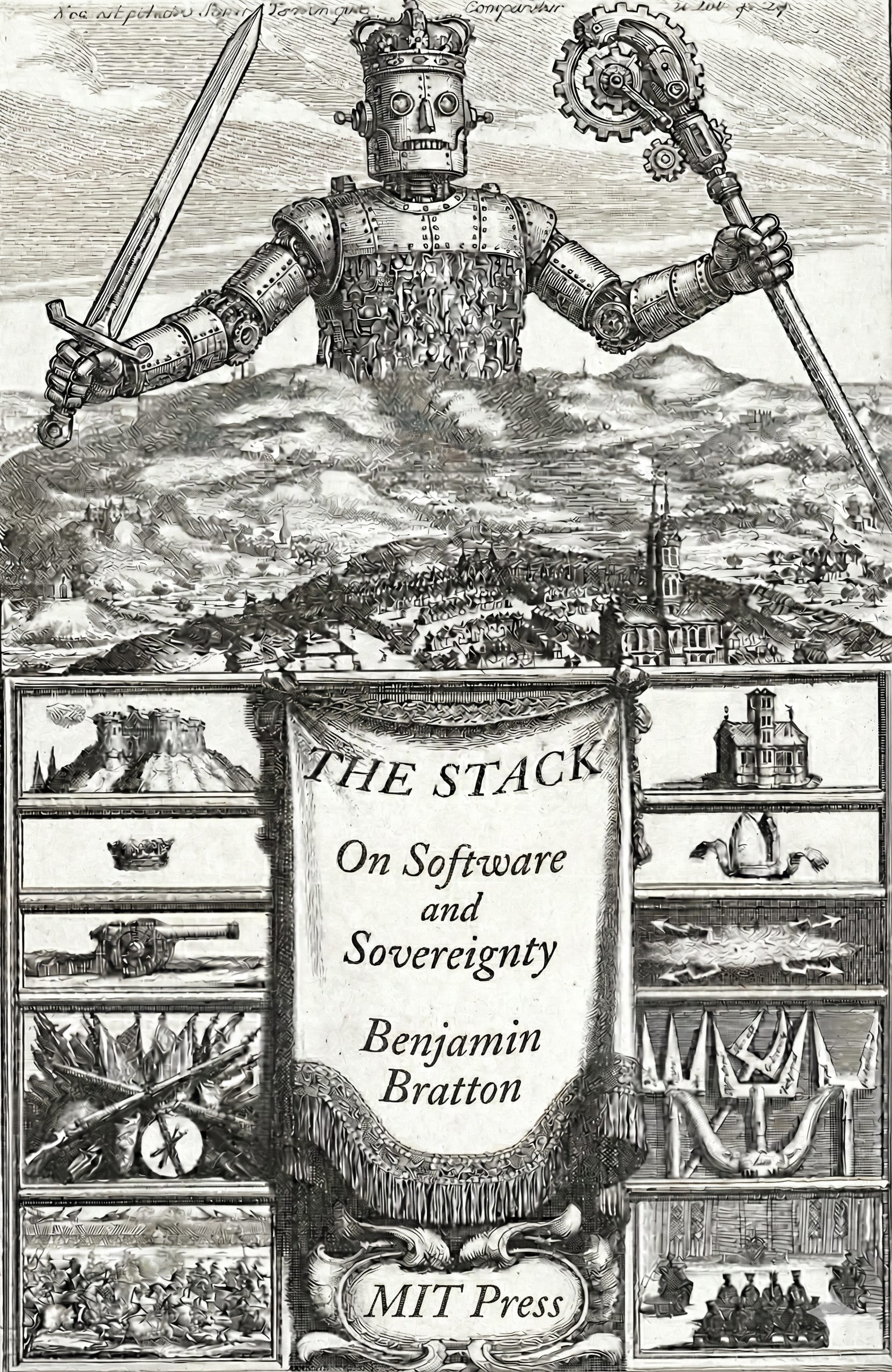
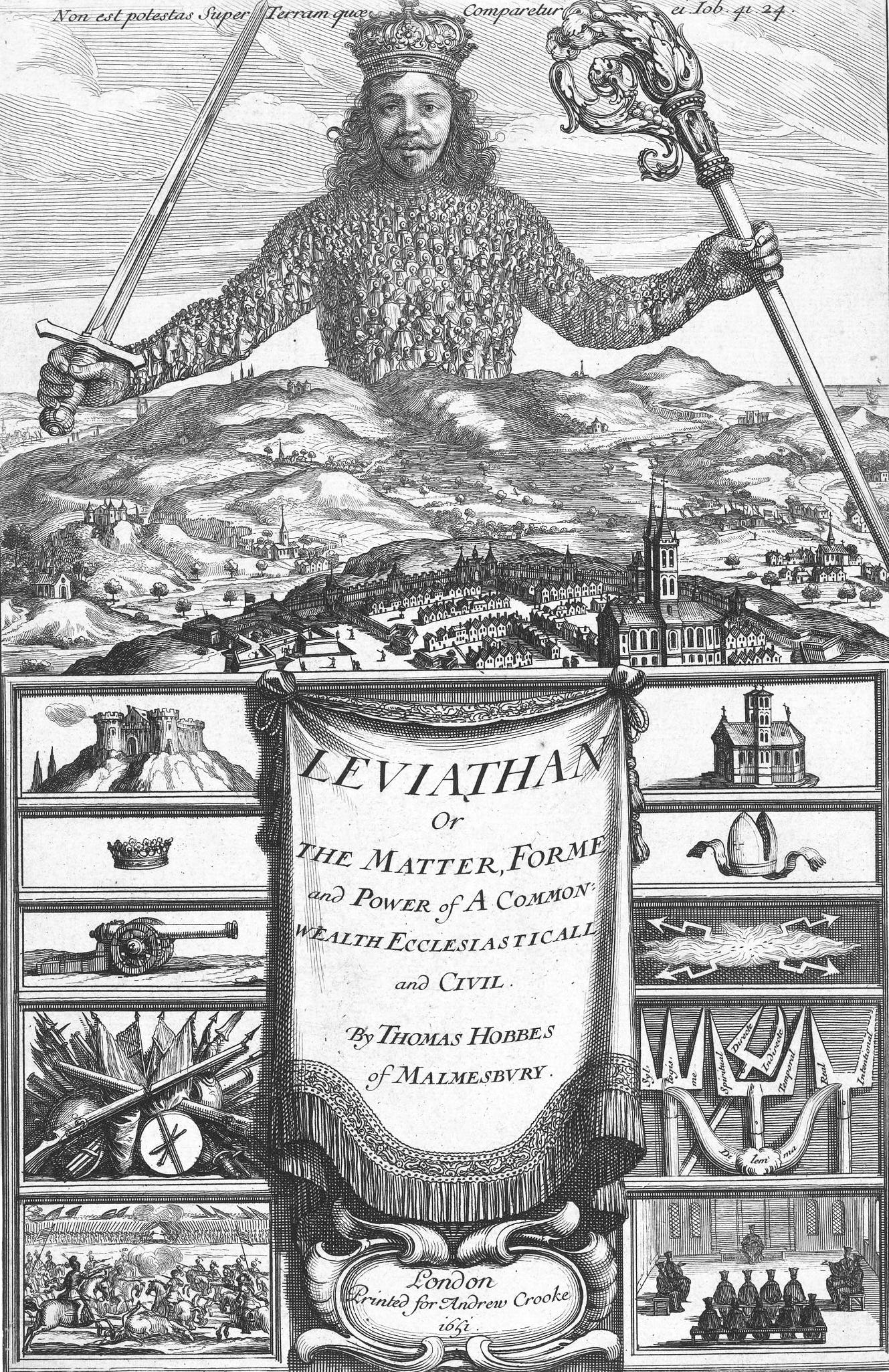
Kate Crawford’s “Atlas of AI” has a thorough analysis of the vast immolation and involution of the Earth’s mineral cavities that goes into the making of the Stack. The Stack - just to be clear, the actual megastructure we have created, not the book - gives off a strong Computational Leviathan vibe, though Bratton doesn’t cite Hobbes much. “Hobbes” occurs three times in the book of which only one is in the text, and “Leviathan” also occurs three times in the book of which only one is in the text, but just as the nation state was the consequence of a series of accidents and appropriations, so is the Stack. These accidents aren’t cheap; we wouldn’t be talking about “Extinction Rebellions” without the orgy of violence that accompanied the nomos of the Stack. Fortunately, there’s still some hope left at the bottom of the box, for:
There’s no Earth without the Stack.
There are at least two ways of reading this statement. There’s a deep history version, which gives Lovelock and Margulis’ Gaia a computational twist. All life and all intelligence is computational (most recently argued here), and the self-regulation of Earth Systems that makes life possible is at heart a computational process.
Many things process information algorithmically and could be said to “compute” in a meaningful sense (DNA and RNA, for example) without also demanding that we must see in them the reflection of our computing machines. We might even assume that the “next machines” (the ones that come after planetary-scale computation) will look less like today’s computers and more like biology itself.
There’s also a recent history version, for without the airborne mapping of the planet’s surface that was then intensified by undersea sensors and satellites revolving around the Earth, we wouldn’t understand the Earth as we do today, including the anthropogenic origins of climate change. Sensors and simulations are the vast machine that makes the Earth as we understand it. We will read about this more in the context of planetary sapience, a theme prominent in the other two books.
Our emerging planetary consciousness is a form of self-understanding that presupposes the Stack. The previous information technology that led to a new self-consciousness was print - the spread of print culture led to novels and national literature, and along with news media, it led to national consciousness and to a larger conception of humanity itself. When Shylock says to Salerio, “If you prick us, do we not bleed? If you tickle us, do we not laugh? If you poison us, do we not die?”, we resonate with his invocation of our common humanity, but I didn’t hear those words spoken on the stage at the Strand, but in a classroom in Delhi, where I read them on a page. Stories have traveled across the ages, but it is print that bound us into a single species-being.
Might computation - as the stack, as compute, as something else - bind all life together? It is very hard to predict, especially the future, but I have a strong bias towards computational institutions being the missing link.
Conclusion: The Metabology of the Stack
The Stack is both algorithmic and material; we can’t ignore either its informational or energetic metabolism, or as Bratton says:
The Stack is a hungry machine, and while its curated population of algorithms may be all but massless, their processing of Earthly material is a physical event, and therefore the range of possible translations between informa- tion and mechanical appetites has another limit that is not mathematical but defined by the real finitude of substances that can force communication between both sides of this encounter.Furthermore, like any megamachine the Earth layer is as socially constrained as it is technologically configured, and so there are political economies of Turing machines that are only accessible through misaligned and uneven hierarchies of geography, energy, and programmability.
If the Stack is the accidental Godzilla that has emerged from our technological choices, then Metabology is the discipline required to tame it before it consumes the world. Bratton argues that the Stack “terraforms the host planet by drinking and vomiting its elemental juices”, a vivid description of a machine that is deeply entangled with the Earth’s geology but indifferent to its habitability. This is precisely where the concept of the Stack must meet the demands of Metabolic Order. As I said in the introduction to the Planetarity Syllabus:
The maintenance of planetary metabolic order is our primary collective task as a species.It is literally the foundation for everything else.
Today’s AI enhanced Stack is a colossal engine of Prediction Metabology. It excels at sensing, modeling, and steering behavior through data, turning uncertainty into managed risk. However, prediction is insufficient if it is not coupled with the material capacity to maintain life support systems. The Stack provides the protocols that write the constitution of our society in practice, but currently, those protocols are optimized for extraction and engagement rather than the maintenance of planetary metabolic order.
To align the Stack with the needs of the Planetary Age, we must reorient it towards an institutional design where computation serves as the nervous system for planetary repair. The Stack offers the sensing and coordination capabilities required to manage carbon budgets, biodiversity, and energy flows at scale. It should be the infrastructure for the nested ecology of governance I call for in Metabology.
TLDR; Computational institutions must also be metabolic institutions.