


This essay is the 1st essay in the Planetarity Syllabus, part of a series on Governance, of which the other essays are:
If you’re a knowledge worker like me, you have no idea of our earthly condition. I don’t gather or hunt my food, the water I drink comes out of a faucet and the air I am breathing right now is heated in my basement before it’s piped into my home office. When I fall sick, I pop a pill. I am insulated - some might say alienated - from the vagaries of the flesh by an interlocking series of technological systems.
In short: my life is mediated.
That’s A-OK with me. I am no homesteader, I have no interest in going off the grid, and any attempt by people like me to ‘go back’ is a posture, not a program. Nevertheless, if mediation is OK, alienation isn’t. If we are to survive as a species, and not cause untold suffering to other species, we need to embrace the condition of Planetarity. Martin Heidegger, the German philosopher, claimed the history of Western Philosophy was a history of the forgetting of Being, that we got lost in the trees of beings and missed the forest of Being as such. He dedicated much of his life to the recovery of the meaning of Being.
Did Heidegger go far enough?
What if history itself - not just the history of Western philosophy - is the history of forgetting the Planet, of treating nature as a Standing Reserve (to use a Heideggerian term)? What if the historical Time in ‘Being and Time’ (Heidegger’s masterpiece) is woefully inadequate?
Can we think our way beyond history into geological time?
We can’t grasp the planet through thought alone, but thought has a role, and for thought to play that role, philosophy has to be rethought from the ground up. Philosophy’s grasping the human condition (beginning with the Axial Age across many cultures) has to be replaced with its grappling with the planetary condition. I don’t know how that phase transition in thinking will happen, but I know it needs to.
Now for some logistics:
Grasping our planetary condition is a hyperproblem (more on hyperproblems here), and we will have to bring many lenses to the condition of Planetarity. The goal of the Planetarity Syllabus is to cover a variety of lenses, digest their insights, and bring those digested insights to bear on our understanding of Planet, in the manner Heidegger attempted with Being. I will cover one lens a month for a total of 10 lenses (Feb - Nov) and a final synthesis at the end of the year. Each lens will be scaffolded by a cluster of representative readings. I am planning to write four essays per lens:
Essay One: General remarks that lay out the lens and its distinctive features and a gesture towards the readings for the month. (Today’s essay is an example)
Essay Two: introducing the the individual readings within the lens.
Essay Three: connecting the readings explicitly with one another and abstracting blended concepts (for conceptual blending see Fauconnier and Turner).
Essay Four: present a partially digested take on the lens as a whole, building upon the blended concepts in Essay Three. If conceptual metabolism is a cow, then Essay Four is the cud after it’s made its way through the first of four stomachs.
Month One: Planetary Governance.
At the very beginning of Asimov’s Foundation series, Gaal Dornick swoops in from the edges of the galaxy to the imperial capital, Trantor. As his ship orbits the heart of the empire, Gaal is eager to see Trantor, but the viewport is closed during the final descent. The officer who gives Gaal the bad news suggests he take a space-tour after arriving, just as you and I might hope on a tour bus in London or New York. Trantor is a planetary city of fifty billion people, a world that has been paved over by the Empire.
The Planetary City, or the ‘Ecumenopolis‘ as the Greek Urban Planner Constantinos Doxiadis (fun fact: Doxiadis planned Islamabad, just as Le Corbusier did so for Chandigarh) called it, is a common trope in Science Fiction; an entire planet remade as urban settlement. Doxiadis imagined urban areas expanding and merging over time -from cities → metropolitan regions → megalopolises- until they form a global “world city”. The Ecumenolopis is the ultimate realization of the Globe as universal human settlement. What it implies in practice or as thought-experiment:
Continuous built environment + infrastructure across continents (transport, energy, data, logistics).
Functional integration: even if there are parks, farms, deserts, and protected zones, they’re managed as parts of one urban system
Planetary-scale governance problems: water, waste, food, disease, climate, inequality, surveillance, mobility
A new ecology: not “city vs nature,” but a thoroughly engineered biosphere, whether humane and resilient or brittle and extractive
In Foundation (the new TV series inspired by Asimov and only loosely based on the books), Trantor is a gleaming blur of metal and glass, with manicured gardens in the style of Versailles adding drops of green to a mass of silver. Does the Ecumenopolis have to be a monument to metal and stone, colonized at every scale by human artifice? Could it be different, offering room for the nonhuman multitude alongside humans and their artificial creations? An alternative imagination of the Planetary City as ‘Gaiapolis’ might look a lot more like the Earth than like a city, except it too would be crisscrossed by the structures of governance of an urban sort, subdivided into functional departments, some of whom might be tasked with biodiversity just as today’s cities attend to water or waste.
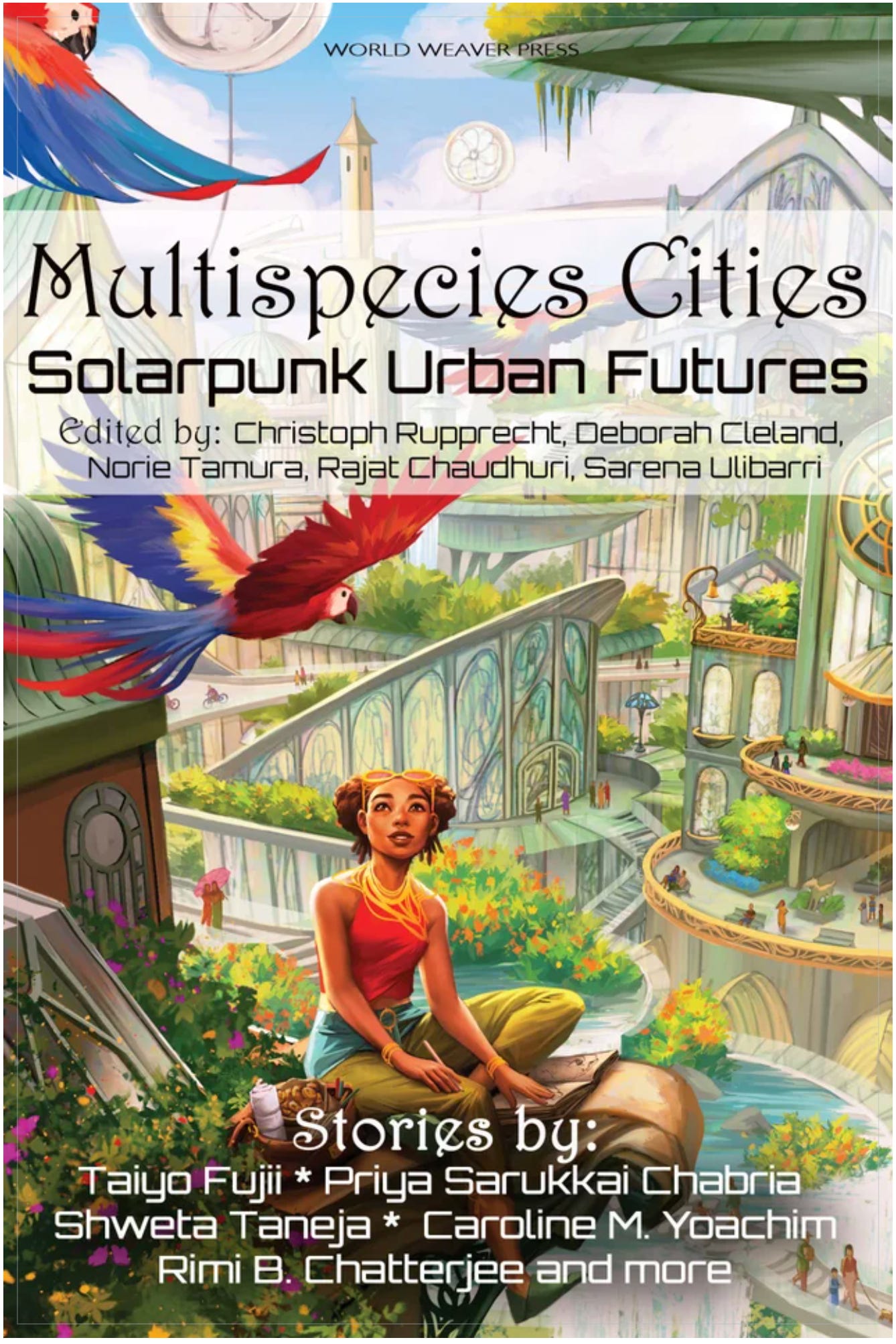
IMHO, conceiving the planet as a city is the only way to govern it as a whole.
Why Now?
The emergence of the Planet as a plausible unit of governance (the largest one can imagine today) is both necessitated by the compounding climate and ecological crises, and made possible by the interconnected information and energy technologies. Additionally, planetary politics is the only candidate for an inspirational politics of the future; its competitors such as international politics are barbaric - the arena of “The Strong do what they can while the Weak suffer as they must” - or in the case of national politics, irredeemably compromised; it’s hard to shake off one’s cynicism about national politics with their capture by corporate and sectarian interests.
A mass planetary movement that expresses solidarity with all living beings is the only struggle worth having today, but for that to happen, we need planetary institutions that help create the arena for planetary politics. Planetary institutions need not precede mass planetary politics; chances are they will arise in parallel, but every institutional development will likely create space for new political developments. I would be surprised and saddened (though I won’t be alive to see it) if there weren’t some form of planetary politics with wide appeal by the end of this century.
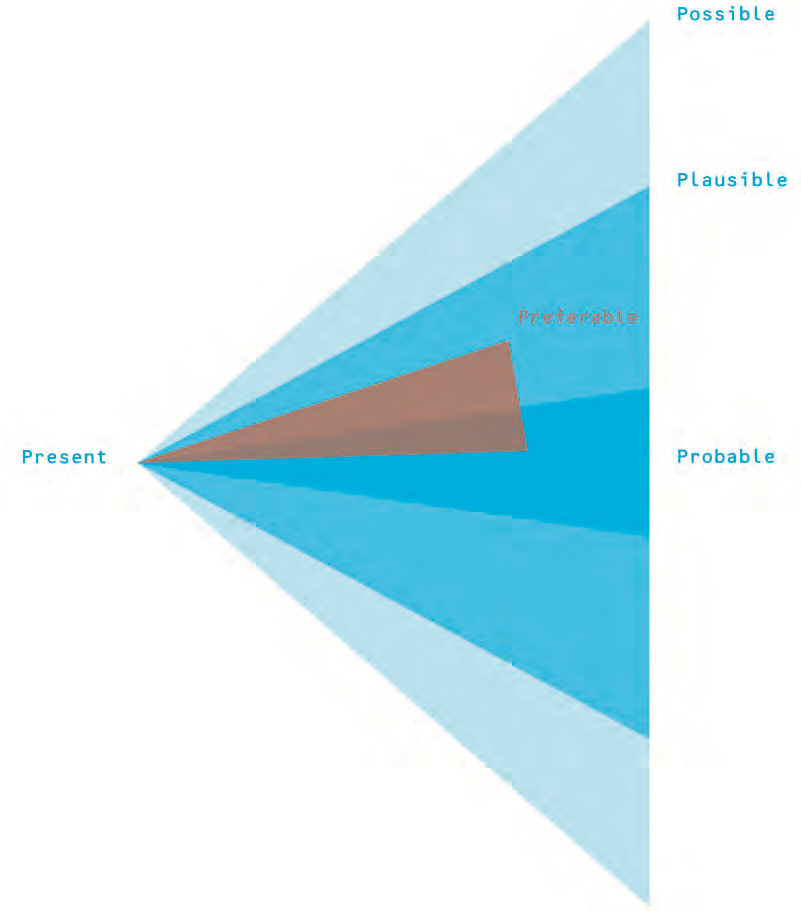
Now is the time to turn the plausible into the probable to use Dunne and Raby’s framework for speculative design.
One process that straddles thinking and acting is ‘governance’ and ‘government.’ The diversity of human needs and the fear of anarchy makes the case for institutions of governance, even if they have a tendency towards tyranny and elite capture. The Nation State is, by far, the most important unit of governance today, but it’s not that old and in the post-War era, the nation state has learned to live with transnational institutions - such as the WTO - that constrain the state’s capacity to act as it pleases. Nevertheless, attempts to go beyond the nation state towards world government have been an abject failure. Is planetary governance plausible? It’s too soon to tell, but it’s clear to me that the nation state isn’t the organizational form for governing the planet.
What then?
Maybe we should let a benevolent AI run the earth while we stick to mismanaging human affairs. The idea has some appeal, but I have a feeling Rule by Robot is not going to be popular as long as humans are running the show. Our ASI overlords don’t need my counsel, so let’s let the robots wait in the wings. Essay two in the Planetary Governance series is on three books bursting with ideas about governance at the planetary scale:
Benjamin Bratton’s “The Stack“ - now out in a 10th Anniversary edition.
Jonathan Blake and Nils Gilman’s “Children of a Modest Star.”
“The Planetary,” a volume edited by Gilman, with essays by Gilman, Blake and Bratton among others.
The three books have a common genealogy in the Berggruen Institute, the institution most committed to Planetarity of any I know. What I like most about conceptions of the Planet coming out of Berggruen:
The rejection of a sentimental, environmentalist framing of the condition of Planetarity, in a manner similar to Latour and his approach to Gaia.
The embrace of computation as the code through which we grasp the planet. As I hinted at in my essay on Metabology, computation is important for planetary governance because, unlike the law, it’s executable. A constitution can’t regulate a smokestack directly, but a protocol can.
When taken together, these two stances help us arrive at surprising conclusions, such as the emergence of AI isn’t a sideshow to the ongoing ecological and climate crises, but an essential component in the condition of Planetarity. At the risk of massive oversimplification, Blake and Gilman offer arguments for new planetary institutions with the power to regulate and enforce carbon emission reductions, and Bratton’s Stack offers us a new computational architecture/grammar for these institutions. The merger of the two points towards Cyborg institutions of the near future.

I will reflect on this merger and more in Essay Four, but I am getting ahead of myself; I want to let the readings speak before I offer my take.