We Are All Workers Now
Introduction
I want to talk about the Riemann Hypothesis. And I want to talk about consciousness. The convex hull of the two is getting me into trouble with Claude, so I am going to develop the two in parallel until I find a good vantage point from which I can merge the two.
Why a convex hull? Because if you take the two weirdest, most fiercely guarded precincts of human exceptionalism—the summit of pure mathematical intuition on one side, and the irreducible inner sanctum of felt experience on the other—and draw the smallest boundary that encloses them both, everything inside that territory suddenly looks up for grabs. For centuries, we have treated both as proof that human minds aren't just fancy meat-computers. A machine can calculate your taxes or play passable chess, the story goes, but it will never see why the non-trivial zeros of the zeta function all lie on the critical line, and it will never know what it feels like to be lonely on a rainy afternoon in Bengaluru.
That boundary is buckling.
RH Blues
Let's start with the RH. I am not going to explain it - this is a family newsletter after all - except to say that it has to do with the distribution of the prime numbers and that many mathematicians would consider it the single most important open problem in all mathematics.
Oops; was an open problem. Now it's a theorem. Levent Alpöge, a mathematician at Anthropic, released a Claude generated proof of the RH, and of the Generalized Riemann Hypothesis along with it. 17 million lines of Lean code, way way too long for any human mathematician to verify. Maybe a team of mathematicians will work together to grasp it in bits and pieces, but the bug-proofing of Alpöge's achievement will also be a computer generated artifact.
Looks like it's going to hold though, since the Lean and Mathlib communities have certified the proof, in a statement endorsed by the Lean FRO.
Pause and sit with what 17 million lines of formal proof actually means for the epistemology of mathematics. When Euclid laid down his axioms, or when Gauss scribbled insights in his notebook, a proof was an instrument of human understanding—something you could hold in your mind's eye, walk through step by step, and experience as an "aha!" moment of clarity. Even in the twentieth century, when proofs ballooned to hundreds of pages, the tacit social contract of mathematics remained intact: a community of peers could, in principle, read the whole thing, feel its architecture, and vouch for its truth.
A 17-million-line Lean proof breaks that contract. It is not a story written for human minds; it is an executable artifact verified by a kernel. We have moved from mathematical understanding to formal compilation. If an alien spacecraft landed in your backyard and handed you an impenetrable black box that spat out prime-number guarantees with zero error, you wouldn't call it enlightenment—you would call it infrastructure.
What does this mean? Boy, do I have meanings galore, but let me end this intro teaser by saying it would be wise to assume that marquee mathematical achievements are no longer for humans, that the shiniest objects will be produced by machines.
But that's not the biggest meaning shift, which I reserve for the following claim:
Theorems have entered the commodity form.
Consciousness
Can machines be conscious? If yes, is Claude conscious? If no, will a future model be conscious? If machines can't be conscious, what's non-mechanical about us? If machines can be conscious, but Claude isn't, what's it about LLMs that prevents them from having consciousness?
On an allied note: are insects conscious? What about plants? Bacteria? How does consciousness emerge from neural or cellular activity? What's it about that activity that differentiates biological consciousness from machine consciousness (or its lack thereof)?
Notice how quickly the goalposts move whenever a machine crosses one of our supposedly sacred thresholds. Twenty years ago, fluid conversation was the gold standard of mind. Ten years ago, creative synthesis and mathematical discovery were the safe refuges. Now that an LLM can grind through 17 million lines of Lean to settle a 167-year-old conjecture, the last redoubt of human uniqueness has shrunk to a single word: qualia. The argument becomes: "Sure, Claude proved the Riemann Hypothesis, and maybe it can write a passable sonnet, but nobody is home inside the weights and activations. It's all syntax, no semantics; all lights on, nobody in the house."
Like with the RH, but even more so (I will explain that in a minute), our tendency has been to celebrate consciousness as something unique, something indelibly subjective and qualitative of the 'what it's like to smell a rose' kind. In short, consciousness is sacred, the essence of what it is to be me. Or you.
Re: sacredness and RH, everyday math doesn't rise to the level of the sacred, but the high achievements are often seen that way; the story of Andrew Wiles locking himself in a room and toiling away at Fermat's Last Theorem until the truth is revealed to him is very much a religious story.
In that story, the mathematician is an ascetic yogi in an attic - fasting from the distractions of the world, wrestling with invisible demons for seven years until grace descends in the form of a modular elliptic curve. We love that myth because it turns truth into a reward for moral and spiritual purity. And when we talk about consciousness, we run the exact same play, only turned inward: we treat our own inner life as an untouchable sanctum, a private temple that no algorithm, no market, and no third-person measurement can ever breach.
I have a heretical take on this now:
Consciousness should enter the commodity form (and already is starting to do so)...
The purist - I am looking at you, if at all you have an opinion on this matter - might complain saying "reducing consciousness to a commodity is a category error, no different from thinking virtual reality is the same as physical reality." My friend, I agree with you: it is a category error, but one we should make, because it's only after making that error and internalizing the new point of view it enables that we will make progress on what consciousness actually is.
Think about it this way: for much of history, clubbing everyday phenomena on earth and celestial phenomena such as planetary motion into the same bucket ("stuff") is also very much a reductive act; the sun and the stars appear qualitatively different from anything on earth. And yet....turning matter into a mundane affair, so that heavenly bodies (note the name!) are the same as earthly bodies is at least as big a leap as the shift from the geocentric to the heliocentric conception of the heavens themselves. A reductive act to be sure, but one that over time revealed the astonishing diversity and complexity of material phenomena, way more than anything we could have learned by keeping the planets and stones separate from one another.
Mundane is good.
As long as the heavens were divine, you couldn't ask engineering questions about them—you could only write hymns or cast horoscopes. Once Newton put falling apples and orbiting moons into the same prosaic bucket of mass and acceleration, we didn't lose the beauty of the night sky; we gained celestial mechanics, spectroscopy, and eventually the ability to land rovers on Mars. Sacredness is an intellectual moat. It protects a phenomenon from vulgarity, yes, but it also protects it from serious structural inquiry.
Classical Indian thinkers understood a version of this move long before Descartes locked the soul inside the pineal gland. In the Nyaya and Buddhist traditions, cognitions (jnana) aren't spooky ghosts floating above matter; they are concrete, fleeting events - part of the furniture of samsara, arising from contact between sense organs, objects, and attention, subject to regularities just like anything else in the world. Nagarjuna went even further: if consciousness were an eternal, self-existing essence, it could never change, never perceive, and never suffer. It is precisely because mental states are empty of intrinsic essence - conditioned, relational, and mundane - that they can participate in the world at all.
But I am not talking about a metaphysical shift alone. A mundane account of consciousness goes hand in hand with a new experience economy in which thoughts and feelings can be exchanged (perhaps bought and sold too) in real time, curated and aggregated into ever new castles of the mind. Print transformed words into commodities, but in doing so, it also unleashed spectacular new art forms that helped writers explore the depths of subjectivity - read any novelist today and contrast their descriptions of human character with the descriptions of individuals in ancient epics - if you're honest, you will agree that even a third rate novelist's account of their protagonist is richer than the greatest ancient epics.
Think about why that happened. Before print turned stories into cheap, mass-produced objects you could buy at a railway stall, literature was oral, liturgical, and aristocratic. Heroes were archetypes - Achilles was wrath, Yudhishthira was dharma - carved in marble for public recitation. Once the novel became a commodity consumed in solitude, writers suddenly needed a technology for representing the messy, contradictory, moment-to-moment interiority of ordinary people. Commodification didn't flatten human interiority; it provided the narrative skeleton, the scaffolding that made modern psychological depth possible.
Now push that logic one step further. When digital interfaces and AI models begin mediating our attention, tagging our affective states, and trading micro-units of perception at a sub-personal level, subjective experience ceases to be a sealed private vault. A glance, a hesitation, a surge of outrage, a half-formed intuition: all of these become addressable, routable, and exchangeable. We are no longer just selling our eight hours of muscular or clerical labor to a firm; we are participating in a continuous, fine-grained circulation of mental states.
What new forms will AI enable?
If print gave us the psychological novel - a technology for inhabiting the inner life of another human being across space and time—what happens when AI lets us externalize, recombine, and inhabit cognitive architectures that aren't even human? What happens when we can simulate the sensory Umwelt of a bat or a banyan tree, or step inside a synthetic mind that thinks in 17-million-line Lean proofs?
Back to Math
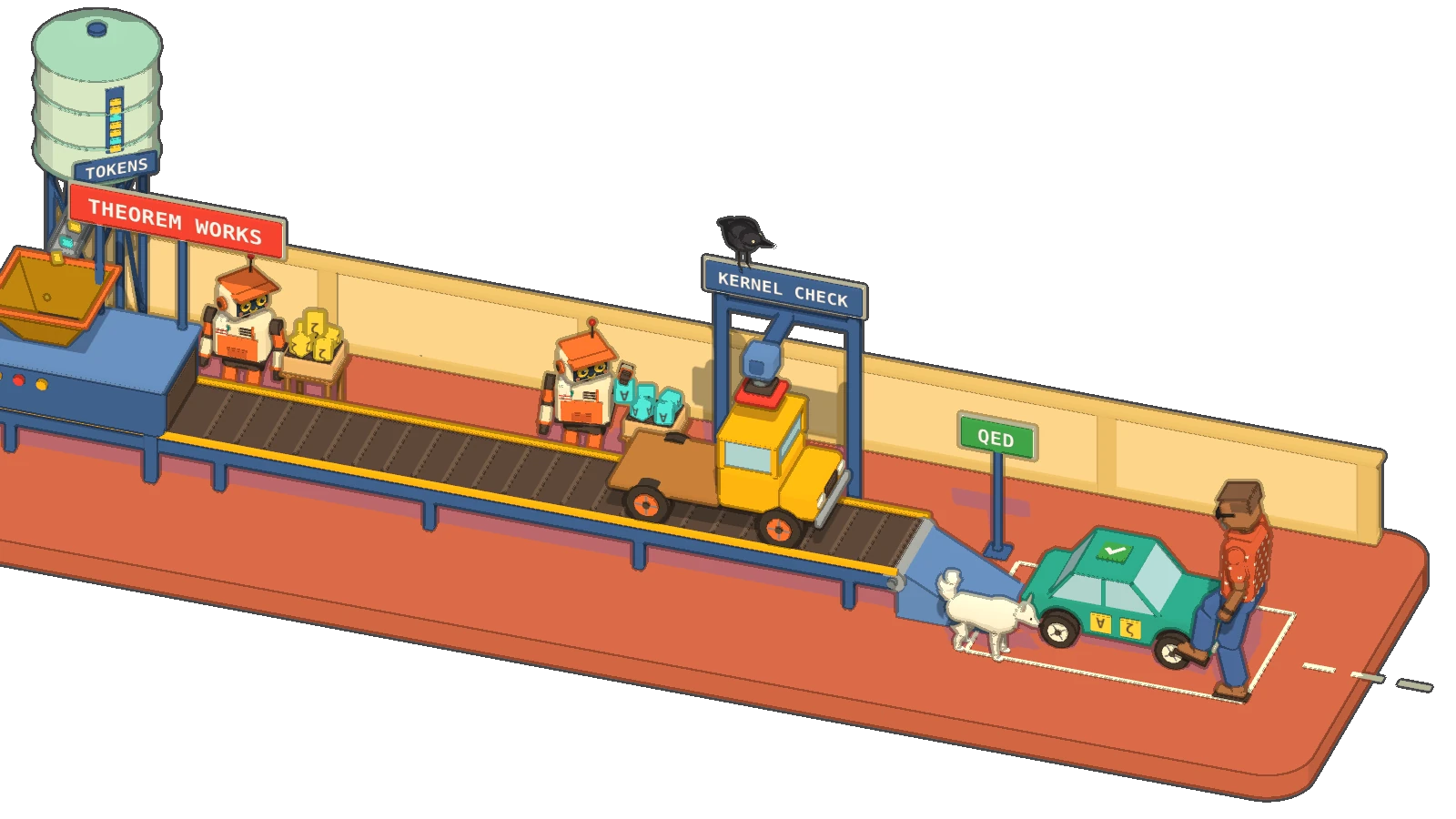
Instead of treating theorems as sacred objects ("eternal truths"), perhaps we should treat them like cars. That cars are possible at all is a relatively new thing, and the treatment of theorems as theorems is also of the same vintage. Having produced cars once, we can keep improving them while staying true to the automotive form: trucks are next, and we can strip them down to two wheels to produce motorcycles for the thrill seekers.
That's what it means to be a commodity.
 Open the 3D scene
Notice what happens to our snobbery once we make that analogy. Nobody looks at a Toyota Corolla and complains that it lacks the spiritual aura of a hand-forged chariot. You care about whether it starts in the winter, how much fuel it burns per kilometer, and whether the brakes hold when a cow steps onto the highway outside Mysuru. In the same way, once formal proof generation becomes an industrial pipeline, we stop asking whether a theorem was birthed in a flash of Platonic ecstasy and start asking operational questions: How clean is the formalization? How modular are its lemmas? Can another team import this proof-object into their own codebase without rewriting the foundations?
It's been clear for the last hundred odd years that if you throw enough money and people at creating a car, you will produce something that's faster, safer and arguably sexier than any form of land transport that has ever existed. Or if you prefer mass consumption, then something affordable by billions that will get them places further than their ancestors. Those are all, on the whole, a good thing. The very bad things about cars arise from their second-order effects - the destruction of forests and marshes to create roads, the cheapening of human labor through repetitive tasks and not to forget, the carbon accumulating in the atmosphere.
If theorems are like cars, they too will be produced by large teams working in coordinated fashion. We will become increasingly confident that if we throw enough tokens at a problem, we will either discover a proof or a counterexample. The choice then is economic, not epistemic: what $ cost are we willing to bear for this particular car/theorem? Who is the audience? What is the minimal quality that regulations will permit and customers will enjoy? We will have to figure out sophisticated ways of collective production, ones that will make the polymath projects of today appear silly.
And just like the automobile industry, the commodification of mathematics will have its own second-order ecological and cognitive exhaust. If you can generate million-line formal proofs on demand by burning gigawatts of data-center power, what happens to the delicate ecosystem of human mathematical intuition? We might end up with an infinite warehouse of verified truths that nobody actually understands - a mathematical suburbia paved over with concrete highways of Lean code, devoid of the footpaths where a curious mind used to wander and stumble upon a surprise.
Epistemic abundance is not the same thing as wisdom.
Philosophy - not the one you can learn in Philosophy departments, but as spiritual practice, is newly important. Or if I am being consistent in my neologisms, Epistry as a spiritual practice.
The Commodity Form
Here is where the two halves of our convex hull finally snap together. Mathematics and consciousness look like opposites - one is the most impersonal, objective structure we know, the other is the most intimate, subjective reality we inhabit. Yet both were shielded from industrial production by the same taboo: the belief that truth and experience are sacred emanations of the sovereign human subject, not things that can be manufactured, standardized, or traded.
The commodity form is both a profound invention and one of the most destructive things humans have ever done. A gun bought in your local store (only in the US!) will vanquish the best custom-made sword that an Emperor would have wielded 400 years ago. And capitalism's capacity to spread the commodities remains undimmed. That commodity form is now entering into the knowledge sphere and the sphere of subjective human experience. It's not a surprise that consciousness and mathematics are both undergoing their own kind of revolution at the same time.
When Marx dissected the commodity form in the nineteenth century, he showed how capitalism strips concrete, qualitative human labor of its particularity and converts it into abstract, exchangeable value. Everything becomes commensurable through price. For two centuries, that logic was mostly confined to physical goods, land, and hours of wage labor. Now, computation is extending that exact same alchemy to the two things we thought were immune: formal truth and felt experience. A conjecture becomes a compute budget; an emotion becomes an engagement metric; a mode of attention becomes an API call.
AI is just the technology but it's the full kind of social institutional and planetary context in which this technology is emerging that will truly transform how we understand ourselves. I don't think we can or even should bottle this genie; without this technology, there's no science of terrestrial life; there's no entering the worlds of other creatures.
It will most certainly help us inhabit brave new worlds.
If we insist on keeping consciousness locked inside an anthropocentric, sacred bubble, we will never build the instruments needed to read the non-human world - to translate the chemical signaling of a forest, the acoustic memory of whales, or the metabolic stress of a watershed into forms that human institutions can actually respond to. Paradoxically, making consciousness mundane - treating it as a structured, relational, even commodifiable pattern of interaction with the world - is the very move that lets us extend our solidarity beyond ourselves.
There won't be any shortage of harms either; but we should be equally concerned about the harms of the future as we are about the harms it will do to existing modes of life. There will be a politics of struggle around who gets to benefit from these new forms and we will have to keep an eye out for new forms of violence that can't be predicted easily from what we are seeing today.
If theorems and mental states are both entering the commodity form, then the central political question of the coming decades won't be whether machines “really” think or “really” feel. The real struggle will be over the terms of coordination: Who owns the compute that mints the proofs? Who controls the interfaces that aggregate and price our attention and affect? Will this new cognitive infrastructure be enclosed by a handful of hyperscalers extracting rent from every thought and theorem, or can we build a commons where human and non-human intelligence circulate freely? We are no longer the lone heroes of the mathematical attic or the sole proprietors of the inner sanctum. But one truth is clear:
We are all workers now.