

The US at 250: The Promise and the Violence of the Blank Slate

This is a one-off essay marking the occasion of the semiquincentennial (that’s 250 in the common tongue). I will be back with regular programming soon.
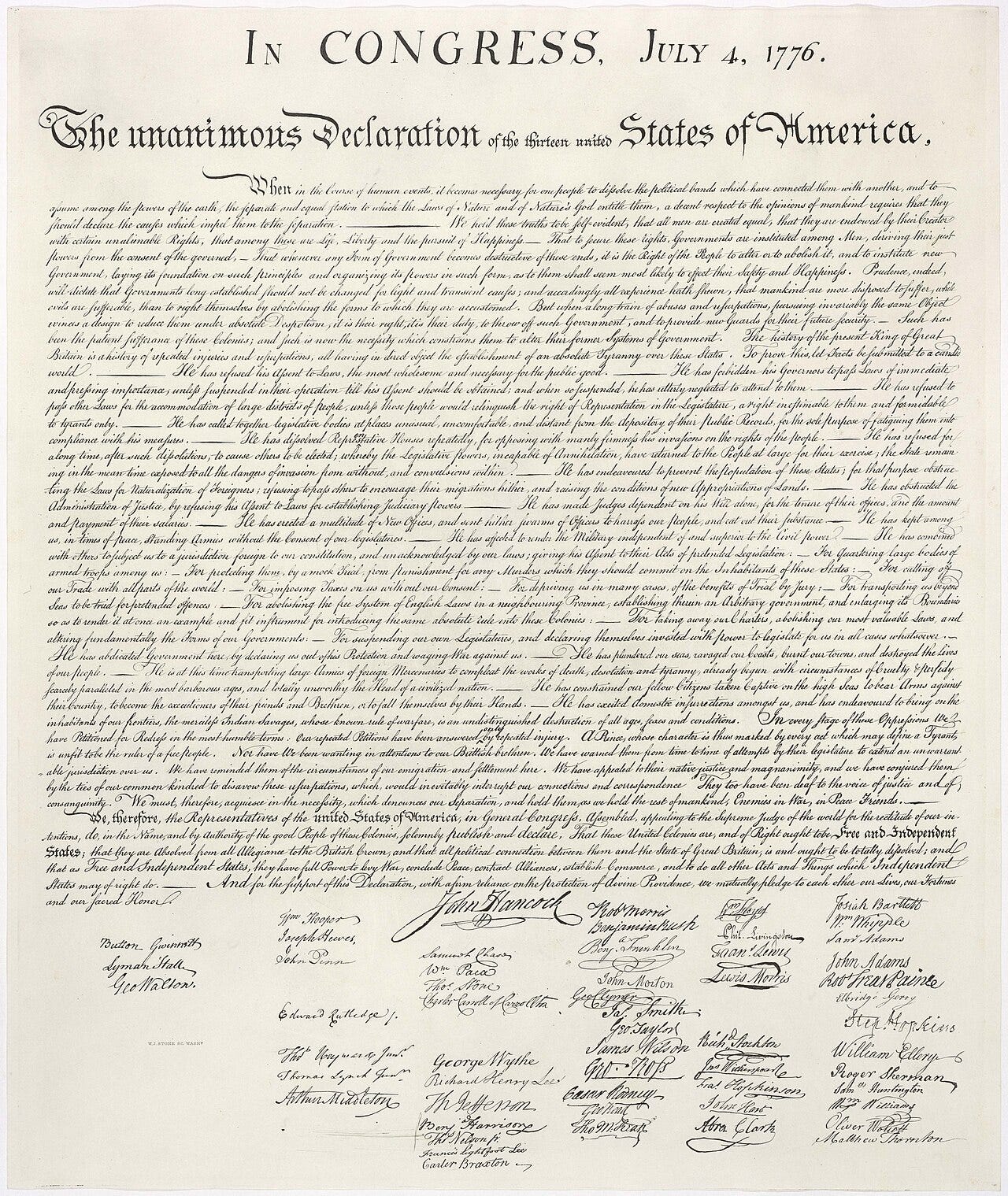
I am not one to wax poetic, but on this 250th anniversary of the United States, I find myself compelled to reflect on a nation with which I have a complicated relationship. I am not an American citizen; I remain an Indian citizen. Yet, having lived in the United States for nearly half my life, my ties here are indelible. My wife is American, my daughter is American, and to the extent that I will leave a lineage on this earth, it will be an American one.
This country has extended extraordinary generosity to me. I have found mentors and friends and partners wherever I have gone. There is an infectious warmth to everyday life here - the effortless smiles on the street, the boundless optimism, and the refreshing conviction that one’s trajectory is entirely one’s own to script. But perhaps what I cherish most is the uniquely American celebration of disobedience. Having a mind of your own, questioning orthodoxy, and refusing to kneel to unearned authority are actively cultivated here. As someone who doesn’t like to be told what to do, I have found this freedom to be, well, freeing.
And yet, as a political animal, I live with persistent friction. The single most foundational geopolitical reality I have witnessed ever since I came of age - now almost thirty years - and which extends deeper into the past - is that American imperial power has been a devastating force across the globe. Whether prompted by an axis of freedom, the greed for oil, or the desire to dominate, the US has not been good to the parts of the world I identify with. From coups overturning democratically elected governments to terror in places like Gaza and Iran today, American hegemony continues to sow destruction. I live daily with this cognitive dissonance: enjoying the joy, comfort, and liberty of domestic life within the metropole, while harboring bitter anger over how this nation treats marginalized populations within its borders and entire nations beyond them.
On a milestone like the Semiquincentennial, predictable scripts emerge. Public figures on the left will rightly emphasize that this nation’s greatness was built atop genocide, chattel slavery, and imperial expansion, while perhaps acknowledging America’s remarkable, albeit imperfect, capacity for internal self-correction. Figures on the right will nostalgicize a sanitized past, yearning for an era where their cultural and political dominance, and that of white men more generally, faced no organized challenge.
As neither an American public figure nor a traditional insider, I have no interest in offering standard praise or ritualistic critique. Instead, I want to point to the truly radical philosophy that underlies the Declaration of Independence.
The most profound, foundational revolution of 1776 was the constitution of a people through the written word. Throughout human history, nations justified their existence through antiquity: through blood and soil, divine right, or ancient ancestral lineage. America was different. It dared to assert that a community of equals could gather on a given day and simply declare themselves a nation into existence. It was an original act of political creation; forging something from nothing. Rousseau started his Social Contract with the famous claim: “Man is born free, but everywhere he’s in chains.” The revolutionaries took inspiration from the Swiss philosopher, affirmed the equality of men as a self-evident truth, and then declared exactly how they will throw off the chains that bind us (the irony that many of them kept men in chains isn’t lost on me).
Flawed as they might be, to construct a nation on a conceptual clean slate is the most revolutionary act imaginable. It is also inherently paradoxical. It is an act of breathtaking violence, because to declare a clean slate is to forcefully erase the histories, peoples, and civilizations that came before. Yet, simultaneously, it carries transcendent promise. By severing nationhood from bloodline, the Declaration created an ideological framework of universal equality that had never been institutionalized at such a scale.
Even the most incendiary modern critiques of the United States - demands to burn broken systems to the ground because of their racial or colonial sins - are only intelligible in the light of the Declaration’s promise. Tyranny that rules purely by the gun requires no moral justification; you can fight a dictator physically, but you cannot convict him of hypocrisy. The American state, however, authored its own moral standard. By declaring universal rights as its foundation, it gave the oppressed the very vocabulary required to hold the nation accountable to its own creed.
A nation constituted by declaration is a nation forever bound to possibility. It is entirely possible that the United States itself will never fully deliver on the radical equality it promised in 1776. Perhaps it will fall to some future nation, building upon a different foundational document, to finally fulfill its spirit. But like the single note of hope remaining at the bottom of Pandora’s box after the monsters were unleashed, that moral baseline has been released into human consciousness. Once uttered, a promise of that magnitude can never be taken back.
In the language of cognitive science, the Declaration functions as an “affordance” - a structural grip in the conceptual environment that opens up novel possibilities for action that were not present in the original design. Indeed, later constitutional and radical experiments - from the post-colonial framing of the Indian Republic to the radical upheavals of the Soviet and Chinese revolutions - have seized upon this structural affordance, mobilizing the power of written declaration to shatter feudal and colonial orders in their own distinct ways.
This is not to suggest the Declaration is sacred or complete. Perhaps the greatest respect one can pay to it is to wrest it entirely from the hands of its signatories - flawed men, many of whom trafficked in human bondage. A nation constituted through an act of declaration does not belong to its founders. And an even greater mark of fidelity to its revolutionary spirit is to identify its limits: to recognize that its universality is simply not universal enough. A marxist would say that words aren’t enough, bonds of ‘declared solidarity’ are broken by the iniquities of our mode of production and how it divides capital from labor.
We can go even further with that critique, for we live today in a planetary epoch. A document that begins and ends by invoking humanity alone - ignoring the complex metabolic systems, ecological webs, and terrestrial realities that sustain our existence - is radically inadequate for the century ahead.
As today’s milestone comes to be and then passes away, the genie of hope is whispering in my ear: If a gathering of flawed thinkers could declare a nation into existence out of thin air 250 years ago, what act of re-creation would it take today to declare and constitute the Earth as a Planet?