Making Sense of it All
'Umwelt,' is the German name for the 'life-world,' the world as experienced by a living organism. Then there's the bare term 'welt' which is a delicious double entendre, standing for world in German and a painful injury in English, which is as good of expressing the Buddhist (and more generally Indian) intuition that all of Samsara is suffering. We take worlds for granted. Science reduces them; literature shrinks them and philosophy ignores them*. And yet, without the world we would be nothing. Literally.
Of course there are exceptions.
Planetarity expands the human world to include the Earth, and at the same time shrinks the universe to the planet. The worldly explorer isn’t an eagle, seeing the Earth from up above - or from the Moon like the astronaut in Earthrise - but an earthworm, digging into the soil, chewing their way to wisdom. But the world isn’t free of contradiction. On the one hand, we have the (tacitly) anthropocentric view expressed by Alva Noe in his book on presence:
The world shows up for us, in thought, and in experience; the world is present to mind. This phenomenon—presence—is the basic phenomenon in the whole domain of the mental. It is what is at stake in disputes over the nature of “intentionality,” and it is the heart of the problem of consciousness.
The world is present to us in consciousness, and we can try to own it and control it just as we try to do so materially. But it’s still possible to experience the world as if it wasn’t owned by us (from Bjornerud’s memories of visiting Svalbaard as a graduate student):
On Svalbard, my perception of time becomes unmoored from the normal measures. It is partly the 24- hour summer daylight (not to say actual sunshine— the weather can be quite awful), which provides no cue for sleep. But it is also the singleminded focus on the natural history of an austere world that has so little memory of humans. Just as the size of objects is difficult to judge on the tundra, the temporal space between past events becomes hard to discern. The few human- made artifacts one finds— a tangled fishing net, a decaying weather balloon— seem older and shabbier than the ancient mountains, which are robust and vital.
Which gives us a hint of planetarity in the way Spivak meant it when she introduced the term:
The planet is in the species of alterity, belonging to another system; and yet we inhabit it, on loan.
Svalbard certainly struck Bjornerud as been loaned out to her and her fellow hut-mates. The familiar world gives way to a terrain bleached of meaning; the more you try to own the world, the more you run into its alterity. Burrowing our worm-like bodies further into the soil, we come to aspects of the planet that aren’t even on loan, an alien expanse (from Chris Impey’s “Worlds Without End”):
A tomb of rock. Not a chamber or underground structure, but a solid and almost seamless mass of granite. It’s laced with fissures and crevasses, the result of cycles of heating and cooling over the eons. Water oozes down the rock surfaces, sticky with dissolved chemicals. No light can penetrate this far underground, hundreds of meters below the surface. The only energy source is a feeble flux of radiation from radioactive decay within the rocks. It feels claustrophobic, desolate, and uninhabitable.
This planet is not even an ‘other,’ it’s not even an alien presence, it’s not there for us in any usual sense of thereness. These worlds aren’t present to us, and because they deny themselves to us, we are sorely tempted to collapse the planet into a field of ‘stuff,’ relics of a dead universe that have washed up on our shore. I want to resist that temptation; I want to hold on to the world without reducing it to the world of human presence or the universe of dead matter.
Is that even possible?
I think it is, and that along with science and philosophy and some aspects of the humanities and social sciences, we should learn also from human practices that routinely engage with alien presences and absences - mystical practices and their theology, for example.
Excerpts
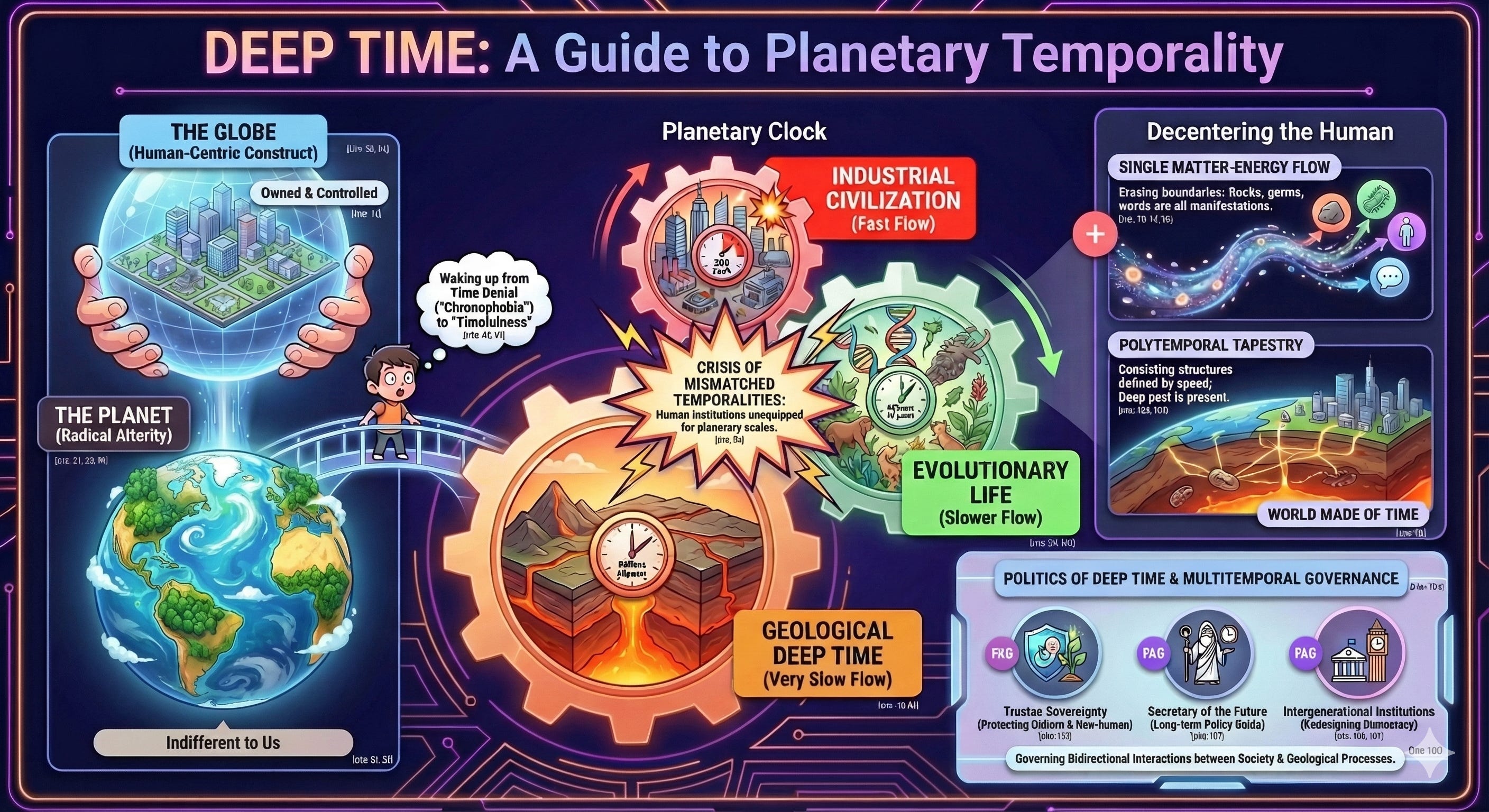
Dipesh Chakrabarty argues that anthropogenic global warming has brought about the collision of three histories that normally operate at vastly different scales and speeds: the history of the Earth system, the history of life (including human evolution), and the relatively short, recent history of industrial civilization and capitalism:
As I argued in the last chapter, Anthropogenic global warming brings into view the collision—or the running up against one another—of three histories that from the point of view of human history are nor-mally assumed to be working at such different and distinct paces that they are treated as processes separate from one another for all practical purposes: the history of the Earth system, the history of life including that of human evolution on the planet, and the more recent history of industrial civilization (for many, capitalism). Humans now unintentionally straddle these three histories, which operate on different scales and at different speeds.
Which leads to the collapse of the nature-society distinction:
The figure of the human had doubled, in effect, over the course of my lifetime. There was (and still is) the human of humanist histories—the human capable of struggling for equality and fairness among other humans while caring for the environment and certain forms of nonhuman life. And then there was this other human, the human as a geological agent, whose history could not be recounted from within purely humanocentric views (as most narratives of capitalism and glob-alization are). The use of the word agency in the expression “geologi-cal agency” was very different from the concept of “agency” that my historian- heroes of the 1960s—E. P. Thompson, for instance, or our teacher Ranajit Guha—had authored and celebrated. This agency was not autonomous and conscious, as it was in Thompson’s or Guha’s social histories, but that of an impersonal and unconscious geophysical force, the consequence of collective human activity.
And that leads to a shift from the Globe to the Planet as the central object of history:
For all their differences, thinking globally and thinking in a planetary mode are not either/or questions for humans. The planetary now bears down on our everyday consciousness precisely because the accentuation of the global in the last seventy or so years—all that is summed up in the expression “the great acceleration”—has opened up for humanist intellectuals the domain of the planetary. As discussed before, even the everyday distinction we make between renewable and nonrenewable sources of energy makes a constant reference, by implication, to human and geological scales of time, to the hundreds of millions of years that the planet would take to renew fossil fuels. Similarly, all talk about there being “excess” carbon dioxide in the atmosphere refers implicitly to the normal rate at which the carbon sinks of the planet take up this gas. Langmuir and Broecker emphasize the critical importance to humans of counting soils and biodiversity among the “nonrenewable re-sources,” not simply fossil fuels.
Note how one of our readings - Langmuir and Broecker - makes its way into Dipesh’s work. I will comment on them later, but this talk about the Planetary gives us an opportunity to channel Bjornerud, who would likely welcome Chakrabarty’s distinction between the human-constructed “Globe” and the deep-time “Planet,” seeing it as a necessary awakening from what she diagnoses as society’s pervasive “time denial” or “chronophobia”. Her core concept of “timefulness”- an acute consciousness of how the world is made of time and our embedded place within it is an essential aspect of Planetary consciousness:
This brave new epoch is not the time when we took charge of things; it is just the point at which our insouciant and raven-ous ways starting changing Earth’s Holocene habits. It is also not the “end of nature” but, instead, the end of the illusion that we are outside nature. Dazzled by our own creations, we have forgotten that we are wholly embedded in a much older, more powerful world whose constancy we take for granted. As a species, we are much less flexible than we would like to believe, vulnerable to economic loss and prone to social unrest when nature— in the guise of Katrina, Sandy, or Harvey, among others— diverges just a little from what we expect. Averse to the even smallest changes, we have now set the stage for environmental deviations that will be larger and less predictable than any we have faced before. The great irony of the Anthropocene is that our outsized effects on the planet have in fact put Nature firmly back in charge, with a still- unpublished set of rules we will simply have to guess at. The fossil record of previous planetary upheavals makes it clear that there may be a long period of biogeochemical capriciousness before a new, stable regime emerges.
We are time-poor even when we think we are being sensitive to time. The time of the planetary is different from the time of the universe so prized by physics:
Academe, too, must take some responsibility for promulgating a subtle strain of time denial in the way that it privileges certain types of inquiry. Physics and chemistry occupy the top echelons in the hierarchy of intellectual pursuits owing to their quantitative exactitude. But such precision in characterizing how nature works is possible only under highly controlled, wholly unnatural conditions, divorced from any particular his-tory or moment. Their designation as the “pure” sciences is revealing; they are pure in being essentially atemporal— unsullied by time, concerned only with universal truths and eternal laws. Like Plato’s “forms,” these immortal laws are often considered more real than any specific manifestation of them (e.g., the Earth). In contrast, the fields of biology and geology occupy lower rungs of the scholarly ladder because they are very “impure,” lacking the heady overtones of certainty because they are steeped through and through with time. The laws of physics and chemistry obviously apply to life-forms and rocks, and it is also possible to abstract some general principles about how biological and geologic systems function, but the heart of these fields lies in the idiosyncratic profusion of organisms, minerals, and landscapes that have emerged over the long history of this particular corner of the cosmos.

I read this as saying that a ‘longue-duree’ version of Bergson’s ‘duree’ is much needed to analyze the condition of planetarity. I will see if I can get to that next week, but I will round off this week’s excerpt’s with some thoughts on how DeLanda might contribute to our understanding of planetary time. His philosophical project is dedicated to entirely erasing the boundaries between the geological, the biological, and the human, so he’s a fellow traveler of Chakrabarty and Bjornerud:
In a very real sense, reality is a single matter-energy undergoing phase transitions of various kinds, with each new layer of accumulated “stuff” simply enriching the reservoir of nonlinear dynamics and nonlinear combinatorics available for the generation of novel structures and processes. Rocks and winds, germs and words, are all different manifestations of this dynamic material reality, or, in other words, they all represent the different ways in which this single matter-energy expresses itself. Thus, what follows will not be a chronicle of “man” and “his” historical achievements, but a philosophical meditation on the history of matter-energy in its different forms and of the multiple coexistences and interactions of these forms. Geological, organic, and linguistic materials will all be allowed to “have their say” in the form that this book takes, and the resulting chorus of material voices will, I hope, give us a fresh perspective on the events and processes that have shaped the history of this millennium.
To reconcile Chakrabarty’s problem of “mismatched temporalities” with Bjornerud’s view of Earth as a tapestry holding traces of all past epochs, DeLanda would point to his concept of non-linear history. He rejects the traditional historical view of a linear “ladder of progress” where new stages replace old ones,. Instead, he argues that historical structures accumulate and coexist at vastly different speeds. The physical world is defined by how fast matter flows: very slow for rocks, faster for lava. Similarly, human history is a mixture of incredibly slow flows (like rigid peasant agricultural traditions) and highly turbulent, fast flows (like volatile urban markets and financial capital). The “feeling of falling” into deep time that Chakrabarty describes is simply the humanist historian waking up to the fact that fast human temporalities are completely nested within and dependent upon the slow, vast, and indifferent flows of planetary matter.
Not very comforting, but perhaps our idea of comfort itself is an artifact of being committed to human history instead of planetary history?
Concluding Thoughts
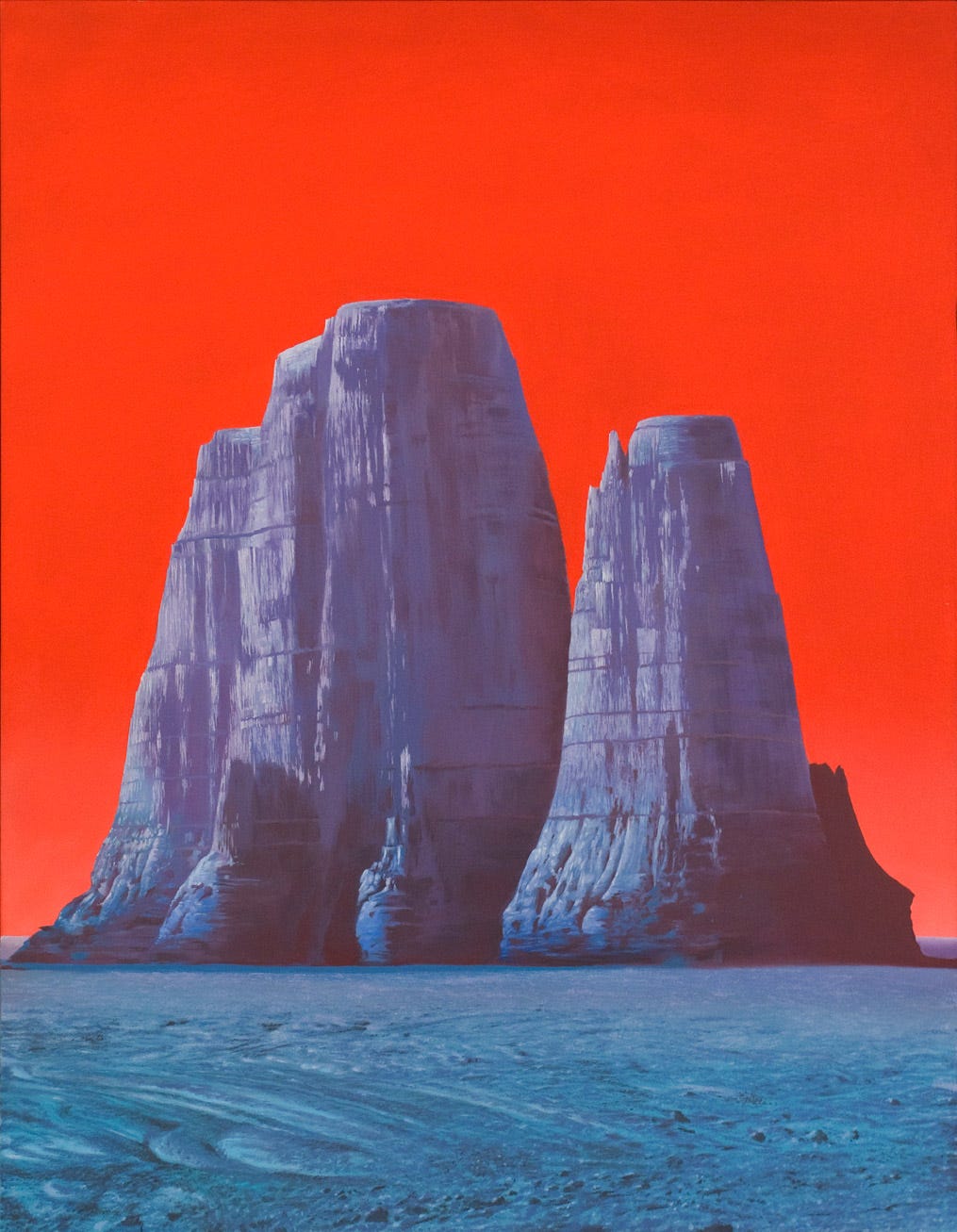
Synthesizing the perspectives of Dipesh Chakrabarty, Marcia Bjornerud, and Manuel DeLanda - alongside the Deep Time Politics of Frederic Hanusch - reveals a radical, emerging picture of Planetary Time. In this framework, time is no longer a passive, empty backdrop to human events, but a dynamic, material, and multi-layered force - and this is why it’s different from the physicist’s conception of time as well.Here are some key insights from reading these thinkers together:
1. Human history can no longer be viewed in isolation; it has violently collided with the deep time of the Earth system. Chakrabarty notes that we now exist simultaneously in two “now-times”: the short span of human civilization is suddenly entangled with the massive geological and biological timescales of the planet. This creates a severe crisis of “mismatched temporalities,” as our political, economic, and social institutions, which operate on the scale of election cycles or short-term markets, are entirely unequipped to manage human impacts on planetary carbon and geochemical cycles that unfold over millions of years.
2. Radical Decentering of the Human. Planetary Time demands that we abandon human exceptionalism. Chakrabarty distinguishes the “Globe”- a human-centric construct built by the logics of capital, empire, and technology - from the “Planet,” an Earth system that represents a radical “otherness” and operates with profound indifference to human existence. DeLanda takes this decentering even further by entirely erasing the boundary between the human and the non-human. He views human bodies, language, and cities not as the pinnacle of a linear history, but merely as temporary “coagulations” of the exact same matter-energy flows that form rocks, magma, and weather systems. Maybe we need a non-anthropomorphic karmic perspective, where our lives naturally flow into the lives of other creatures and the Earth’s material substrate as such.
3. Earth as a “Polytemporal” Tapestry. In the planetary picture, time is not a single, forward-marching arrow of progress. Instead, reality consists of coexisting structures defined by their speed of flow. DeLanda argues that physical matter flows incredibly slowly for minerals, faster for biomass, and very fast for cultural and economic systems. Bjornerud similarly observes that the Earth is “polytemporal”; the deep past is not lost, but palpably present in modern landscapes, rocks, and our own DNA. In this view, time is not just a measure; the world is literally made of time, and it possesses a wide repertoire of tempos ranging from slow tectonic shifts to sudden catastrophic snaps.
What does this mean for governance? Politically, Hanusch argues this requires the invention of a “politics of deep time” and “multitemporal governance” to deliberately manage the bidirectional interactions between human society and cosmic/geological processes. To align human actions with planetary tempos, we must redesign democratic institutions to last across generations, adopting a “trustee conception of sovereignty” to protect the rights of the unborn and the non-human. As Bjornerud suggests, this might even look like creating new infrastructures for intergenerational governance, such as appointing a “Secretary of the Future” to guide policy.
Channeling Blake and Gilman, we absolutely need a focused planetary institution that governs deep time. What shape should that take?