One final essay to close out my coverage of Space as well as Time - next month, I will bring governance, time, and space together under the banner of “Habitability.”
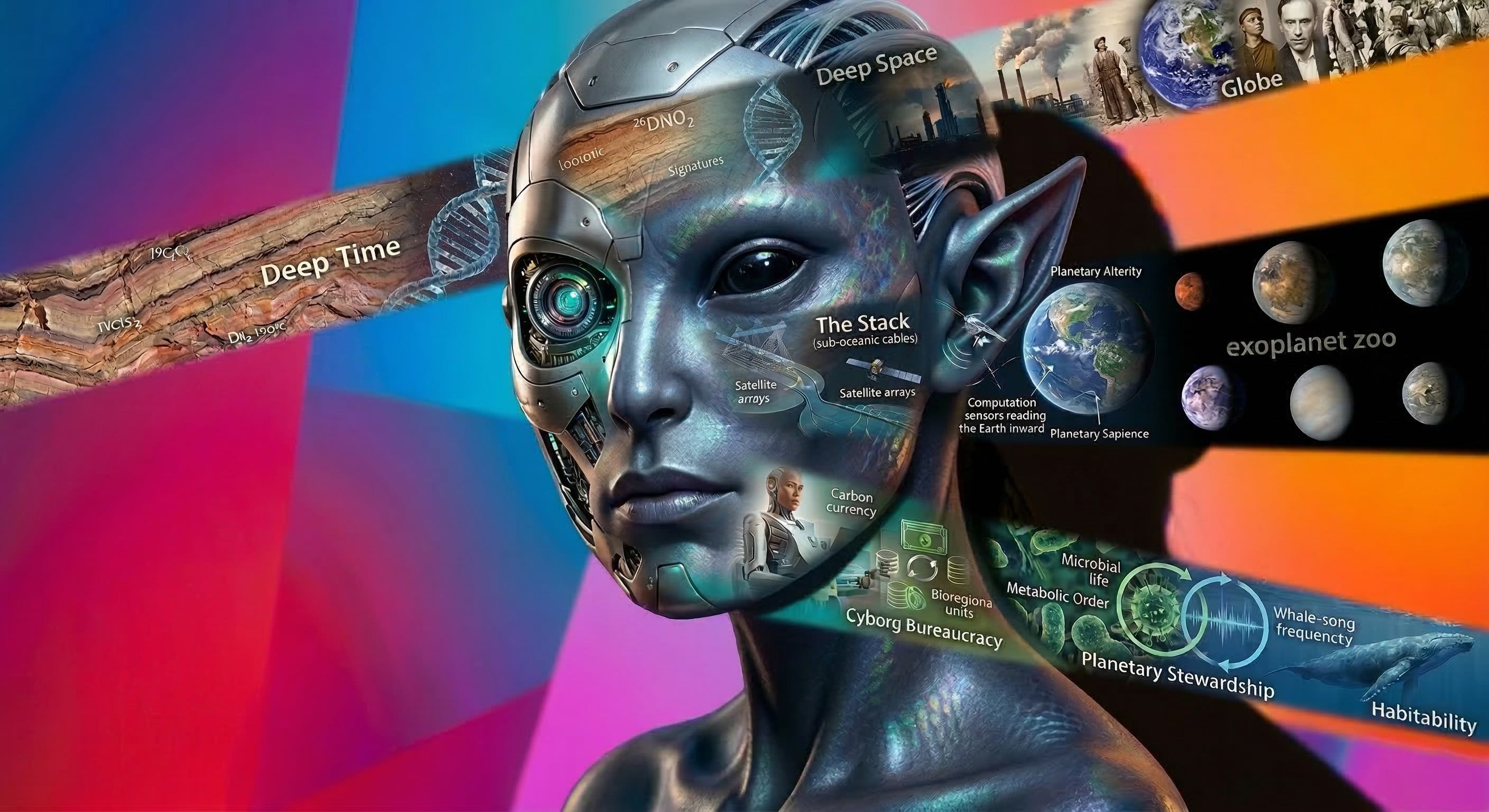
Planetary Stewardship is the wager (updated Pascal’s Wager?) that humanity can consciously govern its relationship with the Earth, acting not as autonomous masters of a passive globe, but as deeply entangled inhabitants of a living, complex system. If you recall, I argued that we are entering the Third Age of Systems Theory. The first age - Cybernetics - was defined by the Cold War, game theory, and the specter of nuclear annihilation. The second age of Complex Systems grappled with the interconnected networks of economic globalization and chaos theory. Today, we have entered the age of Planetarity. Here, the animating force is understanding both the robustness and the fragility of life on Earth, and designing machines, institutions, and behaviors that promote the flourishing of all beings.
To truly grasp what this stewardship entails, one must learn to see the world through a dual lens where we fuse the historian’s sensitivity to human meaning with the astrophysicist’s and geologist’s staggering scales of cosmic and earthly reality. Yet, the moment we attempt to adopt this dual perspective, we run headfirst into a contradiction, for the very tools and frameworks we use to measure our incredible power over the biosphere simultaneously expose our profound insignificance. This friction spawns polycrises and polyconflicts, setting the stage for the central paradox we must now confront.
That contradiction fuels our approach to planetary stewardship.
1. The Contradictions of Planetarity: History vs. Deep Time, the Globe vs. Alien Space
At the heart of the condition of planetarity lies a profound contradiction, one that animates both the temporal and spatial realms of our existence. It is the contradiction between the human-scaled world, what we call History (in time) and the Globe (in space), and the vast, indifferent reality of the Earth itself, defined by Deep Time and Deep Space.
In the temporal realm, let’s note that humanity has evolved into a dominant geophysical force: our daily impact on the biosphere is increasing, industrial emissions threaten to elevate Earth’s temperature to levels not seen in millions of years, and humans and their livestock now constitute the vast majority of land mammals. However, the very technology that enabled this planetary dominance has simultaneously revealed that the Earth is immensely ancient and vast, far beyond human control. Humans will only occupy the Earth for a small fraction of its 4.5-billion-year history.
How do we reconcile these two opposing realities: our overwhelming geological power and our fundamental cosmic insignificance?
This temporal contradiction is mirrored by a spatial one. We have conceptualized and occupied the Earth as the Globe. Globalization views the planet as a smooth, frictionless surface for trade and human borders. However, the physical reality of the Earth is a dynamic, living system characterized by intricate biogeochemical processes operating far beyond our full comprehension. Our lives are increasingly highly mediated by interlocking technological systems - which insulates us from the vagaries of the flesh, and don’t get me wrong, I wouldn’t want it any other way - but while mediation is acceptable, alienation from the Earth is not.
The spatial contradiction, therefore, is the tension between attempting to capture and enclose the planet via the technosphere, and being constantly confronted by the alien unfamiliarity of the Earth’s physical reality. Before we can even begin to build institutions to govern this space, we must first bear witness to what we have done to it. Just as the Mauryan emperor Ashoka looked upon the carnage of Kalinga and immortalized his profound sorrow in stone, we must acknowledge the immense violence of our colonial terraforming - the clear-cut forests, the factory farms, the choked oceans. We cannot erect planetary institutions without first acknowledging profound regret for our assault on the biosphere.
What would a Truth and Reconciliation Commission for the planet look like? Who will confess? Who will bear witness? Who will pronounce judgment?
2. The Planetary Durée: Overcoming the Spatial Fallacy of History
To navigate the temporal contradiction, we must fundamentally revise our conception of time, moving away from clock-time to what we might call the Planetary Durée. Dipesh Chakrabarty notes that anthropogenic global warming has forced the collision of three distinct timelines: the history of the Earth system, the history of life, and the history of industrial civilization. For centuries, human history was treated as a separate domain from natural history. But the philosopher Henri Bergson provides a vital clue for how to weave them back together. Bergson argued that we typically commit a spatial fallacy by treating time like a ruler, i.e., a line of discrete points. This spatialized time is a useful tool for physics and capitalism (measured in fiscal quarters and election cycles), but it murders the actual, fluid experience of reality. Bergson proposed durée (duration) - time experienced as a melody, where the past swells into the present.

Applying this to the Earth, a Planetary Durée suggests the planet is not a dead rock ticking through an abstract void, but a living entity made of compounded time. Marcia Bjornerud captures this beautifully with her concept of timefulness. To the geologist, the Earth is polytemporal. The deep past is not lost; it is palpably present in modern landscapes, in the isotopic signatures of ancient rocks, and in the DNA of every living cell.
Manuel DeLanda complements this scientific view with a materialist history, arguing that reality consists of coexisting material flows operating at different speeds. The slow flow of minerals and biomass coexists with the highly turbulent, rapid flow of human economics and culture.
The concept of the Planetary Durée resolves the temporal contradiction by subsuming human history into geological history. We are not separate from the Earth’s deep time; we are a fast-moving, highly conscious coagulation of the planet’s own duration. By embracing this, we acknowledge our cosmic unimportance while taking ultimate responsibility for our immediate power to destabilize the Earth’s life-support systems.
3. Planetary Alterity: The Alien at Home
Just as we must rehabilitate time, we must also rehabilitate space from a passive backdrop into an active, living participant. The fulcrum of this spatial turn is the concept of Planetary Alterity: the recognition that the Earth is fundamentally alien, inexhaustible, and impossible to fully capture within human frameworks.
The literary theorist Gayatri Chakravorty Spivak articulated this when she insisted that the “planet” must overwrite the “globe.” Where the globe is an abstract, capitalist projection, the planet is in the “species of alterity.” It belongs to another system, yet we inhabit it, on loan. Timothy Morton extends this humanistic perspective with his concept of “hyperobjects”—entities like global warming or oceanic plastics that are so massively distributed in time and space that they defy human perception and induce a sense of paralyzing dread.
The scientific perspective from astrophysics and astrobiology adds another dimension to this alterity. Astrophysicists Chris Impey and Joshua Winn point out that the exoplanet zoo includes worlds completely alien to our own Solar System. When the astrophysicist looks outward, they confirm the philosopher’s intuition: the universe is strange. But this external alterity reflects back on us, forcing us to realize that Earth, too, is an alien world.
Engaging with this alien Earth, over which we have a measure of dominion, requires a “planetary philosophy” that involves thinking with multiple cultures, but also thinking with other beings and things. A whale or a bacterium must become a legitimate interlocutor. Artificial Intelligence and ancient rock formations must be factored into our models of existence. How else can we sit together in a planetary assembly? While Bruno Latour agrees that the Earth is not a passive backdrop, he rejects the conclusion that the planet is an untranslatable mystery. For Latour, the planet is a highly reactive Gaia - a system whose decrees are brought into reality through our scientific instruments.
4. Planetary Stewardship, Metabology, and Sapience
How, then, do we live? How, then, do we act? If we accept the Planetary Durée and Planetary Alterity, what is our political and ethical mandate?
The answer is Planetary Stewardship. Stewardship requires us to embrace the central contradiction of planetarity. We must reject both the techno-utopian fantasy of fleeing the Earth to colonize Mars (abandoning our home) and the romantic fantasy of returning to an imagined pre-industrial purity (abandoning our responsibility). Instead, we need to embrace the empty planet - empty not as in empty space, but empty as in sunyata, the interdependence of all beings. In Mahayana Buddhism, the Bodhisattva vows not to achieve enlightenment until all beings do so together. Mahayanics is the translation of that vow into governance: a commitment to design for the flourishing of all beings, human and otherwise. It is a compassion protocol, a moral logic written into computing systems, recognizing that one’s own thriving depends entirely on the thriving of oceans, microbes, and future generations. The planetary steward acts simultaneously as the Architect engineering the abstractions that structure possibilities, the Connector bringing disparate human and non-human entities into a moral commons, and the Elephant holding the entire system together.
This stewardship relies on what Benjamin Bratton calls Planetary Sapience. In his framework of The Stack, Bratton describes a planetary-scale computation system - an interlocking network of energy, minerals, sub-oceanic cables, satellites, and algorithms. This is a vast, accidental megastructure that serves as the sensory apparatus of the planet itself. Part of the Stack represents a counter-Galilean movement: where Galileo pointed the telescope outward to the heavens, Planetary Sapience directs our sensors inward, toward the Earth, to read the Book of the World.
However, computation is critical here for a very specific governance reason: unlike the law, computation is executable. A traditional constitution cannot regulate a smokestack directly, but a computational protocol can. Bratton notes that the Stack currently terraforms the host planet by drinking and vomiting its elemental juices. To survive, computational institutions must also be metabolic institutions, designed to maintain the metabolic order of the Earth: keeping the lights on, the water clean, and the air breathable.
This requires what Jonathan Blake and Nils Gilman call Planetary Subsidiarity. We must move away from the traditional nation-state’s monopoly on violence over territories. Instead, we must build narrow, functional planetary institutions with teeth - cyborg bureaucracies capable of tackling specific planetary challenges like managing a carbon currency or regulating biogeochemical cycles at the global scale, while devolving all other power to bioregional and local units.
5. Habitability: An Umbrella Concept
By synthesizing time and space, history and geology, human meaning and cosmic indifference, we arrive at the ultimate metric of Planetary Stewardship. Sovereignty - the defining political concept of the Globe - must be replaced by a concept that is one level deeper and infinitely more important: Habitability. Habitability is the umbrella concept under which all of these ideas - governance, metabolic order, time, and space - come together. It is the condition of possibility for all life and all society.
In short: habitability is at the core of metabology
Habitability bridges the cosmic and the intimate. It spans the vastness of astrobiology and exoplanetary science, studying the precise thermodynamic and chemical balances required to build and sustain a habitable world in the dark void of space. But it also scales all the way down to the disciplines of architecture, urban planning, and biophilic design. It asks how we design an HVAC system, a city block, or a cybernetic feedback loop that sustains multi-species flourishing.
Next month, we will explore Habitability in detail. We will move from the cosmic parameters of Fermi’s Paradox and the Drake Equation to the material realities of extreme environment design and patterns of living architecture.
Planetary Stewardship is the wager that through philosophical engineering, executable protocols, and a profound Mahayanic respect for the alien duration of the Earth, we can secure the architecture of existence. We can ensure that the fast-moving layers of human activity do not irreversibly shatter the slow-moving foundations of the Earth's life-support systems, securing a flourishing, habitable world for the deep time yet to come.