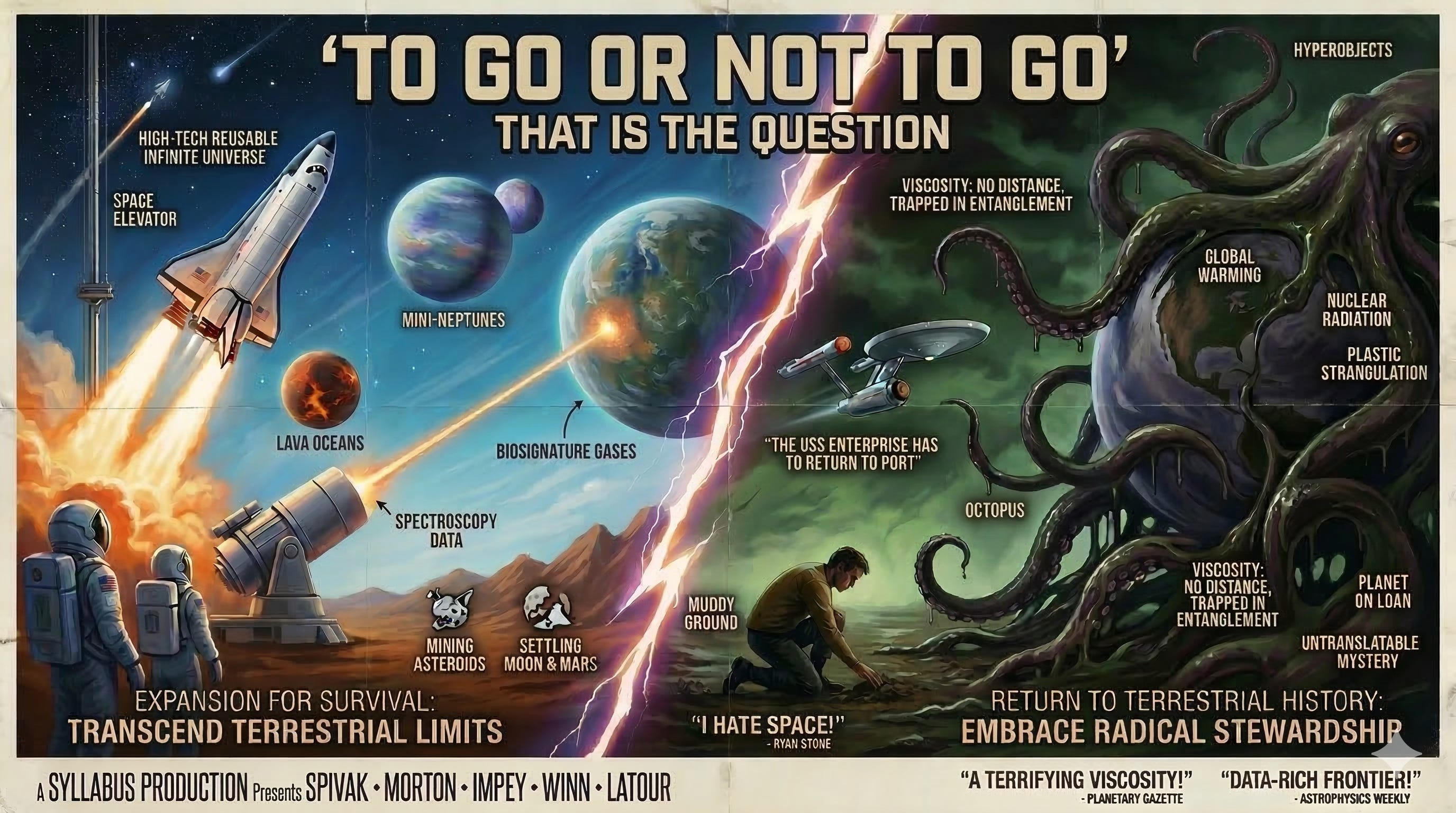
We encounter the alien in space more readily than in time. Planetary history is far removed from us, and you can never really know what it was like to be a dinosaur, but you can walk down to an aquarium and gaze at an Octopus, a creature with whom you last shared a common ancestor about 500 million years ago. Alterity is right there in front of you, but then again, the fact that the Octopus is in your aquarium (or worse, on your plate) demonstrates your ability to colonize their world. Much harder to feel the same regret for the dinosaurs who got fried by an asteroid.
Spivak and Morton
The term “Planetarity” originates in a lecture by Gayatri Chakravorty Spivak, where she establishes a break from anthropocentric geography by insisting that the planet must overwrite the globe.
I propose the planet to overwrite the globe. Globalization is the imposition of the same system of exchange everywhere. In the gridwork of electronic capital, we achieve that abstract ball covered in latitudes and longitudes, cut by virtual lines, once the equator and the tropics and so on, now drawn by the requirements of Geographical Information Systems. To talk planet-talk by way of an unexamined environmentalism, refer-ring to an undivided “natural” space rather than a differentiated political space, can work in the interest of this globaliza-tion in the mode of the abstract as such....The globe is on our computers. No one lives there. It allows us to think that we can aim to control it. The planet is in the species of alterity, belonging to another system; and yet we inhabit it, on loan. It is not really amenable to a neat contrast with the globe. I cannot say “the planet, on the other hand.” When I invoke the planet, I think of the effort required to figure the (im)possibility of this underived intuition.
She critiques the globe as an abstract, mathematical construct designed for totalizing human control and the expansion of electronic capital.
Not surprising from a postcolonial theorist, but it’s clear that the planet is the non-colonized earth. While Spivak and Chakrabarty stick to recent European colonialism, we might want to posit the planet as a refuge from settler humanity as such, which is a much longer history.
In its place, Spivak posits the planet as an entity that exists “in the species of alterity,” belonging to another system entirely, which humanity merely inhabits “on loan,” one that we cannot colonize.
Here’s where I point you towards an earlier essay of mine on the Planet as a Colony and also towards Schmitt’s idea that the Nomos of the Earth is first constituted through an act of appropriation.
By framing the planet through this profound otherness, Spivak decenters the human, insisting that planetary alterity is “underived from us” and that it “contains us as much as it flings us away”. Embracing this alterity functions as a gesture of protest against the flattening logics of global capitalism and rejects the imperial hubris of human custodianship over the Earth. Instead, it demands a dual ethics: a stewardship of a dwelling we occupy only temporarily, and a humble acceptance of the planet’s radical, untranslatable mystery as an “experience of the impossible”.
The planetarity of which I have been speaking in these pages is perhaps best imagined from the precapitalist cultures of the planet. In this era of global capital triumphant, to keep responsibility alive in the reading and teaching of the textual is at first sight impractical.
This intuition, that the planet’s vast otherness defies human mastery and totalizing knowledge, flows into Timothy Morton’s conception of the hyperobject. Morton defines hyperobjects as real entities, such as global warming or nuclear radiation, that are massively distributed in time and space relative to humans. These massive entities are - arguably - the material and ontological incarnations of Spivak’s planetary alterity.
The hyperobject is not a function of our knowledge: it’s hyper relative to worms, lemons, and ultraviolet rays, as well as humans. Hyperobjects have already had a significant impact on human social and psychic space. Hyperobjects are directly responsible for what I call the end of the world, rendering both denialism and apocalyptic environmentalism obsolete. Hyperobjects have already ushered in a new human phase of hypocrisy, weakness, and lameness: these terms have a very specific resonance in this study, and I shall explore them in depth. Hypocrisy results from the conditions of the impossibility of a metalanguage (and as I shall explain, we are now freshly aware of these conditions because of the ecological emergency); weakness from the gap between phenomenon and thing, which the hyperobject makes disturbingly visible; and lameness from the fact that all entities are fragile (as a condition of pos-sibility for their existence), and hyperobjects make this fragility conspicuous.
Just as Spivak rejects the globe because it falsely implies human mastery and a manageable, undivided space, Morton argues that the terrifying encroachment of hyperobjects brings about the end of the world. For Morton, the traditional concepts of “world,” “environment,” and “Nature” are static, objectified aesthetic backgrounds much like Spivak’s “globe”; hyperobjects destroy this illusion entirely, forcing us to realize we are not the masters of our domain.
Furthermore, Spivak’s notion that we inhabit the planet’s alterity on loan prefigures Morton’s concept of “viscosity”. Hyperobjects are viscous; they stick to us, meaning we cannot achieve a detached, objective distance from them because we are always already enmeshed inside them. We are hollowed out and coated by these entities, trapped in an intimate yet alienating enclosure that forces us to realize our painful entanglement.
Post-Humean causality is by no means a matter of “objective” versus “subjective” impressions, let alone a matter of human reality versus nonhuman reality. Rather it’s a matter of different levels of causality. It’s a matter of how entities manifest for other entities, whether they are human, or sentient, or not. Nuclear radiation-for the flower turns its leaves a strange shade of red. Global warming-for the tomato farmer rots the tomatoes. Plastic-for the bird strangles it as it becomes entangled in a set of six-pack rings. What we are dealing with here are aesthetic effects that are directly causal. The octopus of the hyperobject emits a cloud of ink as it withdraws from access. Yet this cloud of ink is a cloud of effects and affects. These phenomena are not themselves global warming or radiation: action at a distance is involved. A gamma particle is a wonder-ful example of a profound confusion of aisthēsis and praxis, perceiving and doing. A gamma particle is an ultra-high-frequency photon. In illu-minating things, it alters things: flesh, paper, brains.
Finally, Spivak describes the planet’s alterity as discontinuous and an experience of the impossible. This impossibility directly parallels Morton’s descriptions of hyperobjects as nonlocal and phased. Because hyperobjects occupy a high-dimensional phase space, human beings can only ever perceive fragmented, local manifestations of them - we might feel a raindrop or a sunburn, but we cannot directly perceive the totality of global warming or ultraviolet radiation. The hyperobject is impossible to see as a whole, rendering our encounters with it inherently uncanny and disorienting.
Spivak’s insistence on the untranslatable, inexhaustible nature of the planet paves the way for Morton’s diagnosis of the “Age of Asymmetry,” an era defined by a humiliating gap between our limited cognitive powers and the much larger, looming reality of planetarity. The two force us to abandon the illusion that we are the center of the Earth, demanding instead that we reckon with our fragile entanglement within a vast, indifferent, and profoundly alien planetary system.
Impey and Winn
Our friendly neighborhood astrophysicists are more optimistic, while endorsing Spivak’s rejection of the human-centric globe and Morton’s assertion that we must abandon the illusion of being masters of our domain. From the perspective of astrophysics, the sheer numbers and diversity of the universe definitively prove that human life is not the pinnacle of creation. Impey actively dismantles the idea that Earth is the gold standard for life, suggesting there may be superhabitable exoplanets far better suited for biodiversity than our own world.
Now that we know there are at least as many exoplanets as stars, we can put our planet in a larger context. The conclusion: Earth is not the best of all possible worlds. Life did not start in naturalist Charles Darwin’s “warm little pond.” It probably began in the darkness and crushing pressure of a hydrothermal vent
Similarly, Winn points out the bizarre diversity of the exoplanet zoo, noting that the most common types of planets in the galaxy, i.e., the super-Earths and the mini-Neptunes, do not even exist in our Solar System.
The newly discovered planets include potentially Earth- like worlds along with many exotic planets that bear little resemblance to any of the members of the Solar System. We’ve found planets on highly elongated orbits, planets on the brink of destruction by the gravitational force of a nearby star, planets as light and puffy as cotton candy, planets orbiting two stars at the same time, and planets that probably have oceans of lava.
However, while both sides acknowledge the staggering, non-human scales of planetary reality, they would radically diverge on how we should respond to it, beginning with how we understand it. Where the philosophers see an impenetrable mystery, the astronomers see a data-rich frontier. Spivak argues that the planet’s alterity is an experience of the impossible that we must accept as fundamentally untranslatable. Morton similarly argues that hyperobjects are essentially withdrawn, occupying a high-dimensional phase space that humans can never fully perceive - let’s note, however, that “high-dimensional” and “phase space” are mathematical terms that Impey and Winn would use in very different ways from Morton.
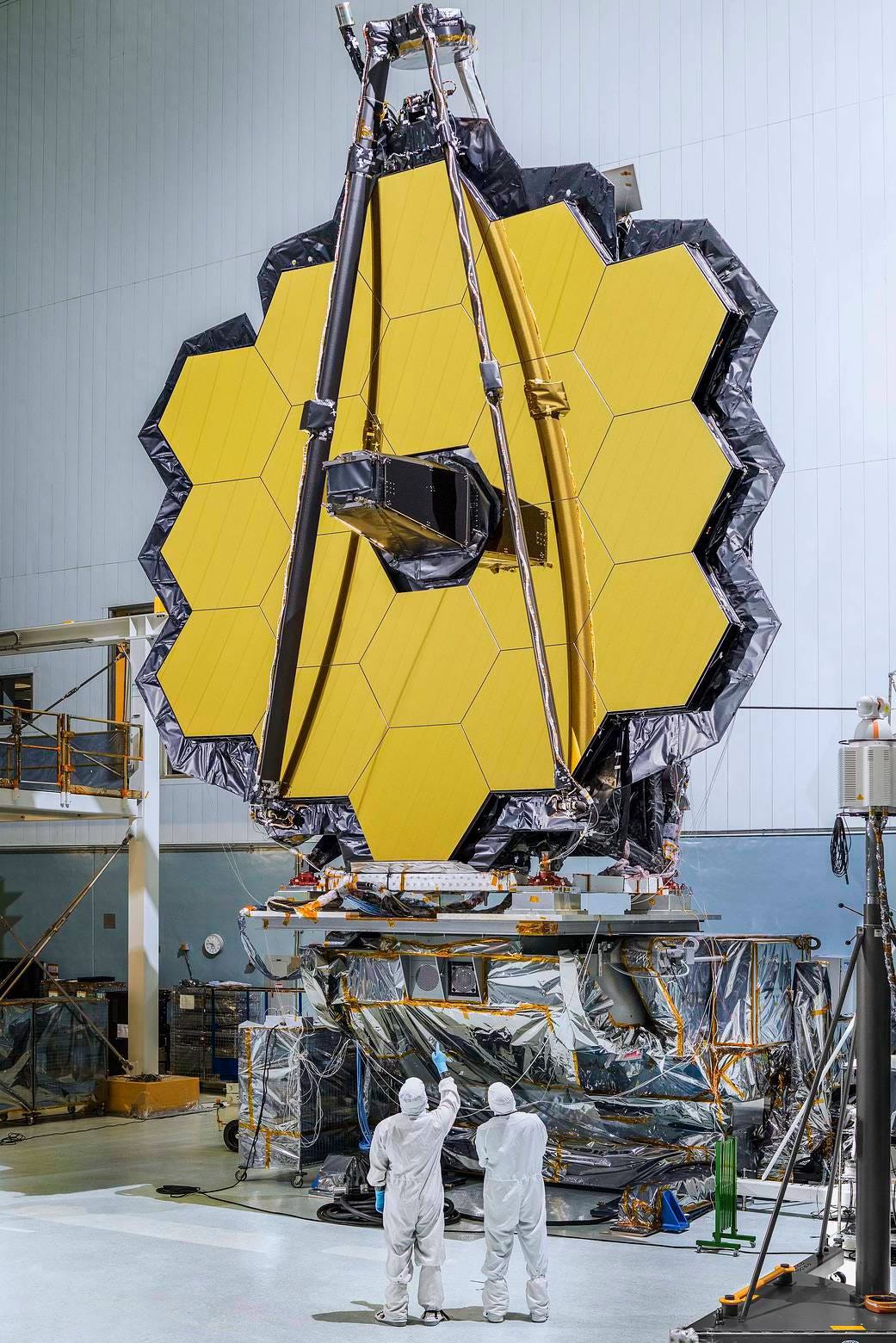
Winn and Impey would likely push back against this epistemological despair. While they acknowledge the immense difficulty of their work, they rely on a rapidly advancing technosphere of telescopes to actively translate the cosmos. I am guessing Bratton, given his fascination with Planetary Sapience, will also argue along these lines. For the astronomers, a planetary atmosphere is not an impossible alterity demanding our intellectual surrender; its chemical reality can be parsed through spectroscopy, and we are quite capable of sniffing out biosignature gases like oxygen or methane to find empirical evidence of life elsewhere in the cosmos.
We can see the outlines of a shining vision, with new opportunities for tourists and entrepreneurs— and perhaps humanity. Science fiction has long presented just about every aspect of this vision to us. But in the coming decades, with reusable spacecraft, economies of scale, and perhaps even a space elevator, it could become reality. The Moon and Mars beckon.
This epistemological split naturally leads to a divergence in action. Spivak asserts that we inhabit the planet on loan, demanding an ethics of stewardship and a rejection of the hubris of imperial control. Morton emphasizes the viscosity of hyperobjects, that we cannot achieve a detached distance from it. Impey, by contrast, would forcefully reject the idea that we should humbly accept our terrestrial limitations. Instead of remaining passively entangled in Earth’s fragile web, Impey views space exploration as a mandate for human survival. He advocates for mining asteroids, settling the Moon and Mars, and eventually sending nanobots to nearby stars to transcend the resource bottlenecks and existential threats we face on Earth. Where Spivak and Morton see the attempt to master space as an extension of the destructive, imperial globe, Impey sees the expansion of human technology into the cosmos as a necessary hedge against our own extinction.
This is the fundamental contradiction of spatial planetarity - on the one hand, trying to grasp planetarity via the technosphere and on the other hand, being confronted by what that grasp reveals in its alien unfamiliarity. I don’t want to resolve that contradiction, and might prefer to embrace it instead. If you see a planet around the sun, kill him?
Latour
Latour helps me hold the contradiction without resolving it in favor of one camp. Addressing the technoscientific optimism of astronomers like Impey and Winn, Latour would forcefully reject their dreams of space expansion and the infinite universe. He mocks the fantasy of escaping our living biosphere to colonize space, quoting the protagonist of the film ‘Gravity’, who, upon finally returning to the muddy ground, declares, “I hate space!”.
Suddenly we have to pull back on our imaginary voyages; Galileo’s expanding universe is as if suspended, its forward motion interrupted. Koyré’s title has to be read in the opposite direction from now on: “Returning from the infinite universe to the closed and limited cosmos.” All those fictional characters you’ve sent out? Bring them back! Tell Captain Kirk that the USS Enterprise has to return to port. “Out there, you’ll find nothing like us; we’re alone with our terrible terrestrial history.” As for the planet Pandora, it’s not in this direc-tion that the next front line against the Na’vi barbarians is going to continue to stretch. Moreover, in the film Gravity, Dr Ryan Stone summed up the situation nicely for us: when she finally made it back down onto the muddy earth, she confessed: “I hate space!”
Conversely, while Latour completely agrees with Spivak and Morton that the Earth is not a passive backdrop and is now actively reacting to our presence, he would firmly reject their conclusion that the planet is an untranslatable mystery or a withdrawn hyperobject that induces only paralyzing dread. Where Spivak and Morton see an experience of the impossible, Latour sees a highly reactive system whose decrees are brought into reality “inside conduits where numerous human hands helped by numerous instruments are bent on making it an external reality”.
If we aren’t specialists in this unknown object, we struggle, of course, but the procedure is exactly the same as the one we engage in every day when we consult the Internet for information about a person, place, event, or product that someone has mentioned in passing. We begin with a name that at the outset “means nothing to us”; then we unfold, on screen, a list of situations; later, after we have become familiar with them, we invert the order of things, and we get in the habit of starting from the name to deduce or summarize what it does.
The End
I don’t know if the souls of Captain Kirk and James Lovelock can be reincarnated in one body, but that’s where I would like to go if I can.