


The current global situation, whether politically, economically or ecologically, is in a state of crisis that’s boiling over into conflict. We thought we were behind wars forever; turns out not to be the case. International efforts to combat climate change have failed to gain sufficient traction. And our dominance over other forms of multicellular life continues to drive the sixth extinction. While each one of these challenges has its specific causes and conditions, I believe there’s one underlying them all: a fundamental flaw in how humans understand their relationship with the Earth.
To move forward, we must shift our perspective from the Global to the Planetary.
Globalization views Earth as a smooth surface for trade, capital, and human borders—it is entirely focused on human needs. Planetarity, however, displaces the human agent from the center to acknowledge the Earth as a dynamic, complex, and living system where human existence is deeply fused with natural, biogeochemical processes.
If Copernicus showed us that Earth wasn’t the center of the universe, and Darwin showed us that humans weren’t a unique creation but an evolving species, Planetarity represents a third major shift. It dethrones humans as the sole important agents or world-makers. It dismantles the old myth of humans as autonomous masters of nature, placing humanity instead as a highly aware but vulnerable product of the planet’s own ancient, powerful biological and chemical cycles. As the biologist Uexkull noted a hundred years ago, even a tiny tick lives in a world as meaningful to it as ours is to us. We must extend this view, recognizing that not only are we connected to all life, but that nonhuman entities - like bacteria and ecosystems - are crucial agents in creating and maintaining the world we inhabit.
The Epistemological Rupture: Apprehending the Anthropocene
The transition to planetary thinking requires a fundamental reorientation of philosophical practice. In his Elements of the Philosophy of Right, G.W.F. Hegel defined philosophy as “its own time apprehended in thought,” positioning the discipline as an act of historical self-consciousness directed toward the institutions of the modern state. Karl Marx radicalized this mandate, arguing that the point of philosophy is not merely to interpret the world but to change it, shifting the object of apprehension from the state to the material reality of capital. Hegel, Marx and their followers brought historical consciousness into the practice of philosophy and the social sciences, but that historical consciousness is limited to human history. Today, the “time” that philosophy must apprehend has undergone a transformation so profound that it displaces the anthropocentric objects of both Hegel and Marx. Why stop with time though - it’s not just history that needs reconfiguration; we also need to bring spatial consciousness into thought (the topic of this month’s essays). And more - concepts such as “habitability” (the topic of next month’s essays) and “metabolism” (also starring in next month’s essays) that have never entered the philosophical lexicon must do so, and do so urgently.
Ultimately, the planet itself must be brought into thought in a manner it’s never done before.
That’s the task of reason in the Anthropocene - a geological epoch defined by human activity operating as a planetary-scale geophysical force. Apprehending the Anthropocene requires moving beyond abstract interpretation to what I might call “Philosophical Engineering,” a practice of composing and constituting the concepts, protocols, and tools required to make the planet livable for all beings.
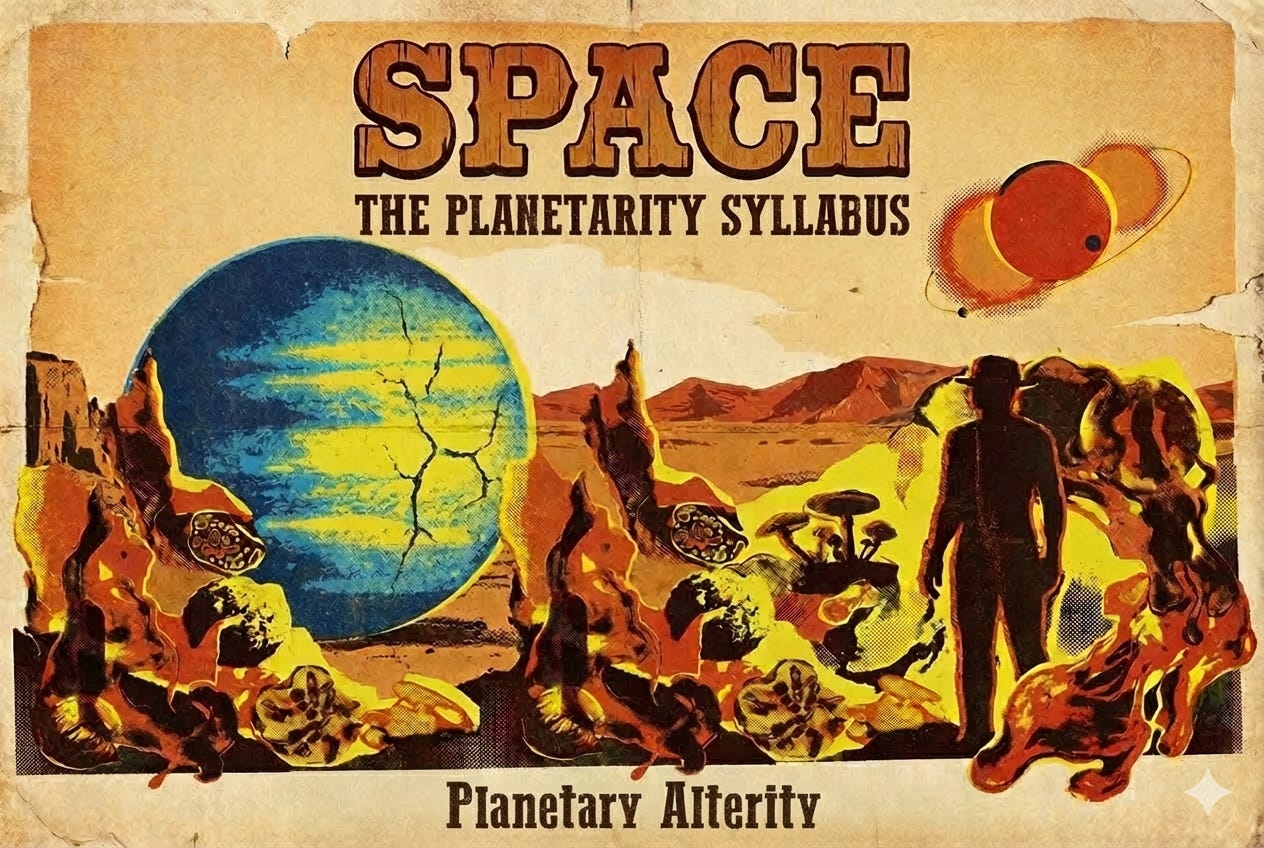
In my discussion of Time, I used ‘Planetary Duree’ as the key concept tying human and planetary history. In my discussion of Space, I will use ‘Planetary Alterity’ in the same way.
The Alien Planet
Readings for this month:
Gayatri Chakravorty Spivak: Death of a Discipline.
Bruno Latour: Facing Gaia.
Timothy Morton: Hyperobjects.
Chris Impey: Worlds Without End.
Joshua Winn: The Little Book of Exoplanets.
On Planetary Alterity
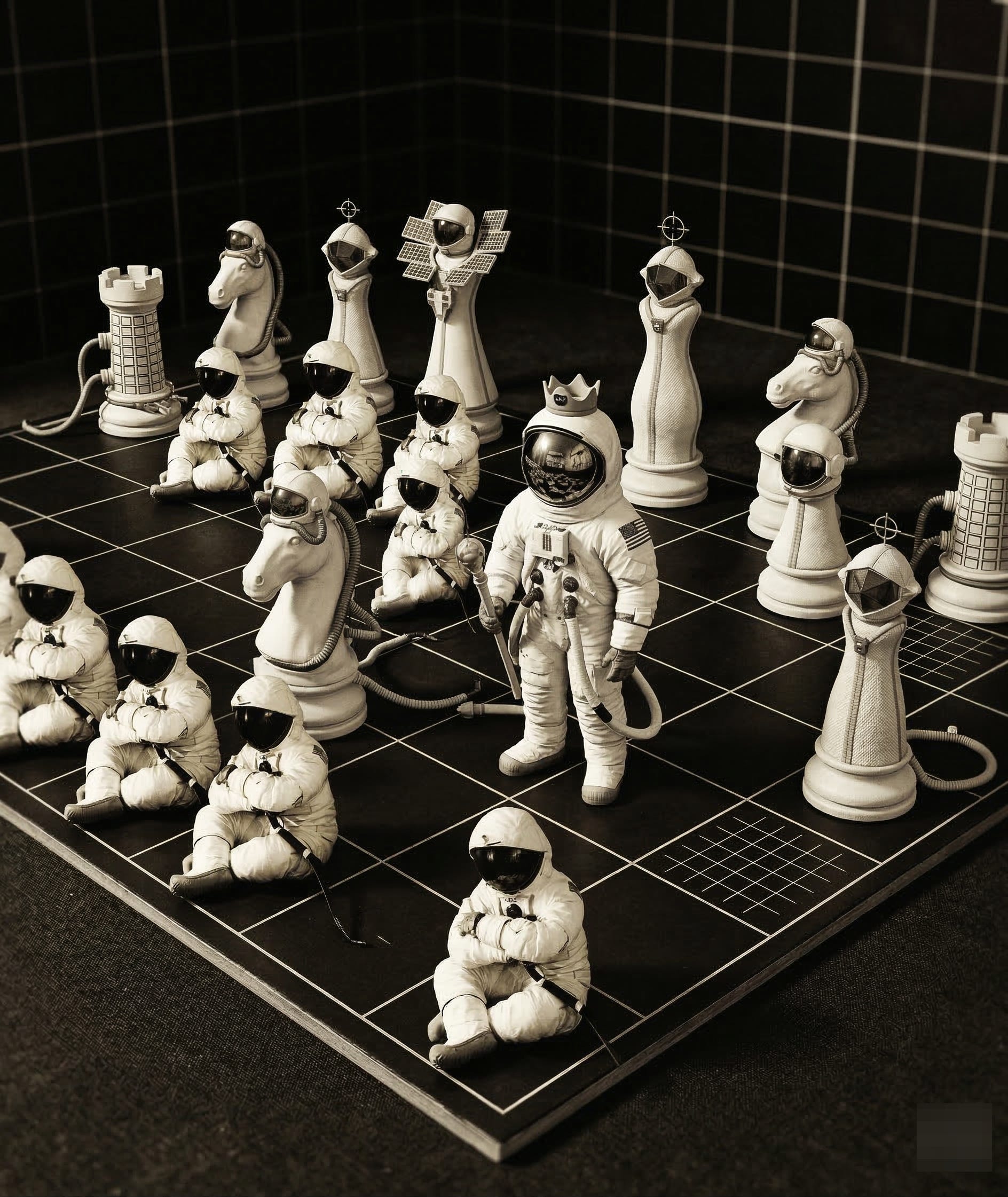
For our purposes, space is the primary domain of difference, of encountering the other. Philosophers have a fancy term for this - alterity. At its core, alterity is the philosophical study of otherness - while we often use the word “difference” to compare two things within the same category (like two different colors), alterity describes a boundary that cannot be crossed. It is the recognition that another entity possesses an internal life, a history, and a perspective that is entirely exterior to your own and can never be fully mapped or consumed by your understanding.
Eating is the fundamental contradiction of alterity - in swallowing a vegetable, a fruit or a chicken, I assimilate the other into myself, but in doing so I reduce their interiority to nothing. In consuming the other, I have absorbed part of their being, but the rest is lost to me for eternity.
In the phenomenological tradition, particularly in the work of Emmanuel Levinas, alterity is not just a concept but an ethical event. Levinas argued that when we encounter the ‘Face of the Other,’ we are confronted with a radical alterity that we cannot control or categorize. This gap between the Self and the Other is the very foundation of ethics; because the Other is fundamentally not me, I am called into a state of infinite responsibility toward them. Ultimately, alterity is the acknowledgment of a not-me that is just as real as me. It is the realization that no matter how much we empathize or communicate, there remains an irreducible core in every other person that remains mysterious and sovereign. Alterity is what prevents us from turning people into mere objects or extensions of our own egos.
Why stop with people? Why not chickens and ticks and rocks and mountains? Why not the planet?
Radical alterity is the premise behind Gayatri Chakravorty Spivak’s conception of Planetarity (she coined the term) as a counter to the homogenizing forces of globalization. In Death of a Discipline, Spivak posits that the planet exists in the ‘species of alterity’ - belonging to another system that humans inhabit merely on loan. Planetarity, for Spivak, is not susceptible to the totalizing grasp of the human subject; it resists the museumization of the Earth inherent in neoliberal concepts like ‘sustainable tourism’.
We are entangled in a world that’s radically unlike us; solidarity with its Planetary Alterity is the key spatial challenge.
Gaia and Hyperobjects
To grasp this entangled reality, contemporary theory relies on concepts that transcend the outdated Nature/Culture dualism. Bruno Latour’s figure of Gaia strips away romanticized notions of Mother Earth, presenting instead a secular, political, and agentic assemblage of living and non-living actors whose interactions constitute the Earth system without centralized control. Similarly, Timothy Morton’s concept of ‘hyperobjects’ - entities like global warming, the carbon cycle, or oceanic plastics that are massively distributed in time and space - illustrates the difficulty of planetary apprehension. In his framing, Hyperobjects are viscous (they stick to us), nonlocal, phased, and interobjective, rendering traditional modes of perception and isolated environmental management obsolete.
Exoplanets
Hyperobjects are not the only way to alienate ourselves - we can also peer into alien worlds, that the Earth is just one planet among many. Paradoxically, looking for life elsewhere in the universe might be the best way to deepen our grasp of the condition of planetarity. In the last thirty years, we have gone from knowing nothing about planets around other stars to cataloging over 5000 (and increasing by the day). This planetary diversity is as much a species of alterity as the ones Spivak writes about. We will round off our exploration of space with two readings on Exoplanets: Chris Impey’s Worlds Without End and Joshua N. Winn’s The Little Book of Exoplanets. While Impey takes a sweeping, astrobiological approach that links distant worlds to the future of humanity, Winn grounds the discussion in the rigorous data of planetary detection and the practical limits of observation.
Both Impey and Winn emphasize that the most profound discovery of the last thirty years is simply the sheer number of planets. Current statistics indicate that there are more planets than stars in the Milky Way. Impey projects this out to the entire observable universe, estimating there are roughly a thousand billion billion (10^21) potential biological experiments out there.Winn highlights that the true surprise is not just the abundance, but the bizarre diversity of these worlds. The exoplanet zoo includes planets with highly elongated orbits, hot Jupiters on the brink of destruction, planets orbiting two stars at once (circumbinary planets like Tatooine in Star Wars), and puffball planets as light as Styrofoam. Most notably, Winn points out that the two most common types of planets found in the galaxy - ‘super-Earths’ and ‘mini-Neptunes’ - do not even exist in our own Solar System. Looking at the unfathomable number of galaxies, stars, and planets, Winn concludes that “every possible chemical reaction has been repeated many times in many places, including those that spawn life. The only question is how far we need to look”.
The condition of Planetarity is characterized by qualitative and quantitative alterity
Thank you for sharing these thoughts Rajesh. I really like all the ideas you discuss. Specifically to the point of eating - where the act of consuming the other eliminates their wholly different world into just fuel for us. The rituals of gratitude for food and harvest that is done among so many indigenous peoples of the world, I think address that issue. Viewing harvest of even plants as needing ceremony and gratitude is a great way to concretely presence and be conscious of our acts and relationships to the world