The Principle of Habitability
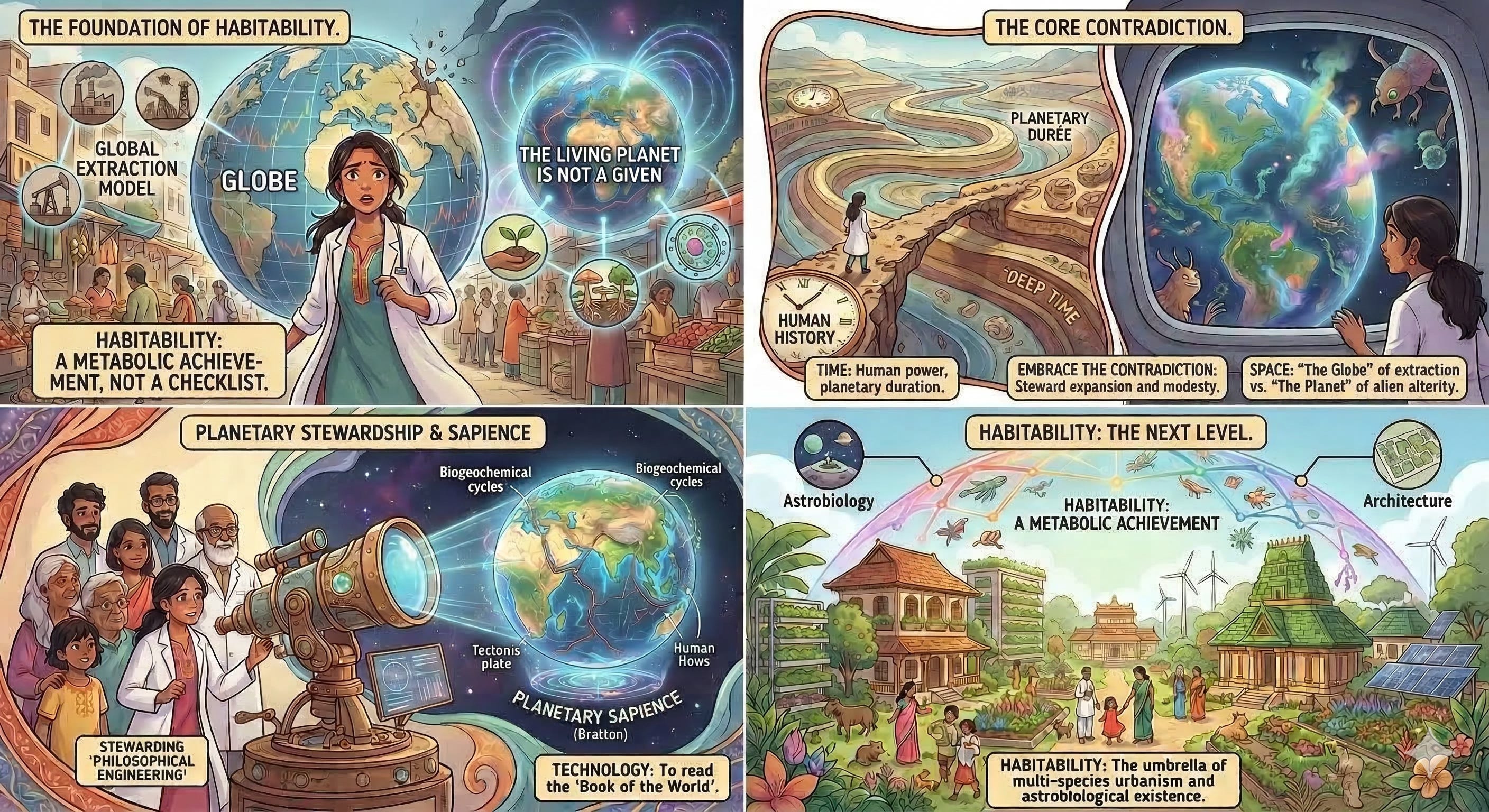
Behind every contemporary anxiety about the future of the Earth (and of human civilization, whatever that might mean), is an existential question: what makes a planet livable? Not just for humans, not just for the present century, but for the full community of beings that constitute Earth’s living systems, across the vast scales of time that geological and biological history demands. That question is the question of habitability, and exploring its diverse manifestations requires a radical shift in how we perceive our place in the cosmos.
What makes a planet habitable?
If you ask an astrobiologist scanning the heavens for exoplanets with the potential for life, they will likely refer you to a checklist: liquid water, a breathable atmosphere, moderate temperatures, a rocky surface, and the right cocktail of biogenic elements. This is the search for the Goldilocks Zone - a planet not too hot, not too cold, but just right. But the astrobiologist isn’t our only consultant, for habitability as a planetary concept is far richer, more dynamic, and more philosophically demanding than any checklist can capture. It is not an accidental sweet spot in a solar system. At its core, habitability is a relational concept: a planet is habitable not because it possesses certain fixed, sterile properties, but because the complex relationships between its geological, atmospheric, chemical, and biological systems are mutually sustaining over time. Habitability is a condition that living systems produce just as much as they require.
It is, in other words, a metabolic achievement.
More speculatively, you might have heard of the Anthropic Principle. The Anthropic Principle takes this idea of metabolic achievement and pushes it to its ultimate logical conclusion, suggesting that the very laws of physics and the fundamental constants of the universe appear suspiciously fine-tuned to allow for the emergence of life and, eventually, observers like ourselves. It posits that we should not be surprised to find ourselves on a planet that is habitable, because if the universe were any other way - if the nuclear force were slightly weaker or the expansion rate of the Big Bang slightly faster - we simply would not be here to ask the question.
In its weak form, the principle is almost a tautology of selection bias: of course we inhabit a Goldilocks world, because a non-habitable world produces no historians to document its sterility. However, the Strong Anthropic Principle suggests something far more radical: that the universe must have those properties which allow life to develop within it at some stage in its history. This shifts the planet from being an accidental chemical reaction to a necessary ontological frame.
I am betting on the Strong version, but in the context of the planetary zoo - that the necessity of life goes hand in hand with a diversity of living contexts. If so, habitability is built into the universe. It’s a pretty wild bet, and how would we test it? A slightly weaker version is to take the necessity of habitability as a hypothesis and see what conclusions we might be able to draw and then refine the hypothesis further until we don’t need the original hypothesis anymore - we have downstream consequences that can themselves be viable starting points for empirical research.

I. Habitability as Metabology
Back to Earth: to understand habitability, we must situate it within the framework of metabology, the flows of matter and energy that constitute life at planetary scales. Metabology posits that life and its environment are not separate entities interacting across a void, but rather a unified, continuous flux. To understand habitability is to understand the governance of these flows across both space and time.
Spatially, planetary metabolism requires the establishment of boundaries and interfaces, what we might term Bhumic architecture. The soil beneath your feet, the ocean currents cycling nutrients across hemispheres, the atmosphere regulating heat and filtering radiation are all active, semi-permeable membranes regulating the exchange of carbon, nitrogen, water, and photons, the skin of the world, so to speak. They are the spatial manifestations of planetary metabolism.
Space is only half the equation. Drawing upon Bergson’s concept of durée - a continuous, indivisible flow of lived time - we recognize that a planet’s habitability cannot be measured in the discrete clock time of human observation, but in the deep time of planetary durée. A habitable planet is one that has mastered the temporal governance of its metabolic cycles, maintaining a precarious, wobbling homeostasis over millions and billions of years, despite shifting solar luminosities, asteroid impacts, and massive geological upheavals.
Therefore, habitability is fundamentally a question of governance, not in the narrow political sense of parliaments and treaties, but governance as the distributed, decentralized regulatory system by which a biosphere negotiates its own survival. It is the complex web of feedback loops managing the spatial distribution of resources and the temporal pacing of evolutionary adaptation. To ask if a planet is habitable is to ask a systemic question: does it possess the metabolic infrastructure to govern its own duration?
Where do we come into this picture as planetary stewards? Answer: through the conscious act of terraforming.
II. Terraforming as Philosophical Engineering
How, then, do we actually study something as vast, complex, and temporally extended as planetary habitability? Science has traditionally relied on observation and analysis - breaking systems down to understand their component parts. But in recent decades, a powerful new epistemological paradigm has emerged: the paradigm of synthesis. This approach is best captured by a principle often attributed to the physicist Richard Feynman, found written on his chalkboard at the time of his death: “What I cannot create, I do not understand.” Note - ironically, Feynman was an arch reductionist, claiming in his famous lectures on physics that the most important discovery of all time is “matter is made out of atoms,” but I digress....
This is the essence of philosophical engineering: the practice of constructing conceptual and material frameworks that reveal the deep structure of the phenomena they attempt to replicate. The synthetic method does not merely interpret the world; it builds versions of the world, and in building, discovers what observation alone could never see.
Artificial intelligence researchers took this seriously from the start. If you want to understand the mind, they reasoned, build one. Your theory of cognition can be tested in the most direct possible way: does a system built according to those principles actually think? By engineering a cognitive architecture from silicon - by testing the hypothesis of substrate independence - researchers isolate the functional logic of intelligence from its biological wetware. The early failures of classical AI - its inability to handle context, embodiment, or tacit knowledge - revealed that mind is not a disembodied symbol-manipulating system. The attempt to build a mind led to claims that the mind cannot be separated from its environment. Then again, maybe it can - the successes of Deep Learning is convincing many that all we need is massive amounts of data fed into a brain in a vat.
Synthetic biologists applied the exact same constructivist logic to life. If you understand how living systems work, you should be able to synthesize one. When researchers at the J. Craig Venter Institute created the first artificial bacterial cell in 2010, and later stripped it down to a minimal functional genome, they found that roughly a third of the essential genes required for life had entirely unknown functions. By stripping away evolutionary noise and building life from standardized parts, synthetic biology moved from describing biological phenomena to demonstrating the absolute algorithmic requirements for vitality. Don’t get me wrong - we are far from synthesizing life from scratch, but the attempt to do so opens up questions about possible life that are quite different from the study of life as it has evolved.
Now, extend this logic one step further. If artificial intelligence is the synthesis of the mind, and synthetic biology is the synthesis of the cell, then terraforming is the synthesis of the planet. Terraforming - the deliberate transformation of a planet’s surface, atmosphere, and climate to make it habitable - is the constructivist method applied to planetary habitability. It is the ultimate epistemological tool, a privileged way of understanding what makes a world livable.
Consider the (realizable?) thought experiment of terraforming Mars. Our best understanding as of today is that Mars is a dead rock - to terraform Mars would be a profound synthetic inquiry into the mechanics of genesis, and potentially a violently evil act - terraforming forces us to take ethics where it’s never gone before. By attempting to induce a planetary metabolism from a cold start, we are forced to define exactly what a Minimal Biosphere requires.
Imagine the proposed pathways: placing orbital mirrors to vaporize the Martian polar caps, releasing engineered greenhouse gases to thicken and warm the atmosphere, redirecting comets to deliver water ice, and introducing genetically modified cyanobacteria to the regolith to begin producing oxygen. What is philosophically revelatory about this exercise is not whether it is technically feasible with today’s rockets, but what it forces the intellect to confront. You immediately discover that you cannot do any one thing in isolation. Warming the atmosphere changes the barometric pressure, which alters the water cycle. Introducing water alters the chemical weathering of rocks, which changes atmospheric chemistry. Seeding with life changes the atmosphere, which in turn changes the selective evolutionary pressures on the life you just introduced.
Every intervention is entangled. The system responds to your engineering as a complex agent in its own right, not as a passive recipient of your blueprints. Every failure in this theoretical process - every toxic soil interaction, every atmospheric leak - teaches us a crucial lesson about the hidden regulatory mechanisms that make Earth work. Terraforming forces us to transition from descriptive Earth sciences to prescriptive planetary engineering.
Hypothesis: we will not truly understand the ‘mind of a planet’ (its self-regulating systems) until we attempt to engineer its body.
Through the rigorous crucible of attempting to make a dead world live, we learn that life is not just something that happens on a planet; life is something that happens to a planet.

III. The Autopoietic Earth: Billions of Years of Terraforming
Now let’s turn that thought experiment back toward Earth, because Earth itself has been through exactly this process of terraforming. Once we adopt this synthetic lens, once we recognize terraforming not as science fiction but as the active engineering of habitability, we see the history of our own world in an entirely new light. Earth was not born habitable for the life that exists today; Earth was terraformed by the life that exists today.
Is terraforming the missing link between human history and planetary history? Between the Globe and the Earth?
The early Earth, ~ 4.5 billion years ago was not the verdant blue marble we know. Its atmosphere was thick with carbon dioxide, methane, and nitrogen, with virtually no free oxygen. Its oceans were rich in dissolved iron, and its surface was bombarded by ultraviolet radiation that would destroy most modern organisms within minutes. By any contemporary standard, it was an alien, highly lethal world. And yet, in that hostile environment, life emerged- and then proceeded, over billions of years, to transform the planet into something hospitable for an entirely different class of organisms, including, eventually, ourselves.
The history of our planet is a history of relentless, autopoietic (self-creating) biological engineering. The most profound terraforming event in our solar system did not occur through human technology, but through the metabolic innovations of cyanobacteria during the Great Oxidation Event, approximately 2.4 billion years ago. These microscopic planetary engineers invented oxygenic photosynthesis, harnessing solar energy to crack water molecules and excrete oxygen as a toxic metabolic byproduct.
Over hundreds of millions of years, this oxygen accumulated. It first reacted with dissolved iron in the oceans, producing the banded iron formations that geologists now read as the signature of this biological revolution, and then built up in the atmosphere. In doing so, these microbes triggered a mass extinction of anaerobic life, plunged the planet into a deep freeze by stripping the atmosphere of heat-trapping methane, and fundamentally altered the chemical composition of the sky and the sea.
They completely rebuilt the planetary interface. Life has been continuously modifying Earth’s habitability since it first appeared. Plants and their fungal predecessors transformed rocky, barren landscapes into living soils, creating entirely new Bhumic substrates for terrestrial life. Forests evolved to alter precipitation patterns, generating their own rain and regulating regional climates. Marine organisms, living, dying, and sinking, drove carbon into deep-sea sediments, drawing down atmospheric carbon dioxide over geological time scales and creating the limestone cliffs of today.
James Lovelock and Lynn Margulis, in developing the Gaia hypothesis, were pointing at exactly this reality: the biosphere is not a passive inhabitant of Earth’s surface, merely adapted to whatever conditions happen to prevail. It is an active modifier of those conditions. The planet and its biosphere have been in a relationship of mutual terraforming from the beginning.
Understanding Earth’s history as a massive, ongoing terraforming project demystifies the concept. It reveals that planetary engineering is not an unnatural violation of a pristine natural order; rather, it is the defining characteristic of a living world. Habitability is a hard-won, metabolically expensive state of equilibrium that must be constantly maintained against the relentless forces of cosmic entropy. The cyanobacteria were planetary engineers. The forests are planetary engineers. The question, therefore, is not whether planetary engineering is permissible, but what kind of planetary engineering serves life.

Readings for this Month
We have an eclectic stew this month, ranging from astrobiology to architecture.
How to Build a Habitable Planet - Charles Langmuir and Wally Broecker. A supplementary reading for Month Two on Time, a core reading this month.
A Foray into the Worlds of Animals and Humans with A Theory of Meaning - Jakob von Uexküll. One of my all time favorites. Ed Yong’s An Immense World is a contemporary, popular rendition of Uexkullian ideas.
A Pattern Language - Christopher Alexander. Another all time favorite. We will not be able to do ‘wise’ terraforming without incorporating Alexander’s ideas.
A City on Mars: Can We Settle Space, Should We Settle Space, and Have We Really Thought This Through? - Kelly and Zach Weinersmith. Popular account of the promises and perils of terraforming.
The Goldilocks Enigma - Paul Davies. Popular exposition of fine tuning and habitability. There’s also the OG book on the Anthropic Principle by Barrow and Tipler.
It goes without saying that we won’t be reading these books from cover to cover in one month.
The underlying ambition, even if it’s a bit much for any single person to comprehend: to understand habitability, we must simultaneously hold the macro-scale of planetary formation - how a dead rock becomes a vibrant, life-sustaining system, as Langmuir and Broecker detail - and the micro-scale of lived experience, except that it’s not just human lived experience! Von Uexküll’s concept of the Umwelt is crucial here; he argues that every organism inhabits a subjective, meaningful world. A habitable planet sustains myriads of intersecting, subjective worlds.
If life itself is the original, relentless planetary engineer, then our conscious efforts to shape our environment must align with its deep logic. Christopher Alexander’s pattern language offers a methodology for this alignment, demonstrating how the spaces we build can either nourish or deaden the metabolic order of the communities that inhabit them. Whether we are designing a sustainable neighborhood on Earth or settling Mars, as the Weinersmiths explore, we cannot simply export our current extractive paradigms to new environments. In doing so, we will fulfil the promise of planetary sapience: the conscious, deliberate maintenance of the metabolic processes that allow the Earth to remain our home.