This essay is the 4th essay in the Planetarity Syllabus, part of a series on Governance, of which the other essays are:
The Three Ages of Systems Theory
I am not a historian, but to my untrained eye, there are three ages of systems theory.
The first age, which you might call the age of cybernetics, came around soon after the Second World War, of course, hit its stride during the Cold War and was often tied to geopolitical concerns. This first age led to developments such as game theory and control theory, which were about dropping nuclear bombs on other people, or preventing bombs from being dropped by those other people on you. Whichever way you look at it, the nuclear bomb and nuclear technology were very closely tied to the cybernetic age. That’s age number one. And if I had to think of an institution that’s associated with the cybernetic age, it is the RAND Corporation.
Number two is the age of complex systems. It came into prominence around the time the Soviet Union was collapsing, which is not totally surprising since one of the key challenges for complex systems was grappling with economic globalization, which only became possible when the whole world came under the sway of capitalism. Throughout the sixties and the seventies, we had become more aware of the complexity, not just of economic systems, but of social systems more generally, and outside the human realm, the complexity of the weather, of ecological systems etc. The second age of systems is tied to chaos theory, complexity theory and towards the tail end, about networks - it brought ideas such as complex adaptive systems into the lexicon of many scholars. Physics of the “more is different” kind was the central discipline of the second age, and if there is an institution associated with this age, it is the Santa Fe Institute.
Now we are at the third age of systems, and in my mind the most important one yet. Like the first Cold War, this one also has a magical new technology at its center: AI. But we haven’t forgotten the insights from complexity and network science; the US and China are still intertwined with each other, not separate camps in the manner of the first Cold War. So many of the insights of the second age are also valid. But if I had to think of a ‘key factor,’ the animating force behind the third systems age (the key factor for first one being nuclear war and the second one being globalization) then the key factor for the third is planetarity, of understanding both the robustness and the fragility of life on Earth and how humans are intertwined with the Earth’s biogeochemical systems, and to design machines, institutions and behaviors that promote the habitability of the Earth and the flourishing of all beings who inhabit it. There’s no institution that comes to my mind as the central institution of this third age (perhaps because the age hasn’t dawned yet), but I know the discipline that is at its core: philosophy, properly configured, so that it’s no longer an abstract discipline that lives only in the ivory tower, but also a material practice that reaches out into the world.
Planetary philosophy is the yet to awaken third eye of cybernetics.
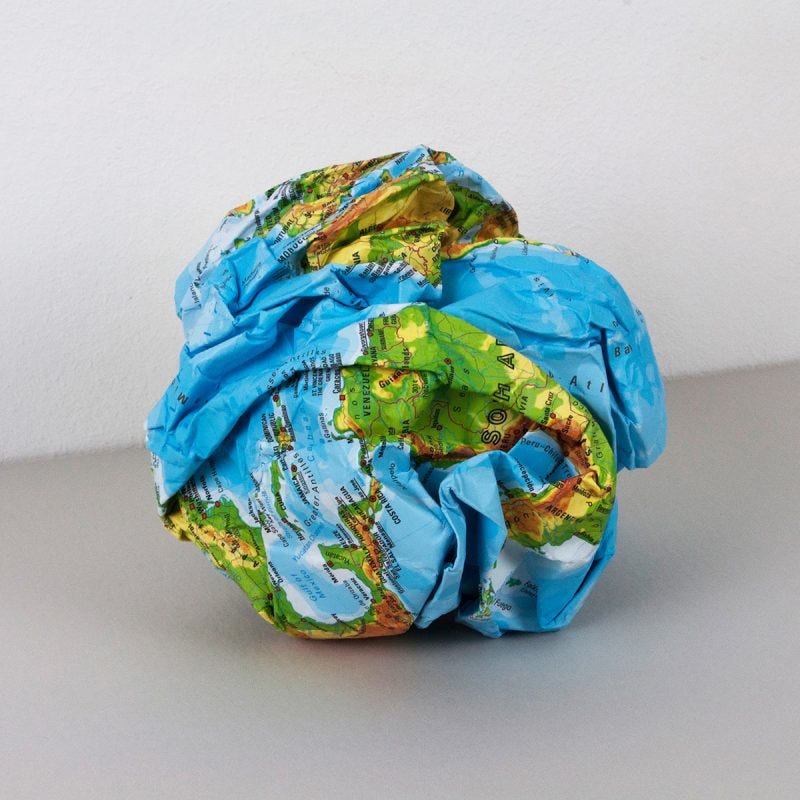
Some thoughts on Planetary Philosophy
In one of the most influential dicta of modern philosophy, Hegel declared that “philosophy is its own time apprehended in thoughts”. This assertion, found in the preface to his Elements of the Philosophy of Right, reframed the philosophical enterprise not as a timeless speculation on eternal verities, but as an act of profound historical self-consciousness. For Hegel, to philosophize was to render in concept the essential character of one’s own epoch, to grasp the “inherent rationality” of the institutions - the family, civil society, and above all, the state - that constituted the lived reality of the age. This act of apprehension (German: begreifen) is not a passive reflection but an active, systematic comprehension, a step-by-step intellectual seizure of the logic immanent within the historical world. Hegel’s project was to take the given reality of the modern state and portray it as something “inherently rational,” a task he believed was the definitive philosophical mandate for his era, the “epoch of the state”.
What might a Hegelian seizure of the planet look like?
This Hegelian vision was sharpened and radicalized by Karl Marx. In his “Theses on Feuerbach,” Marx famously countered: “The philosophers have only interpreted the world in various ways; the point, however, is to change it”. When read against the backdrop of Hegel’s work, Marx’s eleventh thesis does not represent a simple rejection of apprehension but rather its radical intensification. The German verb begreifen carries a potent ambiguity, meaning both to understand and to seize or arrest. Marx leaned into this second meaning, transforming the philosopher from a mere commentator into an agent of historical transformation. His critique was a demand that philosophy move beyond abstract interpretation and engage in “revolutionary practice”. To apprehend the world, for Marx, was to uncover its underlying economic structures, indict the systems of exploitation they engendered, and catalyze the material, political action necessary to remake it.
This romantic vision of the philosopher as a metaphysical detective - part commentator, part conspirator in history’s unfolding - animated the intellectual and political currents of the nineteenth century. The figure of the ivory-tower thinker was recast as a worldly investigator, tasked with diagnosing the maladies of the age and prescribing the means of its transformation. Planetary Philosophy inherits that romance, viewing philosophy not as a sterile scholastic exercise but as a practice of apprehension dedicated to midwifing collective wisdom in turbulent times.
The Earth itself has entered the frame of philosophy, not as a passive backdrop for human history, but as an active, entangled participant. To fulfill Hegel’s mandate today, i.e., to apprehend our age in thought, is to apprehend the Anthropocene. This task compels a fundamental re-evaluation of philosophy’s core questions, extending its inquiries beyond their traditional humanist boundaries and into planetary horizons, for two centuries after Hegel and Marx, the “time” that philosophy is called upon to apprehend has undergone a profound and startling transformation.
To apprehend our age is no longer to grasp a society, a spirit, or a mode of production alone. It is to confront a new geological epoch (rejected by geologists) defined by the fact of human beings becoming a planetary-scale force, altering the Earth’s climate, atmosphere, biosphere, and geological strata. And the opening into geological time afforded by the anthropocene is a challenge to think philosophically about deep time that’s unfolded for much much longer than humans have existed as a species. We must ask anew: What is being apprehended? Who is doing the apprehending? And by what means is this apprehension to be achieved?
The Planetary Shift: What is Being Apprehended?
The object of philosophical apprehension has undergone a decisive expansion. For Hegel, the object was Geist (Spirit), the unfolding of freedom through the rational institutions of the modern state. His philosophical system was an attempt to comprehend the logic of human history as it culminated in the political structures of his time. For Marx, the object was capital, the system of social relations of production that structured exploitation and alienation under industrial modernity. In both monumental projects, the focus of apprehension remained firmly fixed on the domain of human history - society, politics, and the economy. The non-human world, or “Nature,” was treated as an external stage upon which the human drama unfolded, a collection of resources to be mastered and transformed. A “standing reserve” as Heidegger called it.
Today, this anthropocentric confinement is no longer tenable. The object that must be apprehended is the Anthropocene, along with the Earth as a being (Being?) deeply and irrevocably entangled with human activity. The historian Dipesh Chakrabarty argues that the climate crisis forces us to think across two incommensurable but now inseparable registers: the short arc of human history and the deep time of geology. The Industrial Revolution, once understood as an event in the history of human freedom and economic development, must now also be understood as a geophysical event, a turning point in the planet’s climate history. This forces an expansion of apprehension from the human condition to the condition of planetarity (hence this syllabus!).
This shift requires philosophy to develop a new conceptual apparatus, one capable of thinking with the same rigor about the flows of carbon, nitrogen, and silicon as it once did about Platonic forms or Kantian categories. The object of inquiry now includes not just human institutions but forests, oceans, and glaciers; not just human subjects but the vast multitude of beings with whom we share this planet.
Does philosophy - or something like it - have anything to contribute at all?
This is not merely a matter of adding scientific data to philosophical reflection. It represents a fundamental reworking of philosophy’s ontological commitments, demanding that process, relation, and entanglement be treated as primary categories of being. This move is strongly supported by the “new materialist” turn in contemporary thought, which challenges the traditional separation of nature and culture and emphasizes the agency and dynamism of matter itself. The world is no longer a collection of inert objects awaiting human inscription, but a vibrant field of “intra-actions” where human and non-human forces are co-constitutive.
This ontological expansion leads to ethical expansion as well. If philosophy once centered its ethical inquiries on the question, “What is the good life for humans?”, it must now confront a more encompassing question: “What constitutes the flourishing of beings?”. The scope of justice necessarily enlarges from the confines of human communities to the complex domain of multispecies entanglements. Apprehending the Anthropocene means reckoning with the conditioned and interdependent nature of all life within fragile and reactive Earth systems. It demands a metaphysics of material flows, an ethics of multispecies kinship, and a politics adequate to a planet in which the old dualism between society and nature has collapsed. The anatomy of this new apprehension will eventually be articulated through what I have called the five fingers of planetarity - Metabolics, Expanse, Multitude, Technosphere, and Mahayanics - but first, it is necessary to clarify who is qualified to participate in this expanded act of apprehension.
The Widening Circle: Who is Doing the Apprehending?

Just as the object of apprehension has expanded, so too must the circle of apprehenders. Justin E. H. Smith, in his The Philosopher: A History in Six Types, provides a useful taxonomy of philosophical types: the curious natural philosopher, the sage, the ascetic, the gadfly, the mandarin, and the courtier. Each archetype, from the truth-teller to the life-guide to the power-consultant, represents a specific function performed by a particular kind of human within a human society. In the Anthropocene, however, this exclusive and anthropocentric conception of the philosophical subject becomes untenable. Apprehension can no longer be the prerogative of a select few, nor can it be limited to the human species alone.
As I said towards the end of the previous essay, planetary philosophy has to expand itself to include:
Many cultures
Many beings
Many things
The first expansion is to decolonize the practice of philosophy. The wisdom needed to navigate the planetary crisis cannot be sourced solely from the Western canon, which is so often complicit in the very logics of domination and extraction that have produced the crisis. The ecological knowledges of Indigenous peoples, the experiential insights of marginalized communities on the frontlines of climate change, and the diverse philosophical traditions from across the globe must be recognized not as supplementary data points but as essential sources of apprehension. Indigenous philosophies, for example, often operate from a kincentric worldview, which understands humans and nature as part of an extended ecological family, bound by relations of reciprocity and mutual responsibility. The Lakota phrase Mitakuye Oyasin - “all my relations” - is not a quaint metaphor but a sophisticated philosophical and political statement, a practice of apprehension that recognizes the deep entanglement of all beings.
The circle of apprehenders must widen further still, to include non-human beings. This is not a metaphorical flourish but a philosophical necessity. Elephants with their complex social memory, whales with their trans-oceanic songs, octopuses with their distributed intelligence, and trees with their mycorrhizal communication networks are all beings that apprehend the world in their own ways. We must be able to think with them! They are, in a sense, “philosophers of survival, of dwelling, of interdependence.” To include them in the philosophical chorus is to recognize that our own apprehension of the planet is radically incomplete without attending to their modes of sensing, being, and knowing. This move is central to the project of multispecies justice, which seeks to extend political and ethical consideration beyond humans to include the claims and interests of “Earth others.” Donna Haraway’s injunction to “make kin” becomes a methodological imperative for a philosophy that seeks to be adequate to a multispecies planet.
This expansion of the subject of apprehension presents a profound challenge. A purely epistemological approach, which asks how we can truly know what an elephant or a forest apprehends, risks becoming trapped in an unproductive oscillation between anthropomorphic projection and radical skepticism. We must be generous to our fellow creatures. A more fruitful path is offered by the work of philosopher of science Isabelle Stengers and her concept of “cosmopolitics”. Stengers proposes a shift away from the epistemological and metaphysical question “What is true?” to the political question “How do we compose a common world in the presence of those who will bear the consequences?”. From this perspective, the inclusion of non-human apprehenders is not primarily a problem of accessing their subjective experience, but a political and institutional design problem. The task becomes one of creating forums, procedures, and modes of representation - however partial and mediated - that can allow the interests and perspectives of non-human beings to be heard and to matter in collective decision-making. This reframes the question of “who apprehends” from a problem of knowledge to a problem of political engineering. A philosopher who embarks on this project of political engineering at planetary scale should not only read Kant or Nagarjuna or Stengers, but also Uexkull and even that’s not enough: they have to work alongside systems engineers and designers who are building interfaces that connect humans and non-humans. That philosopher is no solitary genius but a connector of perspectives, a choreographer of relations between human and non-human, cultural and biological, ancestral and contemporary voices.
> What are some of the skills this new philosophical planetary engineer must master?
The Limits of the Classical Types and the Need for New Figures

Given the planetary scale of what must be apprehended and the radical widening of the circle of apprehenders, the traditional roles (which I am reframing as skills, for it’s possible to be a gadfly and an ascetic or a sage and a mandarin) of the philosopher prove insufficient for the tasks of our time. While the archetypes identified by Justin E. H. Smith remain vital, their scope is fundamentally limited by the anthropocentric framework within which they were conceived.
Smith’s six types can be grouped into three essential functions: the truth-tellers (the natural philosopher and the gadfly), who investigate the natural and social worlds; the life-guides (the sage and the ascetic), who offer wisdom on how to live; and the power-consultants (the mandarin and the courtier), who advise and navigate the structures of human power. Each of these roles has its place, but none is equipped to grasp the complexities of planetarity. The curious scientist, for instance, may provide crucial data about Earth systems, but often treats nature as a detached object of study, failing to apprehend its agency or our entanglement within it. The gadfly critic may expose social injustices but rarely extends that critique to the ecological foundations of society itself. The sage and the ascetic offer paths to human flourishing that are often disconnected from the realities of ecological interdependence. The mandarin and the courtier, advising the institutions of the state and the market, risk becoming captured by the very logics that drive the planetary crisis.
What is missing are philosophical figures adequate to the scale and complexity of planetary apprehension - roles capable of seeing wholes, designing spaces for collective action, and weaving connections across disparate domains. To supplement the classical repertoire, three new figures for the anthropocene are proposed below:
First is The Elephant. This figure represents the philosopher who apprehends wholes rather than parts. Drawing on the parable of the blind men and the elephant, this philosopher understands that it is better to mistake a rope for a snake - to make an error that nonetheless recognizes the presence of a living system - than to miss the animal entirely. In many traditions, including Indian philosophy, elephants symbolize memory, wisdom, and the capacity to bear the weight of time. As a philosophical figure, the Elephant is the midwife of a planetary constitution, capable of sensing the shape of the whole system even when its details are blurred or uncertain. This figure embodies the practice of holding together disparate scales and complex feedback loops, prioritizing systemic understanding over fragmented analysis.
Second is The Architect/Designer. This philosopher moves beyond interpretation to the active creation of conceptual and institutional spaces that enable collective action as well as artifacts that give us agency. Like the architect of a city or the designer of a digital protocol, this figure engineers the abstractions that structure possibilities. The challenges of the Anthropocene, say, redesigning cities for multispecies cohabitation or reimagining international law for a changing climate, require a philosophical capacity to think through both the technical engineering challenges and the normative horizons of justice and flourishing and then working with engineers and lawyers to turn those ideas into products and institutions. This archetype bridges the speculative world-making that’s common in science-fiction with actual world-making that The Stack is enabling.
Third is The Connector. This philosopher is a practitioner of the most general ecology of thought, dedicated to mapping relations and tracing links across domains, species, and scales. The Connector weaves an ontology of entanglement, while not ignoring fractures and differences where necessary to build coalitions and highlighting divergences where necessary to preserve alterity. This figure brings disparate entities - apples and oranges, scientists and sages, humans and non-humans, algorithms and ecosystems - into conversation, fostering the kind of relational understanding that is essential for navigating a complex, interconnected world.
These new figures are not replacements for the classical archetypes but necessary supplements that expand philosophy’s operational repertoire. Together, they signal a crucial shift in the philosophical mandate: from interpretation to engineering, from contemplation to composition, and from comprehension to constitution. They prepare the ground for the transition to philosophy as planetary engineering, the active and responsible shaping of frameworks for multispecies flourishing on a habitable Earth.
The Planetary Steward: A Philosopher who is not a King

It’s taken me over 3000 words to get to governance, which, after all, has been the topic of this month’s Planetarity Syllabus. Let us return, then, to Plato’s philosopher-king, but reimagine this figure for the third age of systems theory.
Plato envisioned a ruler who had stepped outside the cave to perceive the absolute truth, descending back into the darkness out of a reluctance to rule, but driven by a duty to govern the polis. Yet, the polis was a purely human construct, and Plato’s apprehension remained firmly fixed on the domain of human history. Today, the object of philosophical apprehension is the Planet. The philosopher-king, obsessed with the harmony of the human state, is fundamentally ill-equipped for this.
We do not need a king of the world; we need planetary-stewards. There are about 50,000 elected politicians in the world, and bureaucrats number in the tens of millions. There should be at least as many planetary stewards - my rough rule of thumb is 1% of humanity, i.e., about 70 million, and that’s only the human count - there should be an equal number of non-human planetary stewards too, if not more.
The planetary-steward does not rule over a territory in the traditional sense, because the appropriation of the Earth by humanity is a contradiction. Sticking to human stewards, we need people who perform stewardship functions at every scale - these could be the narrow, functionally defined planetary institutions Blake and Gilman talk about, or a bioregional unit or an urban forest or some other aspect of the planetary city. Much of the bureaucratic aspects of stewardship can be offloaded to machines, for AI excels at many of the functions of the administrative state. The philosopher-steward of the future must work alongside systems engineers and designers who are building interfaces that connect humans and non-humans. The steward here acts as the Architect, engineering the abstractions that structure possibilities , and the Connector, bringing disparate entities - algorithms and ecosystems, humans and non-humans - into a moral commons, and the Elephant holding the entire system together.
Planetary stewardship will not happen overnight, we might not reach 70 million stewards even by the end of this century. And even if we get there in ten years, we will need to invest in our common planetary future for generations, expanding our governing circle steadily to include species that are more and more alien to our ways in each round of expansion. Just as we need planetary institutions that govern spatial challenges - climate change, pandemics etc - we also need new planetary institutions that govern temporal challenges too, to hold our collective responsibility over centuries and more.
TLDR; The planetary steward is responsible for both spatial and temporal flourishing, for being a good neighbor as well as being a good ancestor.
That’s it for governance for now; I am going to turn to time next month, and space the month after that.