


A quick follow up to my previous essay on Polyconflicts - I wanted to dig deeper into one commodity and trace its web of connections. Helium it is.
A couple of days ago, I wrote an essay arguing that polycrisis-talk is a coping mechanism for the establishment technocrat, while the world’s emergencies - war, supply chain collapse, inflation - are not just tangled together, they lead us towards intertwined conflicts, or what I call “polyconflicts.” Polyconflicts can’t be solved - it’s not a matter of data, better models, and putting the right managers in control.
We might be looking for a new equilibrium, but we are not going to find it.
As I discussed in the Gulf-India-China context, escaping one geoeconomic shock means stepping into another. And because these conflicts are overlapping scrambles for leverage (sometimes survival), they defy the bird’s-eye view of macroeconomic forecasting - not that I want to throw away those models - this is not about a new imperial vibe. You cannot understand the shape of this new world by looking at GDP charts or summit communiqués.
I don’t think there’s an overarching frame that explains all polyconflicts. At least not yet. Every unhappy dispute is unhappy in its own way. Instead, the conflict must be traced node by node, commodity by commodity. Each essential material that makes modern life possible carries its own distinct geography of risk, dragging entirely different populations into its specific battles. To see how this non-linear, inescapable web actually functions, we need only look at the second lightest element in the universe: helium.
Why helium? Because it came up during a conversation with a colleague and intrigued me enough that I decided to trace its connections to the ongoing war in the Gulf.
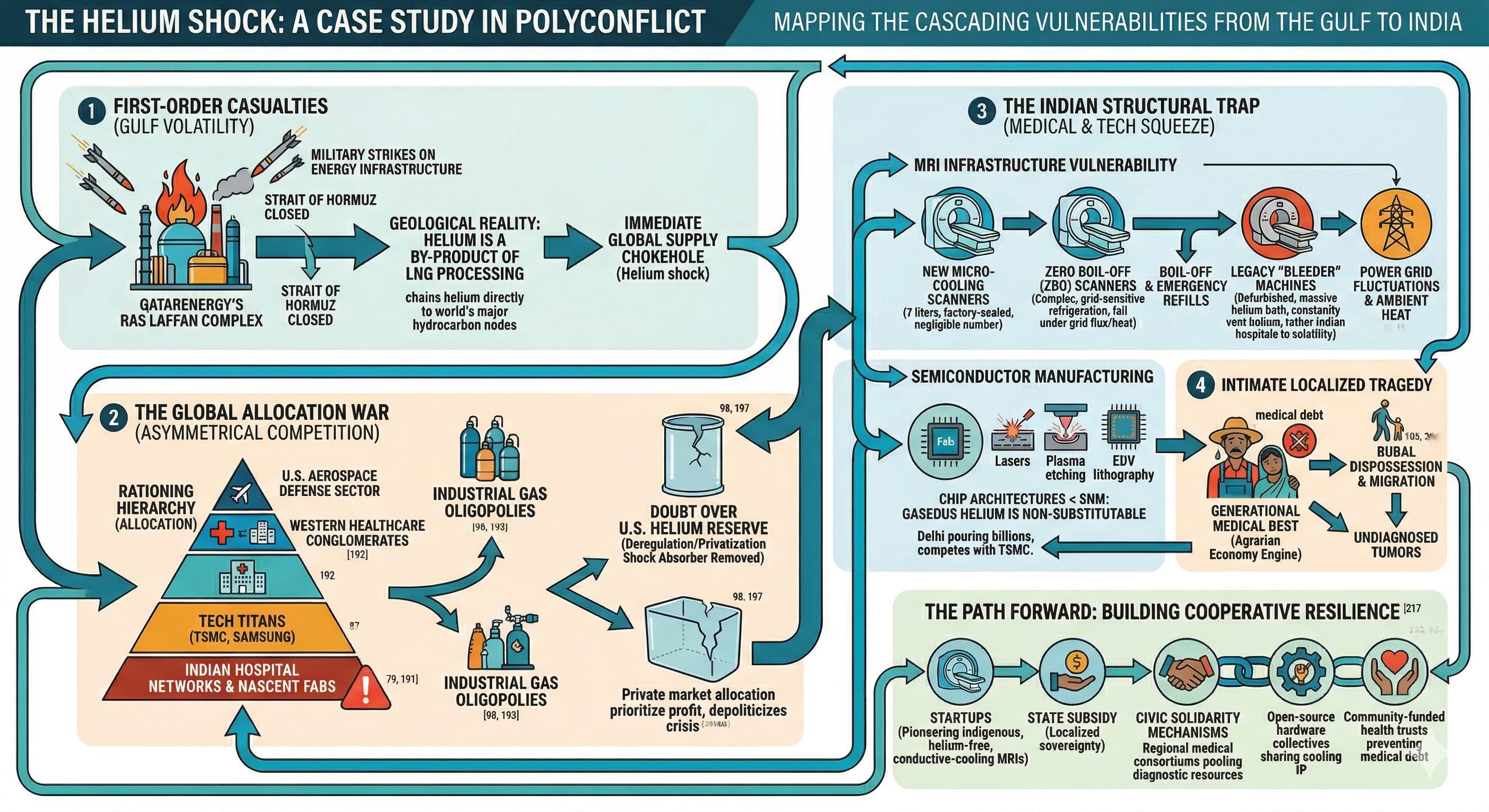
Tracing Helium
When missiles strike the energy infrastructure of the Persian Gulf, it’s obvious that the conflagration will impact the price of Brent Crude and will cause shipping delays for Liquefied Natural Gas (LNG). Oil and gas are first-order casualties of Middle Eastern wars - the disruptions everyone expects and the dependencies every state actively manages. Then again, maybe not - India had plenty of opportunity to build a natural gas reserve but it didn’t.
But it should have!
Polyconflicts have second-order dependencies that are less visible. Helium is a good example. It’s not a hydrocarbon, it’s not a rare earth material and it’s mostly known for its use in balloons and blimps.But as I found out, helium is embedded in a fragile, critical supply chain that sits at the intersection of Gulf volatility, advanced tech rivalry, and health systems.
First, some chemistry.
Helium is not manufactured on Earth; there’s a lot of it in the Sun, but over here it is a scarce resource. It is generated over hundreds of millions of years by the radioactive decay of elements like uranium and thorium deep within the Earth’s crust (uranium decay produces alpha particles which are nothing but helium minus its electrons - the alpha particles pick up two electrons from the surrounding rock and become helium). Helium is very light (the second lightest element) so left to itself, it will escape out of the Earth’s atmosphere and dissipate into space, but as it so turns out, sometimes it gets trapped in the exact same geological formations as natural gas. Consequently, it is extracted almost exclusively as a by-product of natural gas processing. It requires massive infrastructure - cryogenic fractional distillation towers that cool the raw gas to extreme temperatures to separate the helium molecules from the methane and nitrogen. Since helium has the lowest liquefaction temperature, if you cool natural gas to a low enough temperature, the other gases in it will liquify, leaving only helium in gas form.
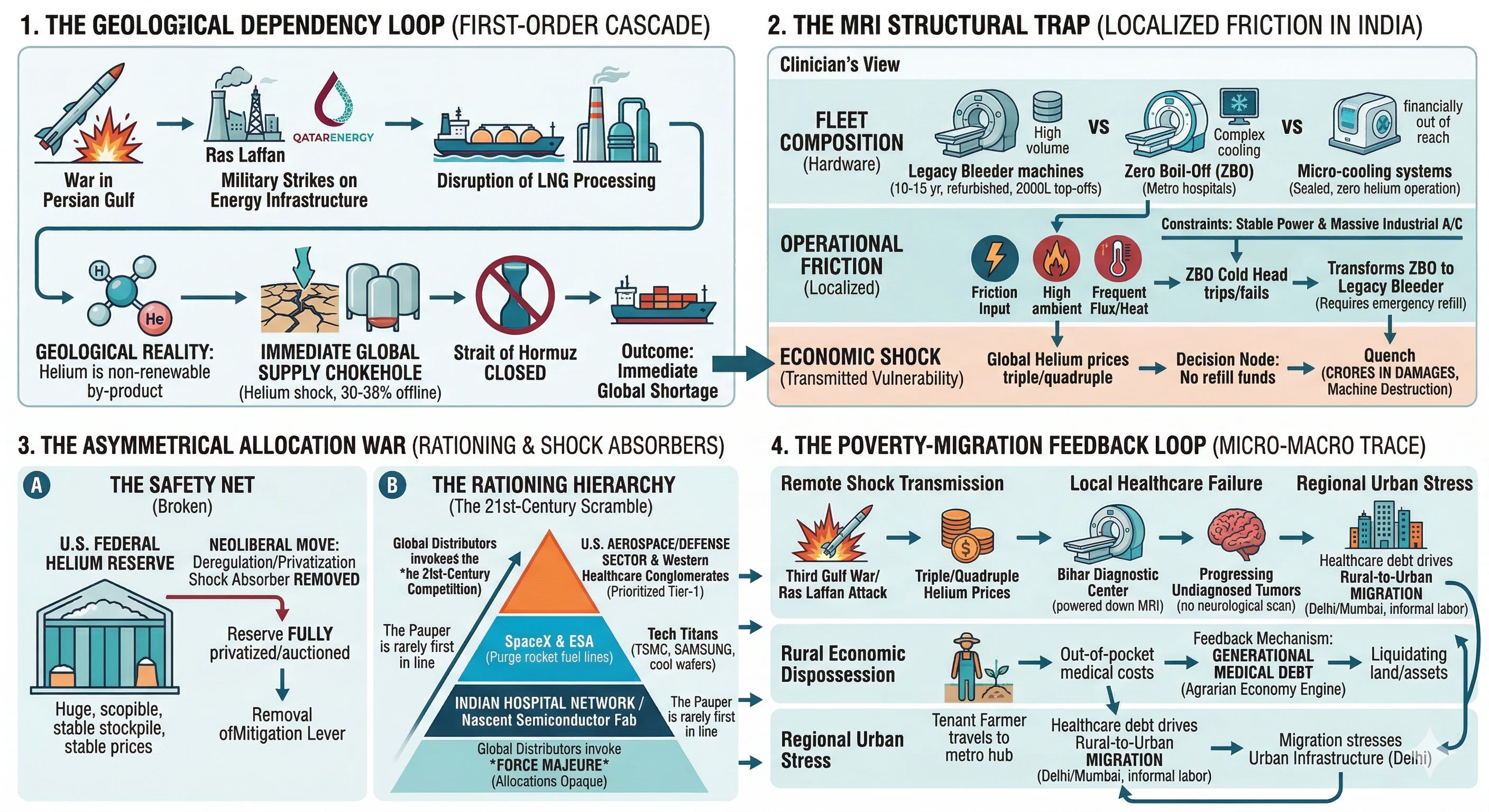
This geological reality chains helium directly to the world’s major hydrocarbon nodes. Not only is Qatar’s Ras Laffan Industrial City complex the world’s biggest gas terminal, it also accounts for roughly 30% to 38% of the world’s entire helium supply. So the attack on Ras Laffan immediately created a helium shock in the world’s supply chains. In a matter of days, a third of this critical industrial gas vanished from the market. And in any case, with the Strait of Hormuz closed, there’s no shipping that helium anywhere else even if you could extract it.
Who cares? What is helium good for?
Turns out, it’s good for some important things, and in particular, it’s crucial for MRI machines and chip manufacturing.
Why Helium is Non-Substitutable
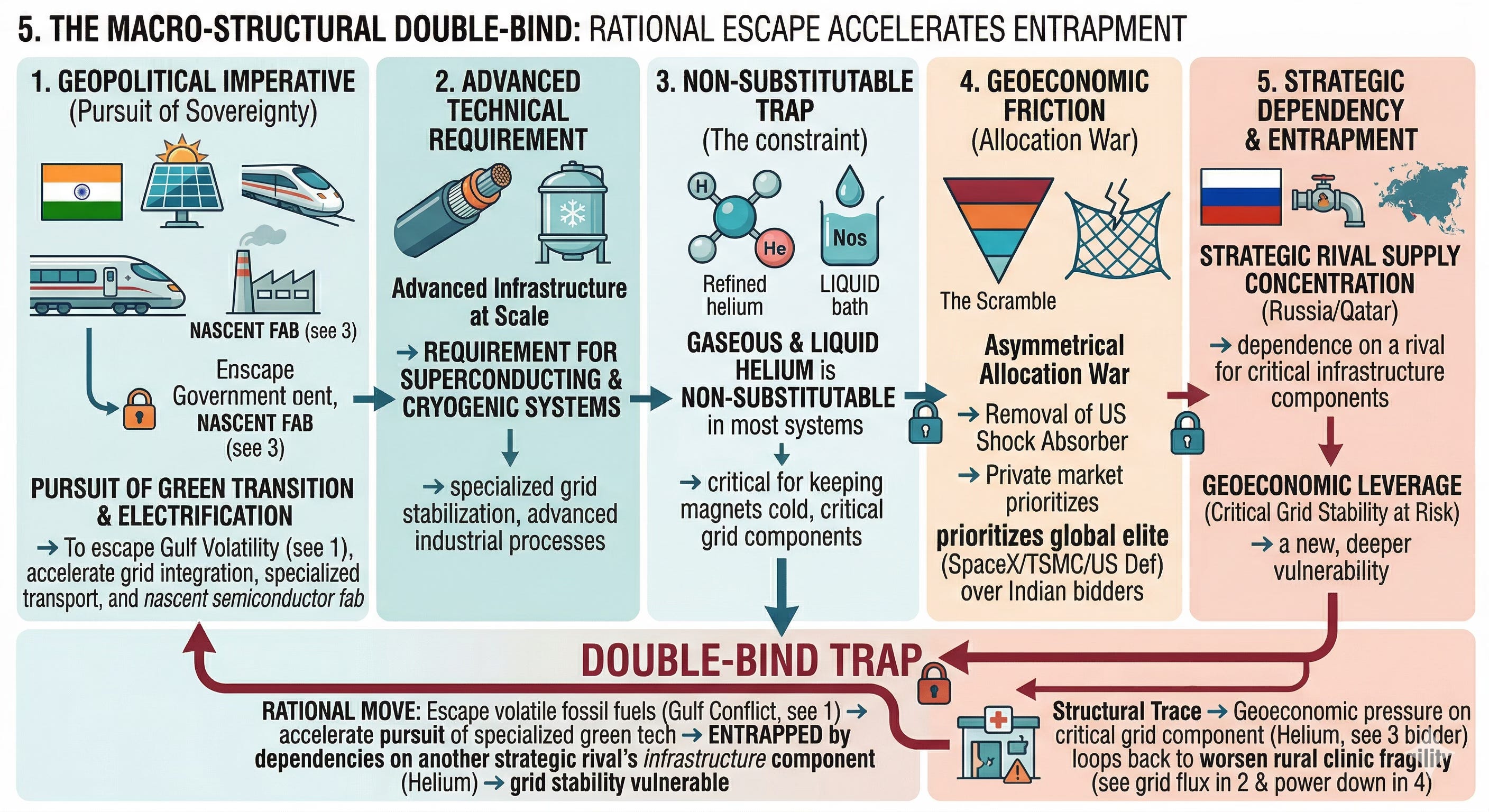
As I mentioned earlier, helium is the second-lightest element in the universe, and because it is so light, any helium released into the atmosphere escapes Earth’s gravity and bleeds off into space. That doesn’t make it valuable though. What makes it essential is that it is chemically inert, and it stays liquid at colder temperatures than any other substance in existence. These two properties make it the invisible architect of modern medicine and advanced computing.
Liquid Helium and the MRI
The first critical use of liquid helium - used to be its biggest use, still second biggest - is in Magnetic Resonance Imaging (MRI). MRIs are large superconducting magnets. To generate the incredibly powerful magnetic fields required to see inside the human body, the internal coils of the machine, typically made of a Niobium-Titanium alloy, must achieve superconductivity. This metallurgical magic only happens at roughly 4 Kelvin, or -269°C - just a few degrees above absolute zero. Liquid helium is literally the only element capable of reaching and maintaining these temperatures. Liquid nitrogen is too warm. There is no synthetic chemical substitute. If you do not have liquid helium, you do not have an MRI. Older MRI machines needed about 1500 liters of helium, and since the gas keeps escaping, it has to be topped-up all the time. Not so for the newer models, some of whom have factory sealed helium (and need only 7 liters) but those models are too expensive to be bought by hospitals in India or other parts of the Global South.
Helium in Chip Fabs
The semiconductor industry relies on gaseous helium for an entirely different set of extreme conditions. As chip architectures shrink to 5-nanometers and below, the margin for error is vanishingly small. During processes like extreme ultraviolet (EUV) lithography and plasma etching, silicon wafers are bombarded with highly energetic lasers and plasma inside a vacuum chamber. They get incredibly hot. The vacuum doesn’t have any air that can transport the heat away from the chip (it’s vacuum!), so to prevent the delicate, atomic-level structures from melting or warping, gaseous helium is pumped directly into the microscopic gap between the cooling chuck and the back of the silicon wafer.
Because helium’s thermal conductivity is unmatched, it pulls heat away from the silicon wafer. Furthermore, because it is a noble gas, it is chemically inert and so does not react with any of the highly volatile chemicals used in chip fabrication, leaving the delicate wafers uncontaminated. Even other noble gases won’t work. If a semiconductor fab runs out of helium, they cannot substitute another noble gas such as argon which is both bigger and heavier, and has far less thermal conductivity.
OK, once again, so what? Where’s the squeeze when there’s a supply shock?
India’s MRI Infrastructure
To understand the depth of India’s vulnerability, you first have to understand the three generations of MRI technology. First, there are the traditional scanners, the legacy machines of the late 20th century. These require a massive bath of 1,500 to 2,000 liters of liquid helium that constantly boils off into the atmosphere, demanding frequent, expensive refills just to survive.
Second, there are zero boil-off (ZBO) scanners. Introduced in the mid-2000s, these still rely on a massive helium bath but are equipped with a complex refrigeration unit called a cold head that captures the boiling gas and re-condenses it back into liquid (how does it work exactly? I need to learn more about the mechanisms involved). Under perfect conditions, they rarely need a refill for the lifetime of the machine. Finally, there is the newest frontier of sealed micro-cooling scanners. Pioneered around 2018, these marvels use only 7 liters of helium permanently sealed at the factory. No hospital-level refills needed.
India has a low density of MRI scanners: roughly 2,500 to 4,800 machines for a population of 1.4 billion people. By comparison, the US has over 12000 for a population a fourth the size of India. But the true structural trap lies in which machines make up that number.
India possesses very few zero-boil-off machines, and a negligible number of the newer sealed micro-cooling systems. Both the ZBO and the sealed machines are too expensive for most Indian hospitals, remaining financially out of reach for all but the most elite, well-capitalized corporate hospitals in metropolitan hubs like Mumbai or Delhi.
Instead, a massive portion of India’s MRI fleet - particularly in smaller private diagnostic centers and Tier-2 or Tier-3 cities - consists of refurbished systems imported from the West to save on steep capital costs. These 10-to-15-year-old models are the traditional, high-bleed legacy machines. They are constantly venting helium, tethering Indian hospitals to the volatility of Gulf supply chains.
Even when a well-funded Indian hospital manages to purchase a modern zero boil-off machine, they run into localized, structural friction. ZBO technology was engineered for the predictable infrastructure of the Global North. The cold head requires a highly stable power supply and massive, uninterrupted industrial air conditioning to function. In the Indian context, frequent power grid fluctuations and extreme ambient heat often cause these cold heads to trip or fail. When the cold head stops working, the helium immediately begins boiling off, instantly transforming a state-of-the-art ZBO machine back into a legacy bleeder, forcing the hospital into purchasing emergency refills.
So, when the Ras Laffan complex goes offline and global prices triple, it’s terrible news for hospitals across India. If the hospital cannot secure a helium delivery or pay for it, the MRI machine’s magnet will warm up, lose superconductivity, and potentially destroy itself - a catastrophic event known as a “quench” that results in crores in damages.
As an aside - the semiconductor side of this helium story also has implications for India. Delhi is pouring billions into establishing domestic semiconductor manufacturing. But those nascent fabs require the exact same Ultra-High Purity helium that the hospitals need, and they will be competing with TSMC for the gas.
Not looking good IMHO.
The Allocation War
Helium cannot be stored or hoarded easily - since the helium atom is the second smallest in the universe, it eventually leaks through the microscopic pores of almost any container. It cannot be stockpiled for years; it must be a continuous, cryogenic flow. And when that flow is interrupted, India does not find itself competing against the usual nation-state rivals; it finds itself in a bizarre, asymmetrical war against a cross-section of the 21st-century elite.
An Indian hospital network or a newly minted semiconductor fab isn’t bidding against the Chinese state. They are competing against TSMC and Samsung - tech titans that alone consume over 20% of the world’s helium to keep their silicon wafers cool. They are competing against Kaiser Permanente and other massive, well funded Western healthcare networks. They are competing against SpaceX and the ESA, which require helium to purge rocket fuel lines and manage satellite systems.
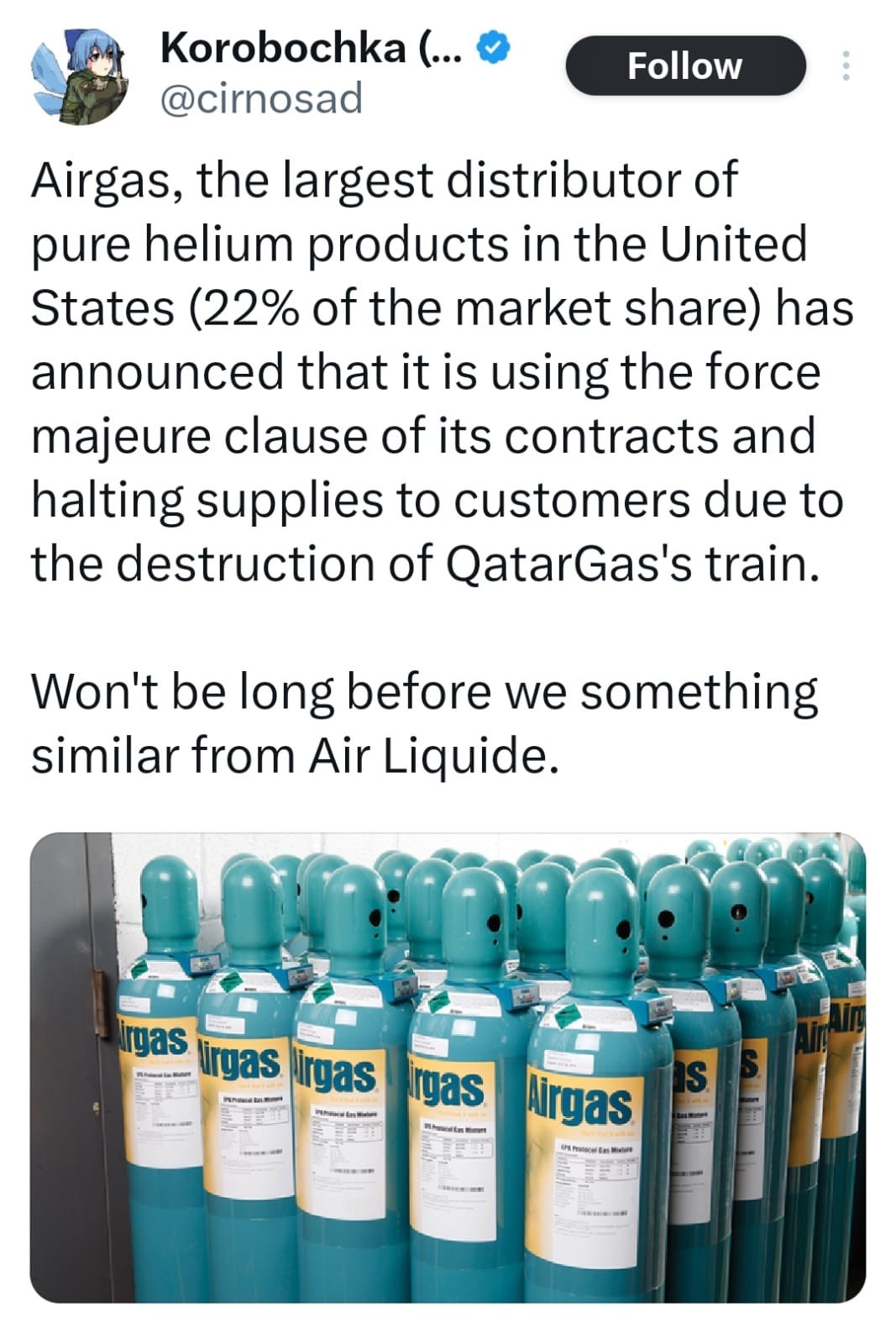
Industrial gas distribution is a highly consolidated oligopoly dominated by giants like Linde and Air Liquide. Like QatarEnergy these corporations can invoke force majeure (force majeure is a contractual clause that frees both parties from liability when an uncontrollable event prevents one or both from fulfilling their obligations), and place all their customers on “allocation,” a rationing system where buyers receive only a percentage of their usual order. The claims on their stocks of cryogenic ISO containers will be fiercely contested. In this rationing hierarchy, Tier-1 priority technically goes to life-saving medical use and national defense. Tier-2 belongs to critical economic infrastructure, like the semiconductor fabs.
How will life-saving in Darbhanga compete with life-saving in Dublin?
The saddest part of this story is that there used to be a safety net. For decades, the U.S. Federal Helium Reserve acted as a massive, sovereign shock absorber, holding billions of cubic feet of helium to stabilize the market during crises. But in a familiar neoliberal move, the U.S. government deregulated and fully privatized the reserve, auctioning off its final assets to private industry in 2021.
I guess no one thought helium deserves a reserve in the public interest, which, if I may say so, is the exact same structural delusion that birthed our modern polyconflicts: the belief that private markets always allocate resources more efficiently than the state, and that optimizing for short-term financial returns is more important than maintaining buffers for long-term survival.
By dismantling this strategic stockpile, the U.S. removed the only buffer capable of mitigating a sudden global shortage. Private distributors are forced to make impossible, opaque choices. They must decide between fulfilling an allocation for a politically connected mega-hospital in Boston or a refurbished diagnostic center in Bihar. For a tenant farmer in Darbhanga, a decommissioned or significantly more expensive MRI machine could mean an undiagnosed tumor and far greater healthcare costs in the near future. It means pooling the family’s savings - such as they are - to pay for much more expensive care, and slipping into generational medical debt just to secure a scan. In the agrarian economy, healthcare debt is among the primary engines of rural dispossession.
More debt, more migration, more dispossession could be the outcome of the helium shock.
BTW, notice how the helium shock intersects with the larger story of the third Gulf war (similar to LPG scarcity and oil prices) but also has its own specificities - the helium reserve, direct impact on healthcare availability etc.
Surviving the Shock: Best and Worst Case Scenarios
The Worst-Case Scenario
The conflict in the Middle East stops Qatar’s LNG output for an extended period. The Strait of Hormuz remains contested, adding massive risk premiums to shipping. Global distributors slash India’s allocation by 50%. Prices quadruple. Smaller hospitals in India cannot absorb the operational cost of top-offs. They are forced to power down their MRI machines permanently. Simultaneously, the lack of UHP helium delays India’s semiconductor fabrication plants by years.
The Best-Case Scenario: The immediate supply chokehold eases within a few months, but the trauma of the near-miss serves as a wake-up call for Indian self-reliance. Startups in Bengaluru, like VoxelGrids are pioneering the first fully indigenous MRI scanners designed specifically for Indian reality. These machines do not require liquid helium. They operate on conductive cooling, require significantly less power, and survive the heat.
The best-case scenario is that the Indian state recognizes this as a matter of localized sovereignty. Delhi must radically subsidize the deployment of indigenous, helium-free machines, alongside other tech (diagnostics etc) that can be deployed in health centers at scale: local MRI machines won’t work unless they come with a localized healthcare system committed to the public interest. Concurrently, the state must secure diversified helium partnerships with emerging producers in structurally safer regions like Canada or Australia for the nascent semiconductor sector.
Concluding thoughts
The helium shock is a perfect microcosm of the polyconflict. It demonstrates how today’s conflicts are non-linear, with second-order effects that shatter our traditional economic models. A drone strike on a gas field in the Gulf dictates the cost of a neurological scan in Muzaffarpur, which in turn dictates whether a family falls into medical debt, which drives rural-to-urban migration, which stresses urban infrastructure in Delhi.
We can bring some general heuristics to understand the polyconflict - tracing the networks of energy and information (i.e., metabology) will always be helpful, but those traces will not be enough. Every commodity has to be understood on its own terms.
All the more reason to build robust mechanisms of civic solidarity.
I can only speculate as to what this might look like - could be regional medical consortiums that pool diagnostic resources instead of hoarding them, open-source hardware collectives that share the intellectual property for conductive-cooling technologies, and community-funded health trusts that prevent medical debt before it forces a farmer into dispossession. I don’t know how we are going to make it happen, but we need to willy-nilly. As the Benjamin Franklin quote goes:
We must, indeed, all hang together or, most assuredly, we shall all hang separately.
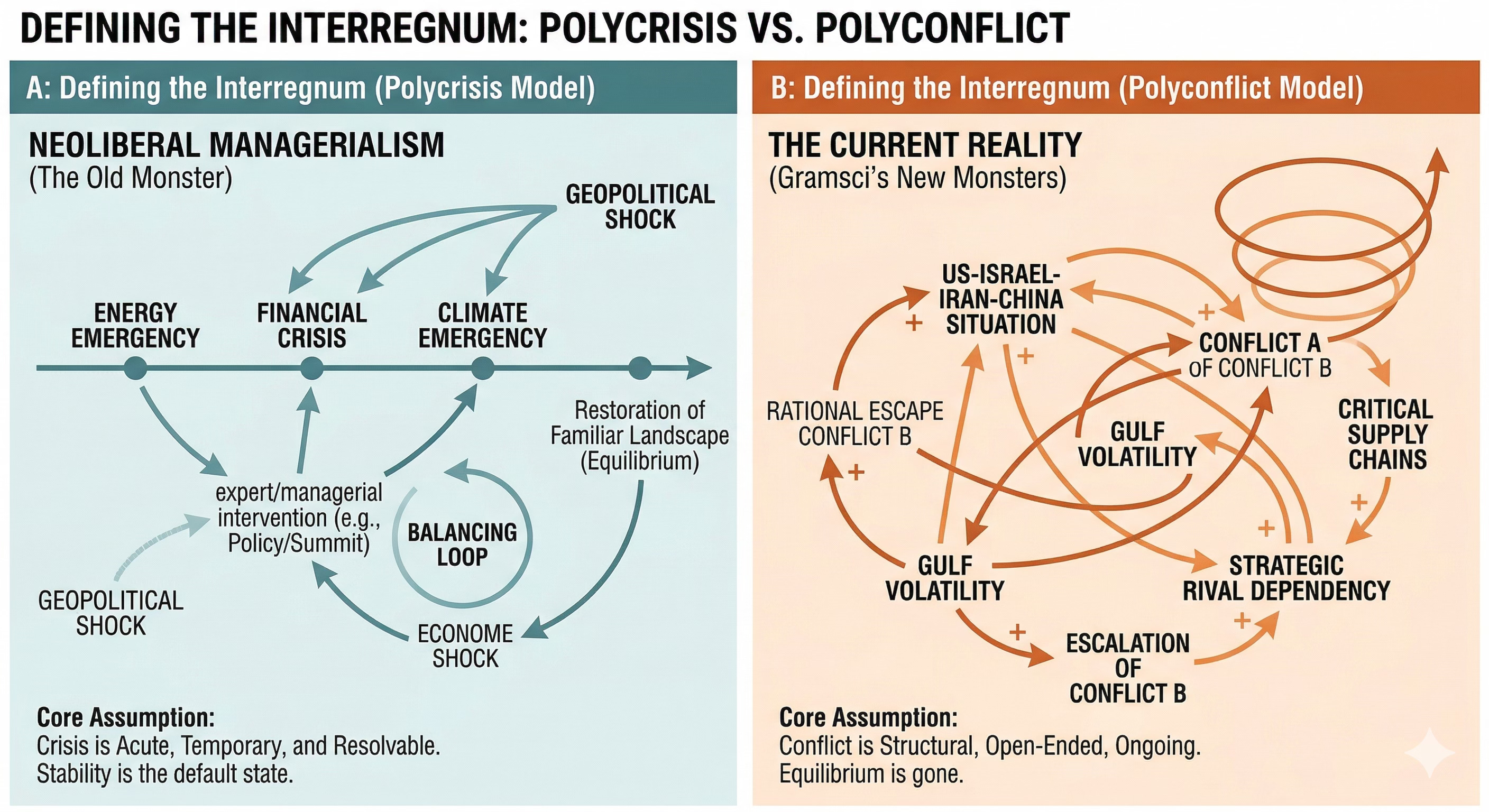
Great systems analysis -- you are like a pessimistic Elinor Ostrom! (That's a compliment). And great graphics! (I assume you have a series of prompts building up the connections or perhaps a configuration document?)
Is this tech alternative not viable in this context?: Technological Advancements: To combat shortages, new "helium-free" or "sealed" MRI systems (like Philips BlueSeal) have been developed. These reduce helium consumption by 99.5%, sealing a tiny amount inside the scanner to avoid the need for external, long-term supply.