


I am no doomer but when Trump retook power in 2020, the old world died. New monsters were waiting in the wings.
That was a premonition, but I am now seeing the monster take shape, and it’s driving me a little insane.
I posted some scattered thoughts earlier today on social media. Having worked on the underlying themes some more, I am sharing the fleshed out version below.
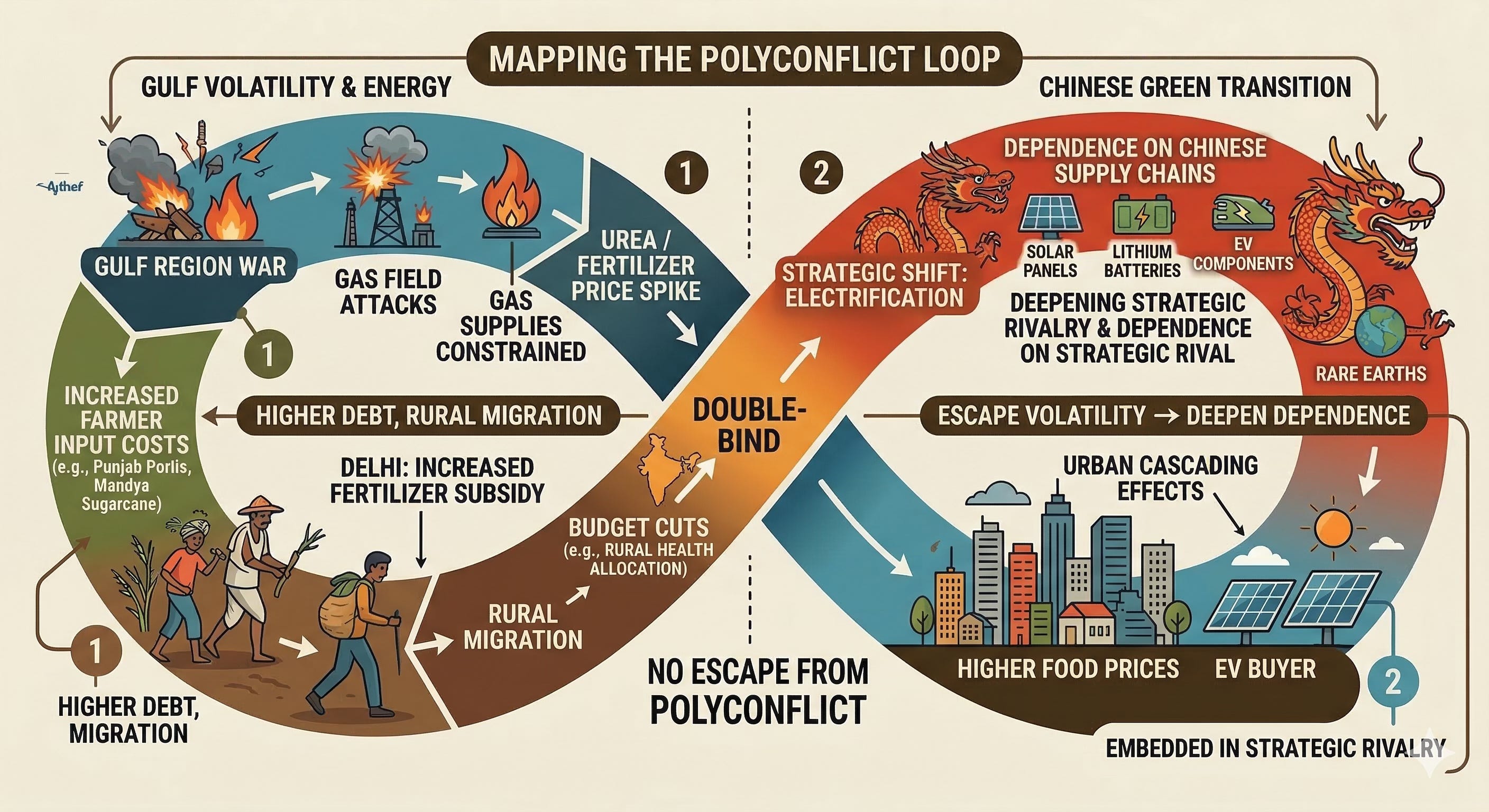
As the current escalating conflict between the US/Israel and Iran demonstrates, geopolitics no longer stops at the border. We are inextricably connected to developments elsewhere, and rarely in ways we can control.
When the global system works, it operates invisibly. We can sleep assured that natural gas will be delivered on time, and the systemic externalities of that comfort will be kicked down the road for our children to deal with (hello, climate change!). But when the system breaks down, geopolitical and geoeconomic volatility suddenly becomes your immediate, localized problem (hello, climate change!).
Yet, our existing media apparatus is woefully unequipped to explain how this planetary turbulence lands on our doorsteps. We get headlines like, “Brent Crude hitting $120 a barrel will lead to an extra 5% inflation in India.” Legacy newspapers and television channels, built for mass-audience broadcasting, are forced to communicate in these abstract, macroeconomic generalizations.
We must do a lot better.
The Local Impact of Global Shocks
Consider the micro-impacts of macro-shocks. Benchmark prices for urea jumped 30–40% in just the first two weeks of March. To an urban dweller, this is invisible data, at least until food prices spike a few months later. But to a farmer planning for the Zaid or Kharif crop seasons, it is an immediate existential threat. To financial planners in Delhi, it means a sudden need to offset mounting fertilizer subsidies with budgetary cuts elsewhere.
What gets cut, and who bleeds for it?
Every day brings new variables that shatter our existing models. Yesterday, the world’s largest gas fields were attacked, first by Israel and then by Iran. Gas supplies could be constrained for months, if not longer. The Kharif season is in trouble.
Sensemaking…
Suppose I am a paddy farmer in Punjab, or a sugarcane farmer in Mandya. What is going to happen to the cost of my inputs? What are my realistic alternatives? Is agroecology a viable shift for me right now, or a luxury I can’t afford? How do I balance these surging agricultural costs with my household realities: after all, I rely on LPG, and I need medical supplies whose supply chains are also fracturing. My needs aren’t the same as the farmer in the next district, let alone the software engineer in Bengaluru.
Yet, there is no personalized sensemaking infrastructure that scours the globe from the village next door to Beijing, translating planetary events into localized, actionable intelligence. This is exactly where I see the true promise of AI: delivering fact-based, hyper-personalized summaries of how events at all scales impact a specific human life today.
From Polycrisis to Polyconflict
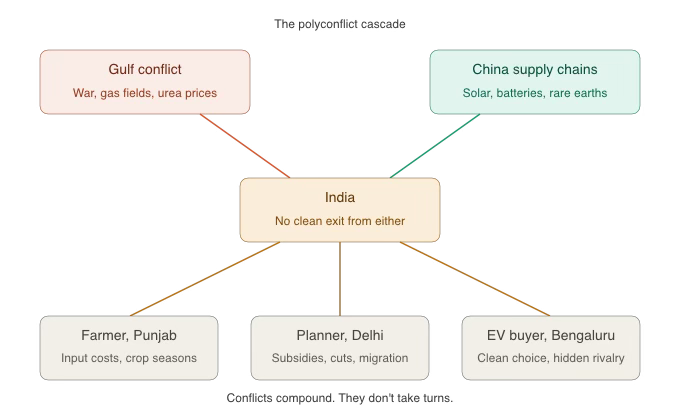
While my engineers are hard at work building that newspaper of the future, we have a new reality to navigate today. We have a Polyconflict on our hands. Notice I didn’t say Polycrisis, which is the buzzword of the Davos class. Polycrisis acknowledges multiple, intersecting emergencies, but it carries the hidden assumption that the crisis is temporary, that it will resolve. Things will eventually settle into a new equilibrium, perhaps with new winners and losers, but a familiar, manageable landscape nonetheless.
What if they don’t?
What if the correct word isn’t crisis, but conflict - ongoing, structural, open-ended, and immune to being fixed by the right policy, the right summit, or the right experts in the right room? That shift in framing from polycrisis to polyconflict is staring us in the face with the US-Israel-India-Gulf-China situation.
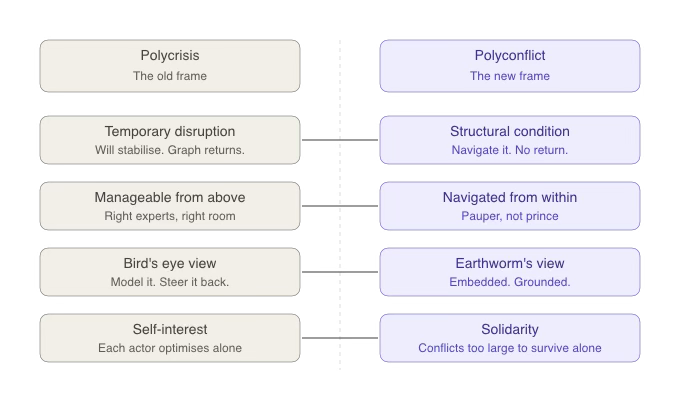
Escaping One Conflict, Wading Into Another
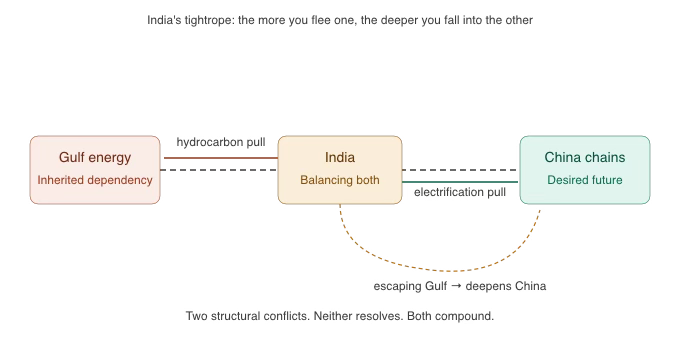
Look again at the paddy farmer in Punjab. His input costs just jumped because urea prices spiked because of an attack on the South Pars gas field during a war with no end date, in a region that has been volatile for decades and is actively unraveling. No global institution is coming to fix this mess. The Rules-Based International Order is dead. What has replaced it is a world where the strong do what they can, and the weak suffer what they must. That is a conflict, not a crisis.
And the farmer in Mandya or Jalandhar is living inside the conflict, whether they know it or not.
India’s rational, strategic response to Gulf energy volatility is electrification. Except the green transition depends on physical supply chains, and those supply chains run almost entirely through China: solar panels, lithium batteries, EV components, rare earths.
No alternative currently exists at India scale.
So, every rooftop solar panel installed in Pune, every electric two-wheeler sold in Coimbatore, deepens a dependency on a rival with whom we share a heavily militarized, contested border, and one with demonstrated willingness to weaponize economic leverage. We should mend the relationship, but the potential for conflict will never disappear.
The faster India tries to escape the first conflict, the deeper it wades into the second.
The sugarcane farmer in Mandya is hammered by a Gulf conflict he has no voice in. If Delhi covers the fertilizer subsidy by cutting rural health allocations, the farmer’s children might decide to migrate to Bengaluru. Where will they live? What will they do?
Meanwhile, the EV buyer in Bengaluru thinks she is making a responsible, localized ecological choice. It is a better choice, but it is one deeply embedded in a macroeconomic strategic rivalry. Tomorrow, she may not get spare parts because rare earth minerals needed for magnets are no longer available. There is no escaping the polyconflict for her either. These are struggles landing on ordinary people who don’t have a framework to understand what is hitting them, or why.
The Interregnum Revisited
Antonio Gramsci wrote from a fascist prison cell that “the old world is dying, and the new world struggles to be born: now is the time of monsters.” We are living in that interregnum. The Rules-Based International Order wasn’t perfect, it wasn’t equal, and it was rarely rules-based. But it was our monster. As it dies, new, planetary-scale monsters are arriving.
This 👇🏾 is where I was at the beginning of last year - note the date
Bhumics, Part 1

We live in a world in the midst of profound transition. The end of history’s faith in liberal democracy has crumbled, replaced by an illiberal global capitalism, sinking “liberalism as culture” alongside “liberalism as power.” With the collapse of the liberal Leviathan, a new possibility emerges:
Machiavelli wrote The Prince for Lorenzo de Medici as a manual for holding power in exactly this kind of moment - when the old order had collapsed and the new one hadn’t settled. For the last year, I have been trying to write the opposite book. Not a manual for the Prince, but a survival guide for the Pauper. For the paddy farmer, the sugarcane grower, and the EV buyer who are all navigating a world nobody prepared them for.
The polyconflict frame is what lends the Pauper urgency. The old frame of polycrisis was deeply embedded in neoliberal managerialism. It relied on the bird’s eye view of complexity scientists who believed that if you just modeled the system well enough, you could steer it back to stability from a control room. But we are now in the Third Systems Age. We don’t need the bird’s eye view - we need the earthworm’s view; embedded, grounded, sensing the vibrations of the soil, and navigating from inside the conflict rather than trying to administer it from above.
This 👇🏾 is when I started writing about the Pauper in earnest
Bhumics Week 8: The Pauper, Part 1

Humans, perhaps uniquely among our animal peers, have the capacity for counterfactual reasoning. An ambitious intellectual looking to worm his way into the current dispensation might whisper to himself:
Machiavelli’s insight was that systemic conflict is structural, not exceptional, and the prince who waits for stability before acting will wait forever. The pauper’s equivalent insight must be this: when the conflicts are too large for any individual to survive alone, solidarity is the only rational response. The olive garden owner in Palermo and the software engineer in Bengaluru are not living in different worlds.
In the age of polyconflict, they can’t separate their fates even if they wanted to.
Thanks! You take me to places with your thought-provoking posts.