Preface
Part III ended with a promise that the AI Polyconflict has a metabolic dimension most analyses of the AI race completely ignore. I want to make good on that promise. So far, I have been talking about Augmented Intelligence, i.e., the merger of distributed cognition and political technology, as though it exists in the realm of strategy, software, and institutional design. It does. But it also exists in the material realm. Information has energetic and entropic implications. Every inference token, every trained neural weight, every algorithmic decision I described in Part III has a material cost measured in watts, in liters, and in dollars (the last one isn’t physics, but it’s still hooked into materiality). The cloud is made of silicon and copper, cooled by water, powered by hydrocarbons, and financed by sovereign wealth. At least in the Gulf.

The Metabolic Dimension
In the 4E Cognition tradition, one of the things that distinguishes extended cognition from ordinary tool use is that the cognitive system becomes dependent on the artifact for its basic functioning. The navigator who uses a chart is cognitively different from the navigator who has memorized the stars; take the chart away and the first navigator is lost. The system’s intelligence depends on maintaining its material extensions.
Scale that to the stack. The Prediction and Production Stacks I described in Part III are cognitive systems that span continents. The American Prediction Stack extends institutional cognition through centralized cloud platforms, proprietary models, and precision hardware. The Chinese Production Stack distributes cognition through AI-enabled industrial infrastructure such as ports, factories, power grids. Both stacks, like the Navy bridge crew in Hutchins’ original study, can accomplish things no individual component could do alone. But both stacks also have metabolic requirements that most commentary on the AI race fails to register.
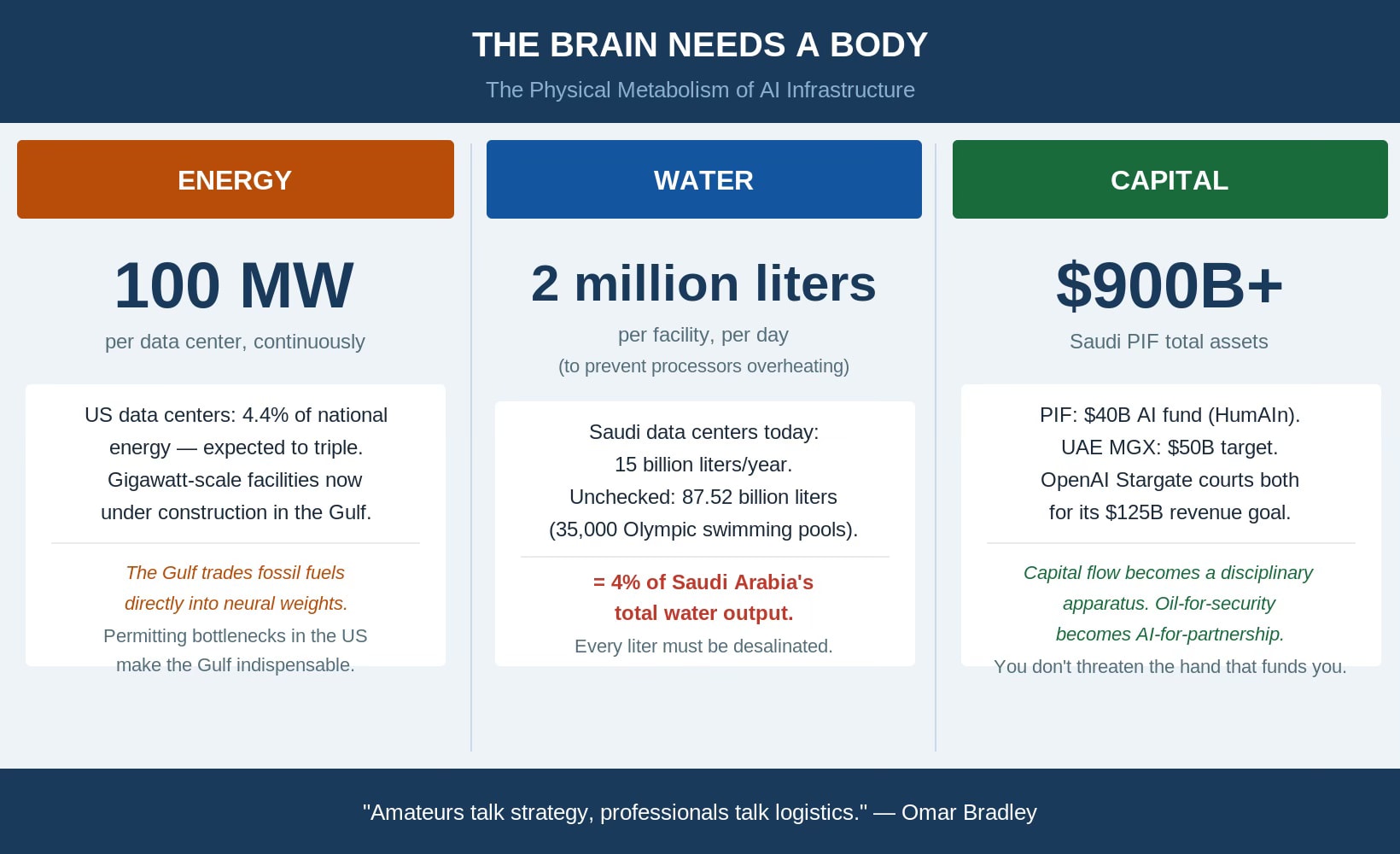
A typical hyperscale data center requires around 100 megawatts of continuous power - the output of a small gas turbine running without pause. Gigawatt (1000 megawatt) scale data centers are under construction. As an aside, it’s instructive that the most widely used measure of datacenter size is its energy footprint. A single such facility consumes approximately two million liters of water every day just to keep its processors from overheating. In the United States, data centers already account for roughly 4.4% of annual energy consumption, and that figure is expected to triple in the coming years. The resulting friction with local communities over water rights and grid stability has produced severe domestic permitting bottlenecks.
This metabolic demand is the third thread of the AI Polyconflict. Not who has the best algorithms. Not who controls the cognitive heights. But who controls the physical substrate - the energy, the water, the capital - that makes the compute possible in the first place. If your cognitive extensions depend on material infrastructure, then whoever controls that infrastructure has leverage over your intelligence. This is true whether the extensions are centralized in a cloud or distributed across a continent of factories. The brain needs a body, and the body has to eat. Energy, water, and capital are to the AI stacks what grain and iron were to premodern empires.
“Amateurs talk strategy, professionals talk logistics” - saying attributed to Omar Bradley.
Two Architectures, Two Metabolisms
In Part III, I described the American and Chinese AI stacks as two competing visions of augmented institutional cognition - one centralizing intelligence in the cloud, the other embedding it in physical infrastructure. Now I want to look at the same rivalry from below: through its metabolism.
The American strategy amounts to Intelligence as a Service. The United States controls the foundational hardware (Nvidia chips), the hyperscale data centers (AWS, Azure, Google Cloud), and the proprietary foundation models (OpenAI, Anthropic). It offers the world the ability to rent American cognition. Foreign nations and global enterprises do not own their cognitive capabilities; they subscribe to them. This is the European Navigator’s approach to global intelligence - abstract, centralized, portable, and powerful. But it concentrates massive metabolic demands in a small number of nodes. Centralized cloud infrastructure means centralized metabolic dependencies: specific power grids, specific water supplies, specific cooling systems. A blockade on critical cooling gases like helium, a kinetic strike on a server farm, a cyberattack on a utility grid - any of these can degrade or extinguish the cognitive system.
China’s approach is Infrastructure as a Service. Rather than renting cognition from the cloud, China integrates AI into the physical body of production: robotics, port logistics, manufacturing, energy management. China constructs the roads, the power grids, the factories, and the logistics networks with the cognitive algorithms baked in. This is the Trukese Navigator at national scale. Its metabolic demands are spread across thousands of smaller installations embedded in industrial infrastructure. Harder to knock out with one strike, but also harder to upgrade, harder to audit, and far harder to decouple once installed.
Both create deep dependencies. Not least upon one another.
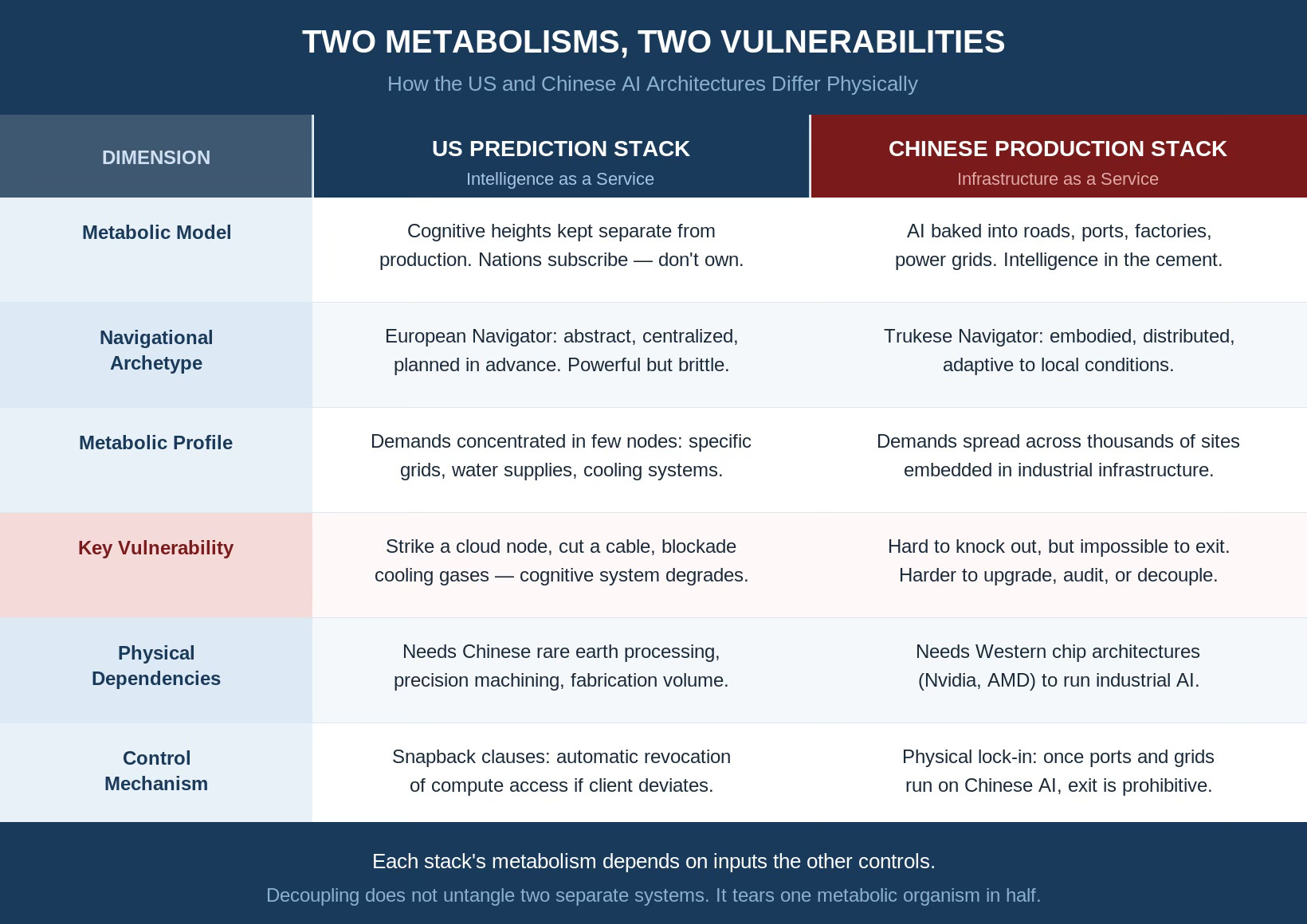
The United States requires Chinese manufacturing capacity and supply chain resilience to physically build the hardware for its exquisite cognitive architecture - the rare earth processing, the precision machining, the sheer volume of fabrication that American industry cannot currently replicate at scale. China requires Western chip architectures, particularly advanced GPU designs from Nvidia and AMD. Each stack’s metabolism depends on inputs that the other controls.
From Gas Station to Compute Hub
This is where the Gulf enters: as the metabolic center of the AI Polyconflict.
The Gulf states sit on two of the inputs that both competing stacks need in vast quantities: energy and capital. They have a third advantage that receives less attention: geopolitical flexibility, which means they can engage both, as I described in Part III - purchasing American targeting systems and cloud platforms while running their ports and smart cities on Chinese infrastructure. OK, maybe that’s a bit too much - they have been American vassals for much of the post war era, but this war against Iran might precipitate more hedging than in the previous 75 years.
But hedging is not sovereignty. To rent your intelligence from two competing empires is to be cognitively dependent on both of them. So the wealthy Gulf states are attempting something more ambitious: a phase transition from planetary gas station to planetary compute hub. Data centers in the United States face severe domestic permitting constraints, localized noise resistance, and acute power grid bottlenecks. The Gulf has abundant, low-cost energy - hydrocarbons today, solar tomorrow - vast tracts of buildable land, and governments that can approve infrastructure at speed. Western hyperscalers need somewhere to build. The Gulf is offering itself as the site. The GCC can congeal their abundant sunlight and fossil fuels into neural networks.
In parallel, the Gulf states are building their own cognitive substrate. The UAE’s Technology Innovation Institute developed the Falcon family of large language models under permissive open-source licenses. The UAE’s Jais model and Saudi Arabia’s ALLaM are Arabic-first models that natively grasp the linguistic and cultural nuances of the region rather than filtering everything through English-language training data. These sovereign models are deployed alongside commercial Western tooling - Saudi Arabia hosts ALLaM on the DEEM Cloud alongside IBM watsonx - maintaining local control over critical inference and data while retaining access to frontier capabilities where useful.
This strategy of managed interdependence is itself a political technology, that uses financial entanglement and energy leverage to discipline the larger powers rather than being disciplined by them. The 1973 oil embargo is a more extreme example. The Gulf states will not passively accept whatever congealed patterns come bundled with American or Chinese infrastructure.
The Market Makers
The capital required to build this infrastructure is unprecedented. Hyperscale data center construction, frontier model training, talent acquisition, and the supporting energy systems demand investment at a scale that exceeds traditional venture capital by orders of magnitude.
The Gulf Sovereign Wealth Funds are among the few entities on the planet that can write checks at this scale. Saudi Arabia’s Public Investment Fund, managing over $900 billion in assets, has established a dedicated $40 billion AI investment fund operating under the newly launched national champion HumAIn - designed to advance domestic AI infrastructure, support local startups, and establish joint ventures with global firms like Andreessen Horowitz. The UAE has established MGX, a sovereign investment group exploring plans to raise up to $50 billion in third-party capital to expand its AI portfolio, building on existing stakes in OpenAI and xAI. OpenAI itself, pushing toward a reported target of $125 billion in revenue by 2029 and seeking to fund its massive Stargate data center project, has actively courted both PIF and MGX.
This financial leverage comes with disciplining power. When a Gulf sovereign wealth fund provides the capital to build a hyperscale AI facility, it shapes the conditions under which that facility operates: where the data is stored, which models are deployed, whose assumptions are embedded in the system. The oil-for-security relationship that defined the US-Saudi alliance for decades is giving way to an AI-for-partnership arrangement in which the Gulf’s capital buys not just a financial return but a seat at the cognitive table. Maybe.... Capital flow is becoming a disciplinary apparatus of its own - not through snapback clauses, but in the softer mode of financial entanglement.
Why threaten the hand that funds you?
The Data Center in the War Zone
All of this compute, whether American, Chinese, or sovereign, has to physically exist somewhere. And wherever it exists, it needs to be cooled. Over the next five years, data center capacity in the Gulf is expected to triple, rising from roughly one gigawatt today to 3.3 gigawatts by 2030. These facilities will operate in a climate where summer temperatures regularly exceed 45°C. They cannot be cooled by the ambient air. They require massive quantities of water. And in the hyper-arid Middle East, that water must come from the sea.
Desalinating the ocean in order to feed data centers feels like a dystopian movie come to life doesn’t it? Data centers in Saudi Arabia alone are projected to consume 15 billion liters of water per year. If the current growth trajectory holds, that figure could scale to 87.52 billion liters, roughly 4% of the country’s total water output. Desalination is itself an energy-intensive and environmentally costly process. Consider the three dominant technologies. Seawater reverse osmosis, the most efficient option currently available, consumes 3.7 to 4.5 kilowatt-hours per cubic meter of freshwater produced and emits over 3 kilograms of CO₂ per cubic meter. Multi-stage flash distillation, still widely used across the Gulf, requires roughly 4 kilowatt-hours per cubic meter of electrical energy plus vast thermal energy inputs, and emits over 23 kilograms of CO₂ per cubic meter. Multi-effect distillation sits between the two in efficiency but produces comparable emissions and pollutant loads. All three technologies discharge concentrated brine back into the Gulf’s shallow, enclosed waters - an ecological cost borne by the non-human inhabitants of the Gulf.
This creates a dependency loop that tightens with every new gigawatt of installed capacity. The Gulf states burn hydrocarbons to generate electricity. That electricity powers desalination plants that produce freshwater. That freshwater cools the data centers that run the AI. The AI, in turn, manages the smart grids and logistics systems that distribute the power and water.
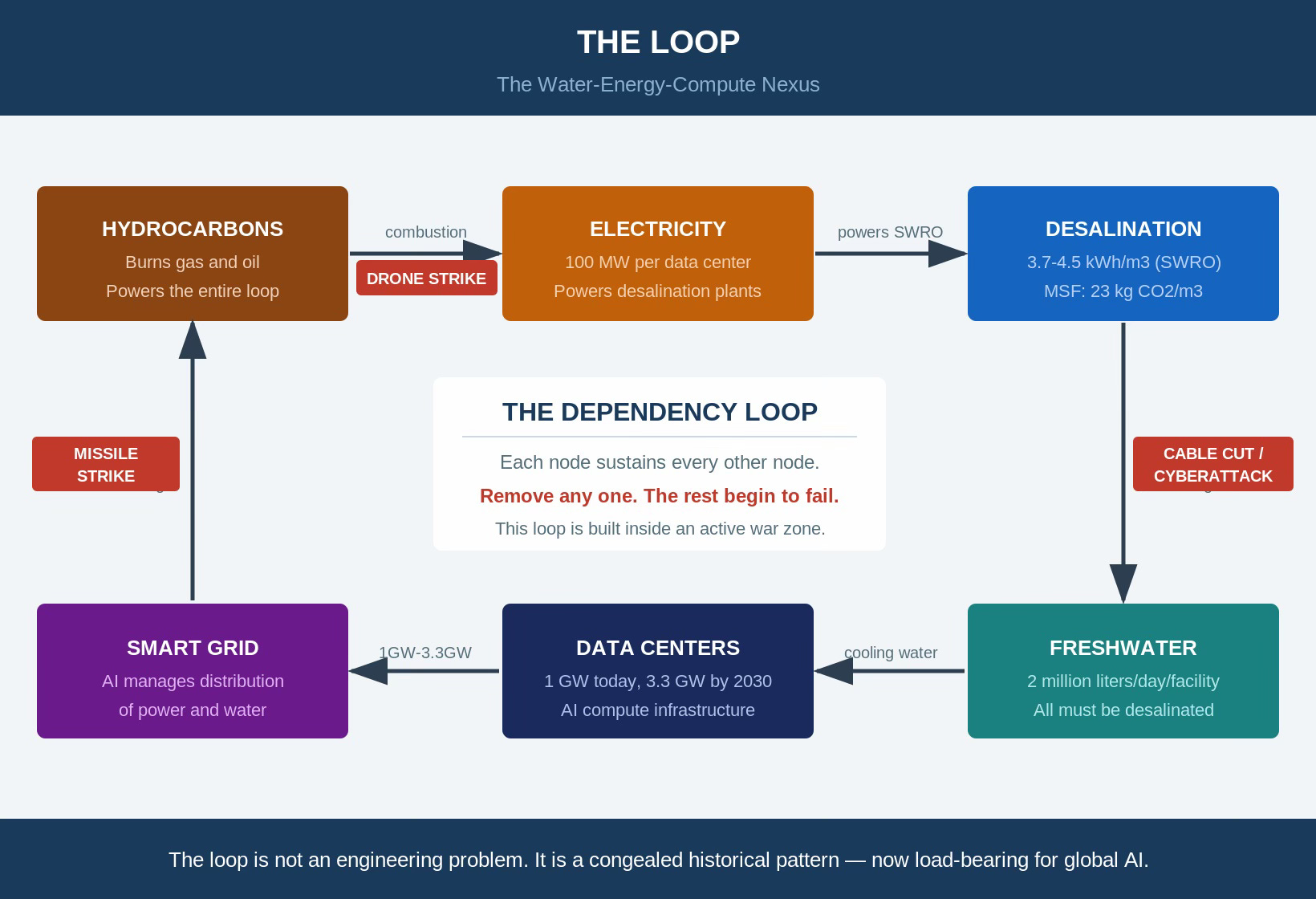
The Gulf’s AI infrastructure is not being built on blank ground. It is being built on top of the existing political economy of the petrostate - an economy historically organized around hydrocarbon extraction, desalination, and sovereign wealth accumulation. The new cognitive architecture inherits these dependencies and cements them deeper. What was a contingent historical arrangement - we have oil, but we don’t have water, so we built desalination - is becoming a central dependency for the global AI system.
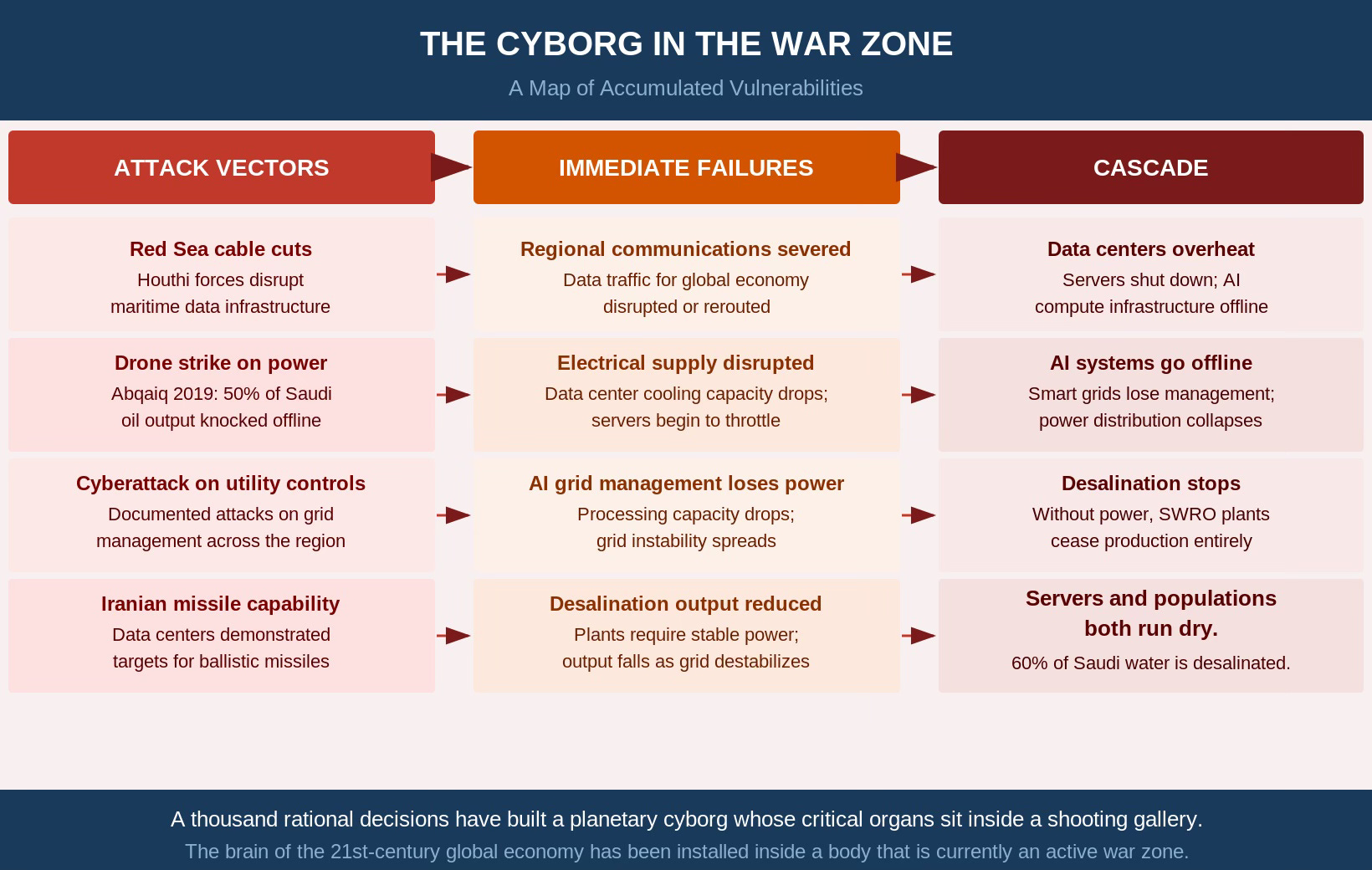
BTW, Iran holds all these developments hostage, because data centers are targets for their missiles as they have demonstrated.
Every cable cut in the Red Sea, every drone strike on energy infrastructure, every cyberattack on utility controls is an attack on the extended cognitive system that powers global AI. This fragility is unavoidable, the product of building the planet’s cognitive infrastructure on top of the same geography that supplies its energy, in a region where the kinetic and digital battlefields overlap. A thousand individually rational decisions by hyperscalers seeking cheap energy, by Gulf states seeking economic diversification, by sovereign wealth funds seeking returns, by militaries seeking cognitive advantage, have collectively produced a system of great vulnerability.
Next Up
The metabolism of intelligence creates new forms of economic dependency, new asymmetries between those who control the metabolic inputs and those who must rent them. In Part V, the last essay in this series, I want to turn to this macroeconomic dimension: how the cognitive imperialism emerging from both the American and Chinese stacks is reshaping the global economy, what it means for the nations caught between them, and why the Gulf’s phase transition from gas station to compute hub is an example of this imperialism at work.