I wasn’t planning on writing another essay in the Polyconflict series this quickly, but a twitter thread sparked a reverie on the relationship between the Gulf War, gendered harms and the need for metabolic sovereignty.
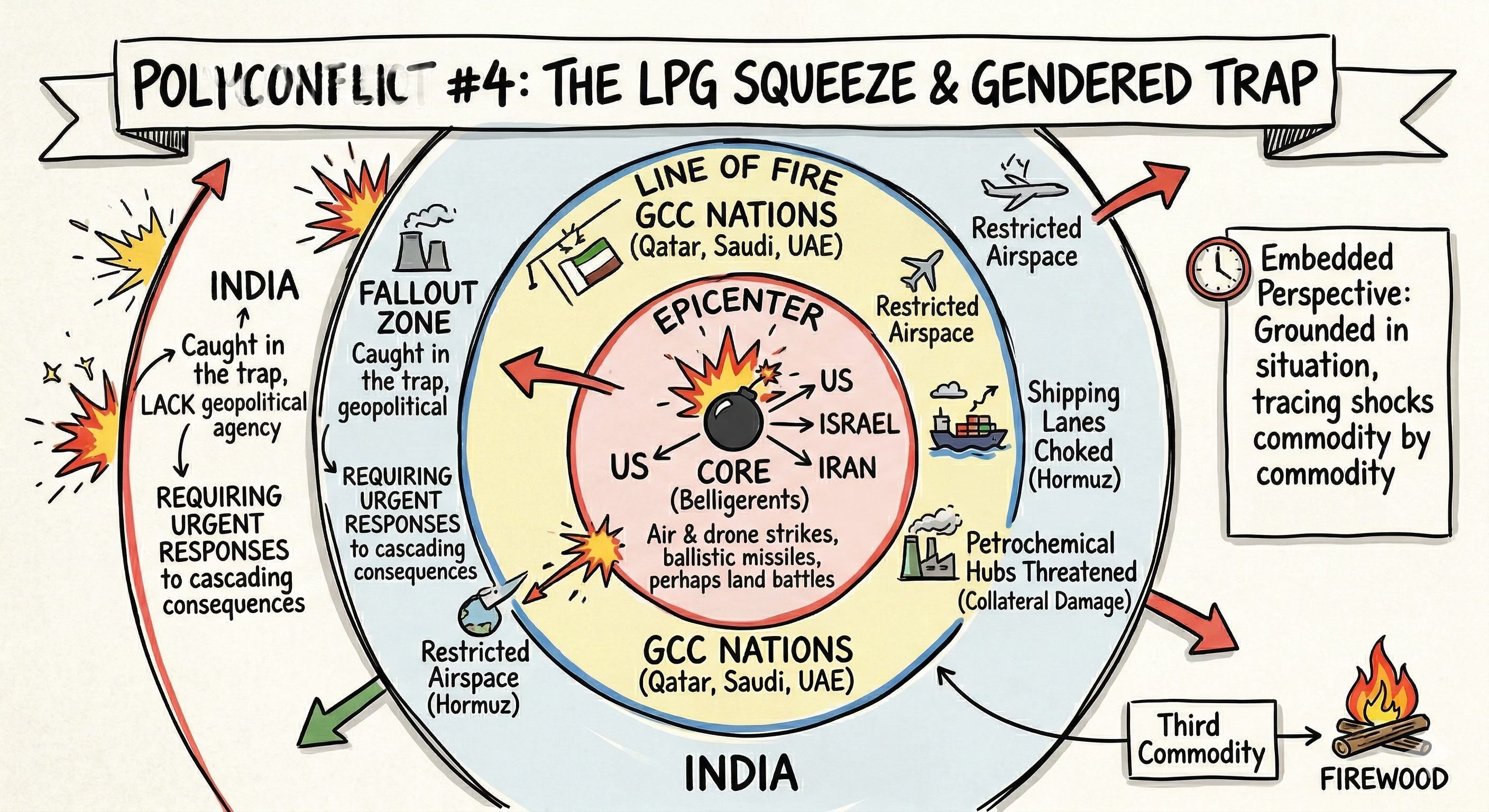
When we hear the term “World War,” we think of nations the world over fighting pitched battles across their landscape, that they strike everyone, everywhere all at once. But that’s not the reality at all is it? Polyconflicts (of which WWs are one example), have a core - periphery grading to them. The ongoing gulf war has an epicenter, a blast radius, and a fallout zone (to use a nuclear metaphor).
At the core of this conflict are the belligerents - the US, Israel, and Iran - trapped in a zone of air and drone strikes, ballistic missiles, and perhaps soon: land battles. Then, there is the immediate line of fire: the Gulf Cooperation Council (GCC) countries. Nations like Qatar, Saudi Arabia, and the UAE aren’t the primary combatants, but their airspace is restricted, their shipping lanes in the Strait of Hormuz are choked, and their petrochemical hubs are threatened by collateral damage.
Further out, in the fallout zone, you have countries like India. We are not launching missiles, nor are our refineries under physical bombardment. Yet, we are caught entirely in the polyconflict trap. We are the outer ring, lacking the geopolitical agency to stop the core conflict, but requiring urgent responses to its cascading consequences.
I have argued that we cannot navigate this time of monsters using the bird’s-eye managerial view from the sidelines. Polyconflicts require an embedded perspective, grounded in the situation as it is being affected by the conflict, tracing the shocks commodity by commodity. I have done this for two commodities already. We traced how a drone strike on a Qatari gas field instantly chokes the global supply of Helium, endangering MRI machines across India. We mapped how that same strike squeezes the petrochemical precursors for Metformin, creating a metabolic trap for the Indian diabetic.
Today, let’s examine a third commodity implicated in the Gulf War Polyconflict. It is not a high-tech supercoolant, nor is it a complex synthetic molecule. It is one the most primal commodities in human history: Firewood.
The Illusion of Neutral Energy
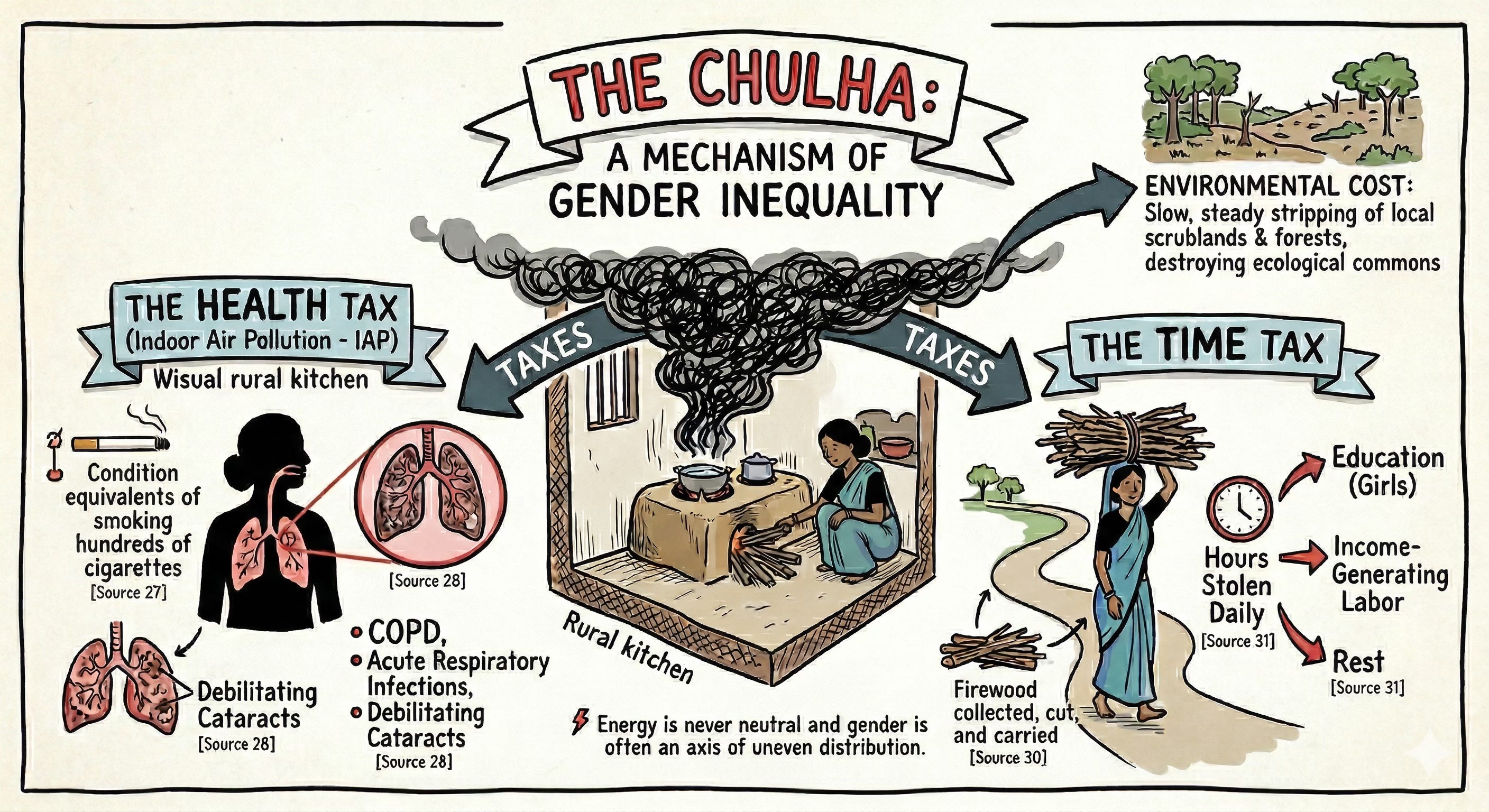
From the bird’s-eye view, energy is a neutral resource. When policymakers look at energy models, they tend to see numbers on a spreadsheet: barrels of oil, cubic meters of gas, gigawatts of solar, BTUs of heat. But on the ground, energy is never neutral and gender is often an axis of uneven distribution. For millennia, the primary source of household energy for cooking and heating across the Indian subcontinent has been biomass - firewood, crop residue, and dried cattle dung, burned in unventilated mud stoves known as chulhas.
Whatever its historical value, the chulha is an ongoing catastrophe now. Environmentally, the relentless need for cooking fuel drives the slow, steady stripping of local scrublands and forests, destroying the ecological commons that rural communities rely on for resilience. The human cost is equally, if not more, severe, and it is borne almost exclusively by women.
Burning solid biomass in an enclosed space produces horrifying levels of Indoor Air Pollution (IAP). Cooking three meals a day over a chulha is the physiological equivalent of smoking hundreds of cigarettes. It is a primary driver of chronic obstructive pulmonary disease (COPD), acute respiratory infections, and debilitating cataracts among rural Indian women. And that’s not its only harm - firewood extracts a brutal ‘time tax’ for it does not pipe itself into a kitchen. It must be foraged, cut, and carried. This labor falls squarely on the shoulders of women and girls, who often spend hours every single day walking miles to gather fuel. Every hour spent foraging for firewood is an hour stolen from education, from income-generating labor, and from rest.
Once again, whatever its past usefulness, the chulha is a mechanism of gender inequality. It chains women to the hearth, destroys their lungs, and consumes their time.
The LPG Bridge and Its Collapse
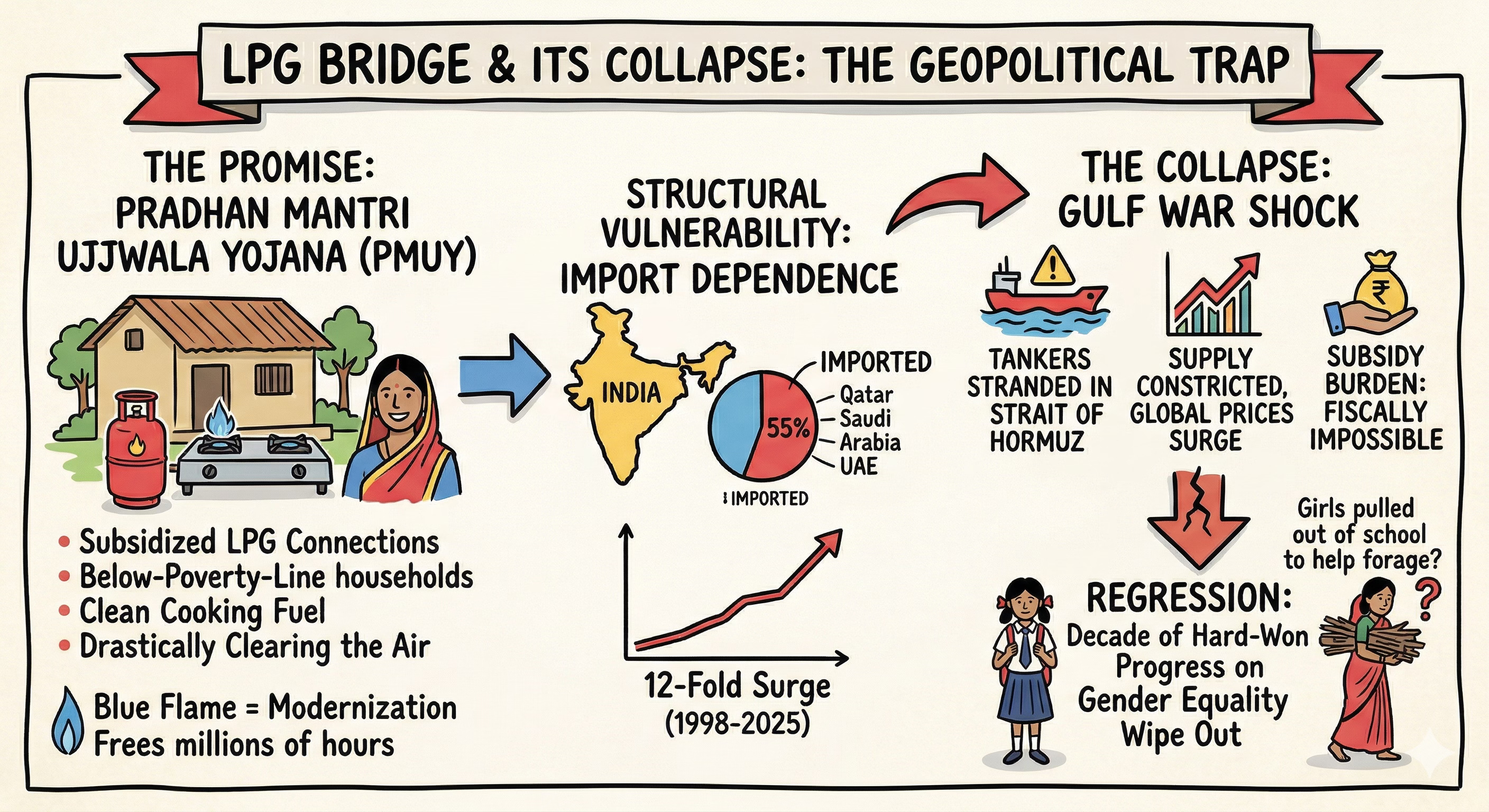
Recognizing this profound injustice, the Indian state launched one of the most ambitious public health and gender-equity interventions in modern history: the Pradhan Mantri Ujjwala Yojana (PMUY). By heavily subsidizing Liquefied Petroleum Gas (LPG) connections for below-poverty-line households, the state aimed to move hundreds of millions of women away from toxic chulhas and toward clean, efficient cooking fuel. The blue flame of the LPG stove became a symbol of modernization, freeing up millions of hours for women and drastically clearing the air in rural kitchens.
Note: we too easily forget how much fossil fuels are woven into our idea of modernity.
But the Ujjwala Yojana contained a hidden, structural vulnerability. LPG is a byproduct of natural gas processing and crude oil refining. India simply does not produce enough of it. To fuel the Ujjwala revolution, India became the world’s second-largest consumer of LPG, importing roughly 55% of its supply - the vast majority of it shipped directly from Qatar, Saudi Arabia, and the UAE. Over the last two decades, India’s LPG imports have surged dramatically, increasing nearly 12-fold from 1,722 TMT in 1998–99 to over 20,667 TMT by 2024–25.
Those LPG tankers are all stranded in the strait of Hormuz. Supply has constricted, and the global price of gas has surged. For the Indian state, the subsidy burden to maintain the Ujjwala scheme at these new war-time prices will become fiscally impossible. That’s catastrophe enough, but I worry that a geoeconomic shock will wipe out a decade of hard-won progress on gender equality.
Will girls be pulled out of school to help forage?
Escaping the Trap
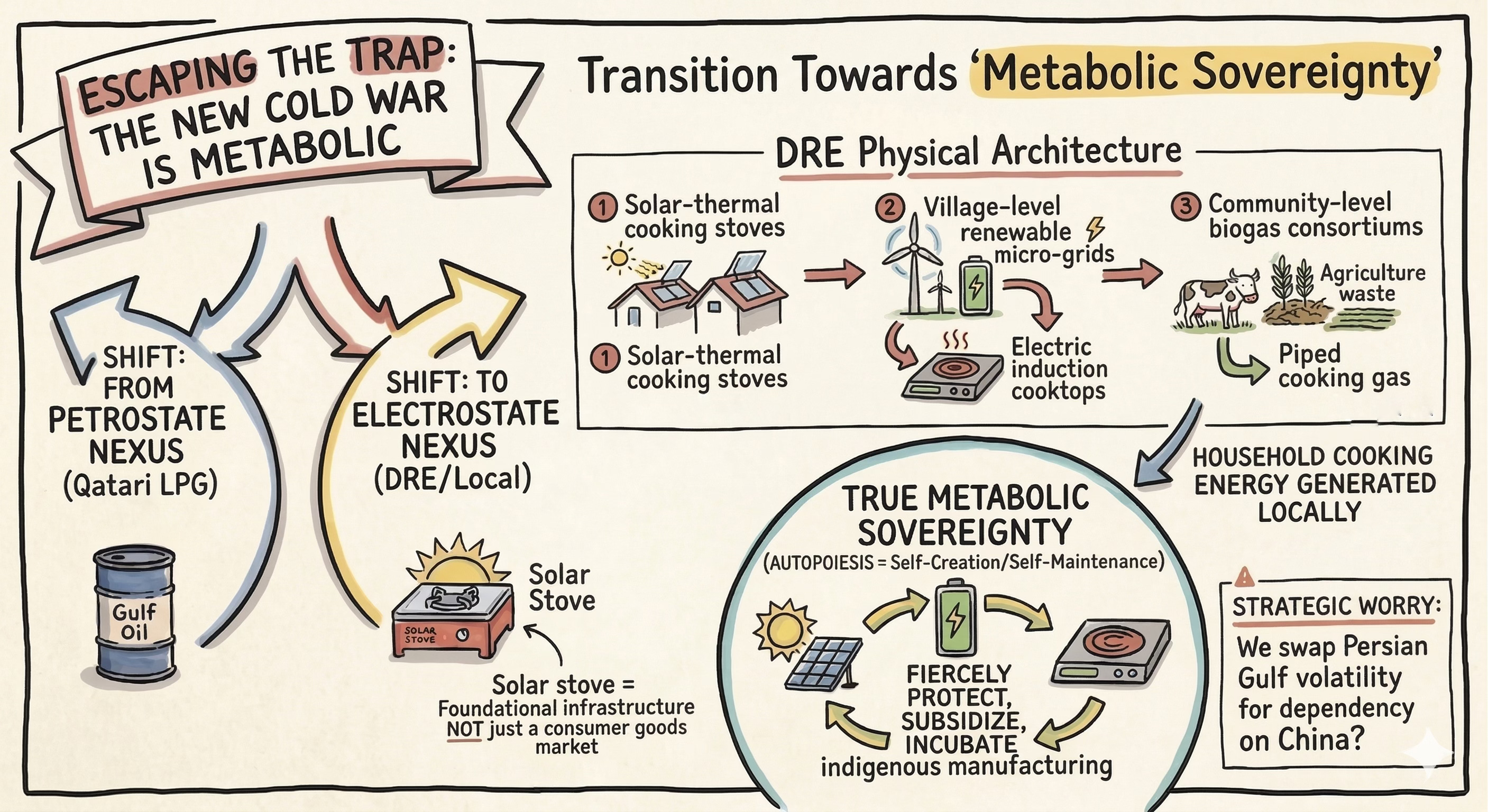
We cannot simply accept this regression. We cannot allow the promise of the Ujjwala Yojana to die on the altar of Middle Eastern geopolitics; we cannot afford to tether the dignity of Indian women to the Persian Gulf. We should maintain the spirit of our household energy policies, but we must shift their physical architecture towards DRE (decentralized renewable energy). We need to aggressively institutionalize the distribution and adoption of solar-thermal cooking stoves, build village-level renewable micro-grids to power electric induction cooktops, and (not so renewable) invest in community-level biogas consortiums that turn agricultural waste into piped cooking gas.
If a household’s cooking energy is generated locally - derived from the sun beating down on the roof, or derived from the agricultural waste of the adjacent fields - it won’t be at the mercy of a naval blockade in the Strait of Hormuz.
But to understand what this transition truly entails, we have to look deeper into the nature of the new cold war. It is increasingly clear that the geopolitical struggles defining our era are not strictly ideological; they are metabolic. When we transition a rural Indian kitchen from Qatari LPG to an electric induction stove powered by solar panels, we are shifting from the Petrostate nexus to the Electrostate nexus. Which is, on the whole, a good thing, but it does bring some strategic worries along with it: in our attempt to escape the volatility of the Persian Gulf, we will deepen our dependency on China.
To break this cycle of merely swapping one set of masters for another, India must strive for true Metabolic Sovereignty. A metabolic sovereign is a political unit that possesses monopoly control - or what systems theorists Humberto Maturana and Francisco Varela would call autopoiesis (self-creation and self-maintenance) - over the vital energy and information that flows across its borders. Achieving this does not mean walling off the country, but it absolutely means executing the renewable transition with clarity. It requires the Indian state to fiercely protect, subsidize, and incubate the indigenous manufacturing of solar panels, battery storage systems, and high-efficiency induction stoves.
We must stop viewing the manufacturing of a solar stove as a mere consumer goods market best left to the cheapest foreign bidder. We must treat it as the foundational infrastructure of a new metabolic regime, necessary not just for the physical liberation of Indian women, but for the self-governance of the nation.
Bad Intersectionality and the Necessity of Solidarity
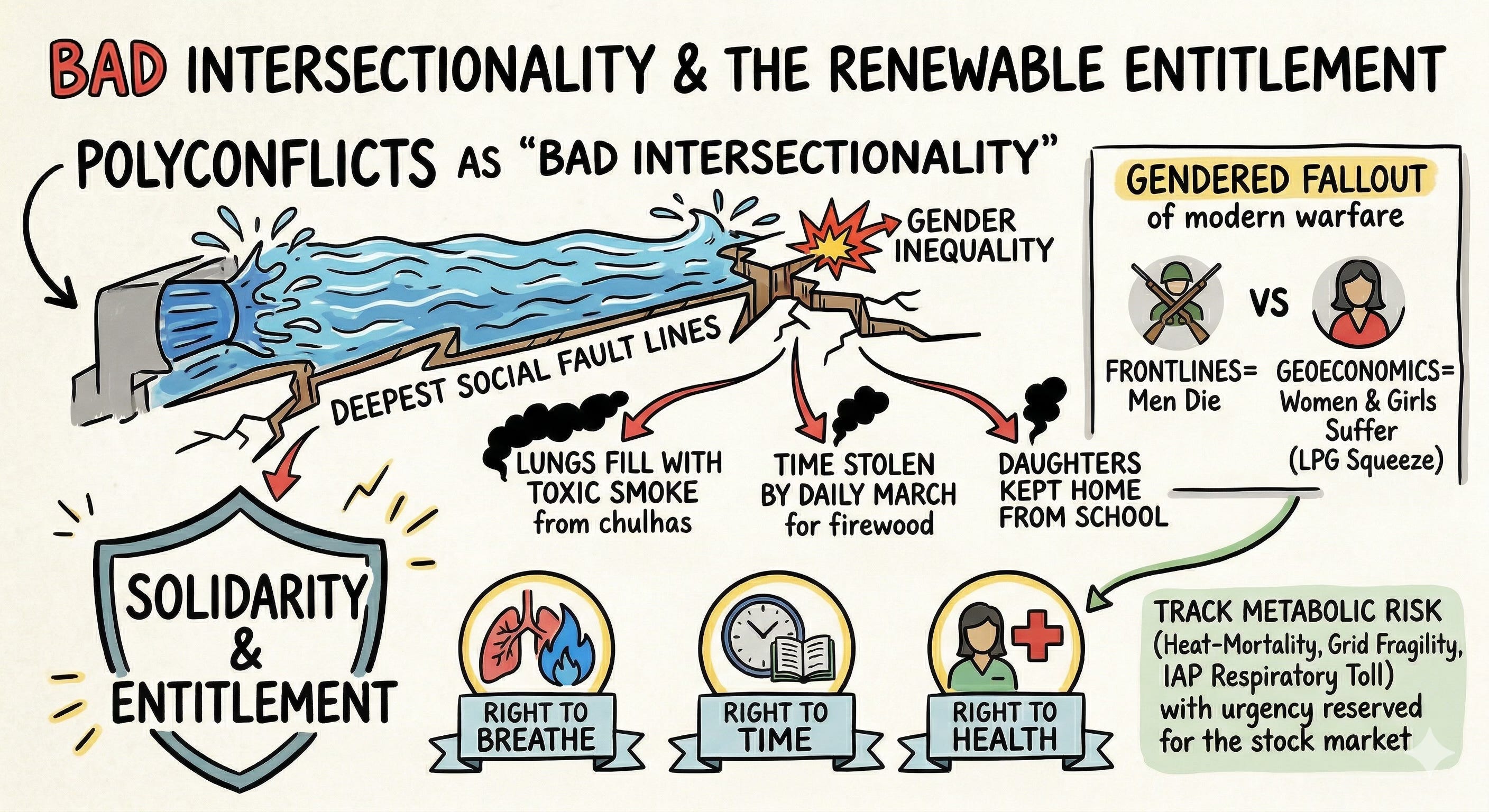
In academic and progressive circles, we often talk about intersectionality - the idea that various forms of oppression exacerbate each other. Polyconflicts are intersectional in the most destructive sense of the word. They act like water under pressure, seeking out the deepest, most historically vulnerable fault lines in a society and cracking them wide open.
We have known that about war zones for a long time: the gendered realities are brutal - men die on the front lines, while women are haunted by sexual violence. But modern geoeconomic warfare - supply chain decoupling and commodity shocks also have a gendered fallout.
When global energy prices spike due to a war in the Gulf, it is rural Indian women who will pay the physical price of the LPG squeeze. Their lungs will fill with toxic smoke from chulhas. Their time will be stolen by the daily march for firewood and their daughters will be kept home from school to aid in housework.
If we are to achieve metabolic sovereignty, we must track metabolic risk as seriously as we track macroeconomics. We must measure localized heat-mortality exposure, village-level grid fragility, and the respiratory toll of indoor air pollution with the same urgency we reserve for the stock market.
In this interregnum as new monsters roam the streets, citizens owe their allegiance to the tangible institutions that keep life possible and do so within planetary boundaries. The transition to clean, localized energy must not be rolled out as a technocratic imposition from above. It must be championed as an expansion of entitlements - a right to breathe, a right to time, and a right to health.